
You crank up the AC, wait for the house to cool down, and somehow your bedroom feels like a sauna while the living room is perfectly comfortable. Sound familiar?
Uneven cooling in house is one of the most common AC complaints homeowners deal with, especially during the peak of summer. The good news is that most causes are fixable; some you can handle yourself this afternoon, and others may need a professional eye.
In this guide, we’ll walk you through every major reason your home isn’t cooling evenly, step-by-step fixes you can start today, and the warning signs that tell you it’s time to call in an HVAC technician.
Why Is Half My House Hot and Half Cold?
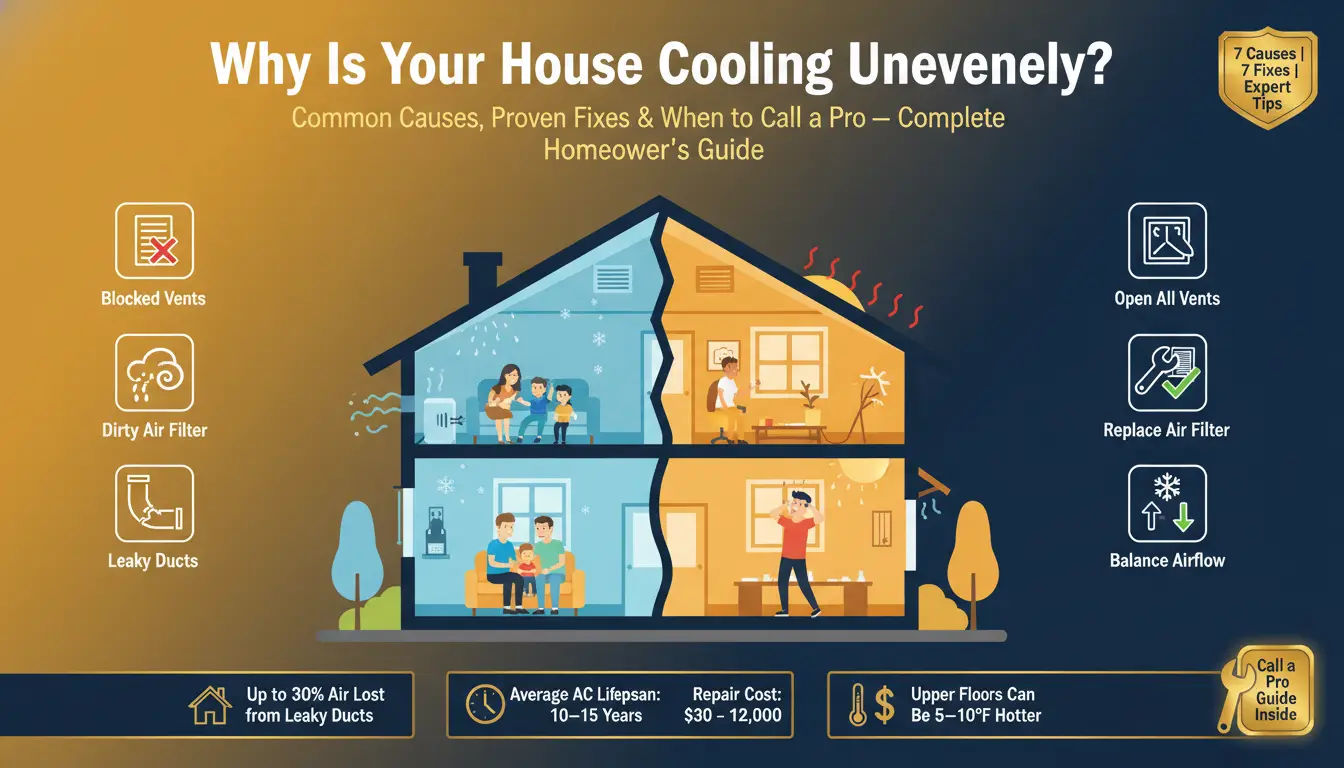
When half your house feels hot while the other half stays cool, it usually means your HVAC system is struggling to distribute conditioned air evenly throughout the home. This happens because of blocked airflow, duct problems, poor insulation, or a system that isn’t properly sized for your home’s layout.
In two-story homes, this problem is even more common. Heat naturally rises, so upper floors absorb more heat from the roof and walls, and your AC has to work harder to push cool air all the way up there. In single-story homes, the culprit is usually ductwork, vents, or insulation issues in specific rooms or wings of the house.
The gap between hot and cold zones tends to get worse in summer when outdoor temperatures are at their highest, and your AC is under maximum load.
7 Common Causes of Uneven Cooling in House
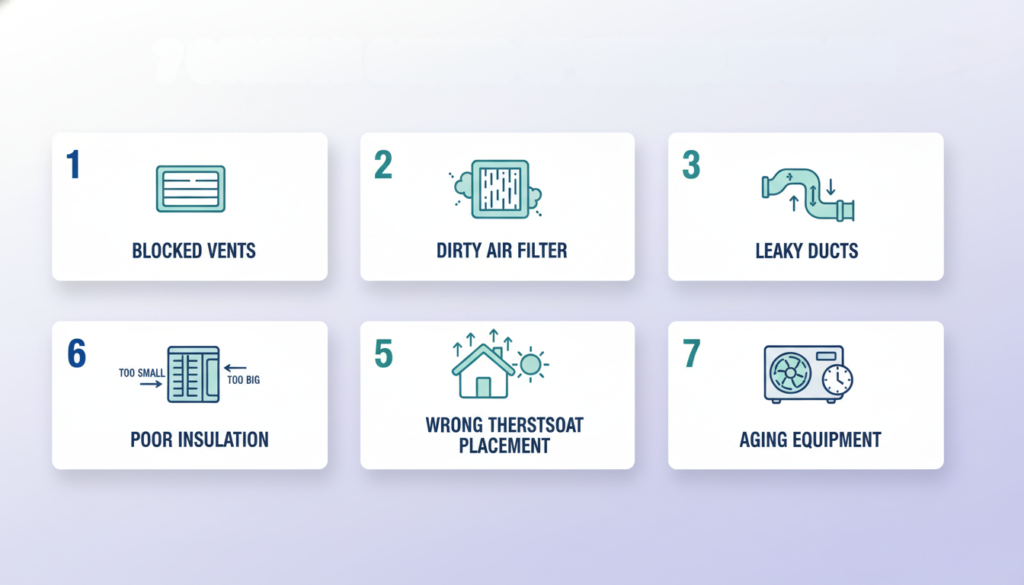
Understanding the root cause is the first step. Here are the seven most frequent reasons your home has hot and cold spots.
1. Blocked or Closed Vents
This is the easiest cause to miss. If a supply vent is covered by furniture, a rug, or heavy curtains, the cool air simply can’t enter the room properly. Some homeowners also close dampers or vents in rooms they don’t use often, thinking it saves energy, but this actually increases pressure in the duct system and causes airflow problems throughout the house.
Walk through every room and make sure all supply vents are fully open and unobstructed. Check return air vents too, those larger grilles that pull air back into the system. If a return vent is blocked, the whole system loses balance.
2. Dirty or Clogged Air Filters
Your air filter is the lungs of your HVAC system. When it gets clogged with dust, pet hair, and debris, airflow through the system drops dramatically. Less airflow means less cool air reaching your rooms, and the rooms at the far end of your duct system suffer the most.
A dirty filter also forces your AC unit to work harder, which wears out the system faster and raises your energy bills. Most filters should be replaced every one to three months, depending on your home and whether you have pets.
3. Leaky or Uninsulated Ductwork
This is one of the biggest hidden causes of uneven home cooling. Your ductwork is the network of metal channels that carries cooled air from your AC unit to every room in the house. When ducts develop cracks, loose joints, or gaps, which happens naturally over time, conditioned air leaks out before it ever reaches the room.
Studies show that leaky ducts can waste up to 30% of the cooled air your system produces. Rooms at the end of long duct runs, like upstairs bedrooms or rooms far from the air handler, are hit the hardest.
Uninsulated ducts running through hot attic spaces lose even more cooling along the way; the air heats up as it travels through the duct before it even enters the room.
4. Poor Insulation and Air Leaks
If your attic insulation is thin or old, heat from outside pushes straight through your ceiling and into your living space. No matter how hard your AC works, it’s constantly fighting against heat entering from above.
Air leaks around windows, doors, and electrical outlets have the same effect; they let hot outside air seep in and push cool air out. Rooms with older windows or poorly sealed exterior walls are almost always harder to cool.
5. Thermostat Placement Problems
Your thermostat is the brain of your cooling system. It reads the temperature at its exact location and uses that reading to decide when to run the AC. If your thermostat is placed in direct sunlight, near a heat-producing appliance, or in a drafty hallway, it gets an inaccurate temperature reading.
When this happens, the system either shuts off too early (because the thermostat spot is already cool) or runs too long, and either way, the rest of the house doesn’t cool evenly.
6. Improperly Sized HVAC System
An AC unit that’s too small for your home simply can’t produce enough cooling to reach every room on a hot day. You’ll notice this most in rooms farthest from the unit or on upper floors.
But an oversized unit causes problems too. It cools the air near the thermostat so quickly that it shuts off before the rest of the house has a chance to reach a comfortable temperature. This short-cycling also means the system doesn’t run long enough to properly dehumidify the air, leaving the house feeling clammy and uneven.
Proper HVAC sizing uses a calculation called Manual J, which accounts for your home’s square footage, insulation levels, ceiling height, window size, and local climate.
7. Aging HVAC Equipment
As your AC system gets older, individual components lose efficiency. The blower motor may not push air as forcefully. Refrigerant levels drop. The coils accumulate buildup. All of these factors reduce your system’s ability to cool your home consistently, and you’ll notice it first in rooms that are already harder to reach.
Most residential AC units last 10 to 15 years. If yours is in that range and you’re dealing with uneven cooling, the age of the equipment may be a contributing factor.
Why Is One Zone Not Cooling in My House?
If you have a zoned HVAC system and one specific zone isn’t cooling, the problem is almost always isolated to that zone’s controls or ductwork. The most common causes are a failed damper motor (the damper gets stuck and blocks airflow to that zone), a malfunctioning zone thermostat sending wrong signals to the system, a duct blockage or disconnection specific to that branch, or low refrigerant affecting the system’s ability to cool at full capacity.
Zoning issues usually require a professional to diagnose because they involve both mechanical and electrical components. If your single-zone system has one room or area that just won’t cool, refer back to the vent, filter, and duct causes listed above; those are the most likely culprits.
How to Fix Uneven Cooling in Your House, Step by Step
Work through these fixes in order from easiest to most involved. Many homeowners solve the problem at step one or two.
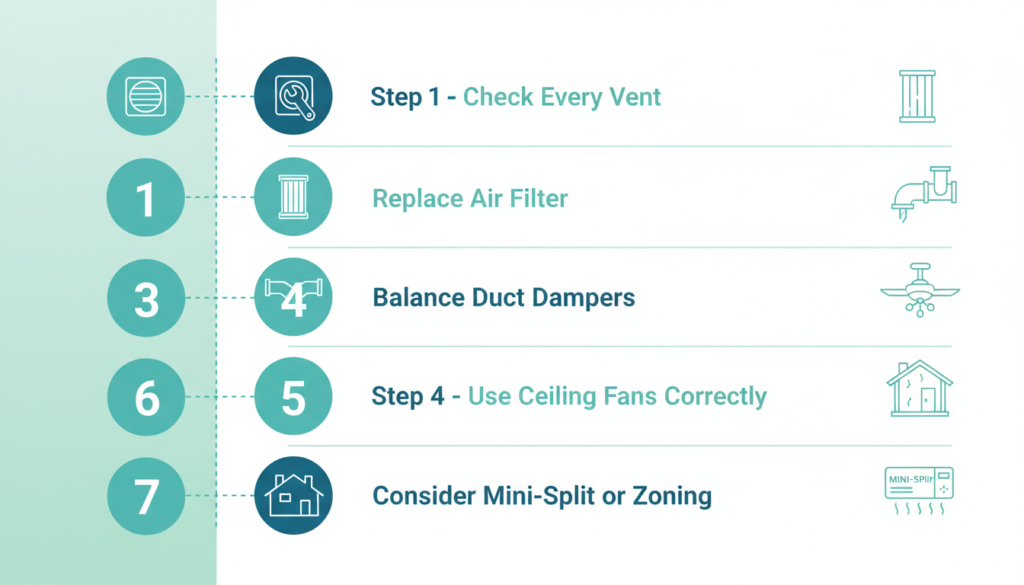
Step 1: Check Every Vent in the House
Walk through every room. Open all supply vents completely. Clear any furniture, rugs, or objects blocking them. Check return air vents and make sure they’re unobstructed, too. This takes 10 minutes and costs nothing.
Step 2: Replace Your Air Filter
Pull out your current filter and check it. If it’s gray and packed with dust, replace it immediately. Use the correct size and a mid-range MERV rating (8 to 11 is ideal for most homes). Set a reminder to check it every month and replace it every one to three months.
Step 3: Balance Your Duct Dampers
Many duct systems have manual dampers, small levers on the duct branches near the air handler. These control how much airflow goes to each part of the house. In summer, you can partially close dampers to lower floors and open them fully to upper floors to push more cool air upstairs. This is called air balancing and it can make a noticeable difference in temperature consistency.
Step 4: Seal Leaky Ducts
If you have access to your ductwork in the attic, basement, or crawlspace, inspect the joints and connections. Seal any gaps with mastic sealant (a paste-like compound) or UL-listed metallic foil tape, not regular duct tape, which fails quickly. Wrap exposed ducts in attic spaces with duct insulation to prevent heat gain as air travels through.
Step 5: Use Ceiling Fans the Right Way
In summer, ceiling fans should spin counterclockwise when viewed from below. This pushes cool air downward and creates a wind chill effect that makes the room feel several degrees cooler. Ceiling fans don’t actually lower the room’s temperature; they just help distribute the cool air your AC produces more effectively. Turn them off when you leave the room.
Step 6: Improve Insulation and Seal Air Leaks
Add weatherstripping around doors and windows that let in outside air. Apply caulk around window frames and any gaps in exterior walls. If your attic has less than 10 to 12 inches of insulation, adding more can dramatically reduce how much heat enters your home from above.
Step 7: Consider a Zoning System or Mini-Split
For rooms that consistently stay hot no matter what you do, a sunroom, a bonus room above the garage, a converted attic, or a ductless mini-split system is often the best long-term solution. It provides dedicated cooling for that space without putting additional strain on your central HVAC system.
A full zoning system with multiple thermostats and motorized dampers is another option for larger homes. It lets you set different temperatures for different areas and only cool the spaces you’re actually using.
Uneven Cooling in Two-Story Homes: What’s Different
Two-story homes have a built-in challenge that single-story homes don’t: hot air rises. The upper floor absorbs radiant heat from the roof and the sun-exposed walls all day. By the time afternoon rolls around, it can be 5 to 10 degrees warmer upstairs than down, even with the AC running.

Here are a few specific strategies for two-story homes:
In summer, partially close the supply vents on the first floor to redirect more cool air through the duct system toward the upper floor. The first floor will still cool, just not quite as aggressively.
Make sure there’s at least one return air vent upstairs. Many older homes only have return vents on the lower level, which means the system isn’t pulling hot air from upstairs efficiently. Adding an upstairs return is one of the most effective fixes for persistent two-floor temperature differences.
Check attic insulation thoroughly. An under-insulated attic directly above a second-floor bedroom is the single biggest reason that the room stays hot.
A zoned HVAC system with separate thermostats for each floor is the most effective permanent solution for two-story homes that can’t maintain an even temperature.
What Is the $5,000 Rule for HVAC?
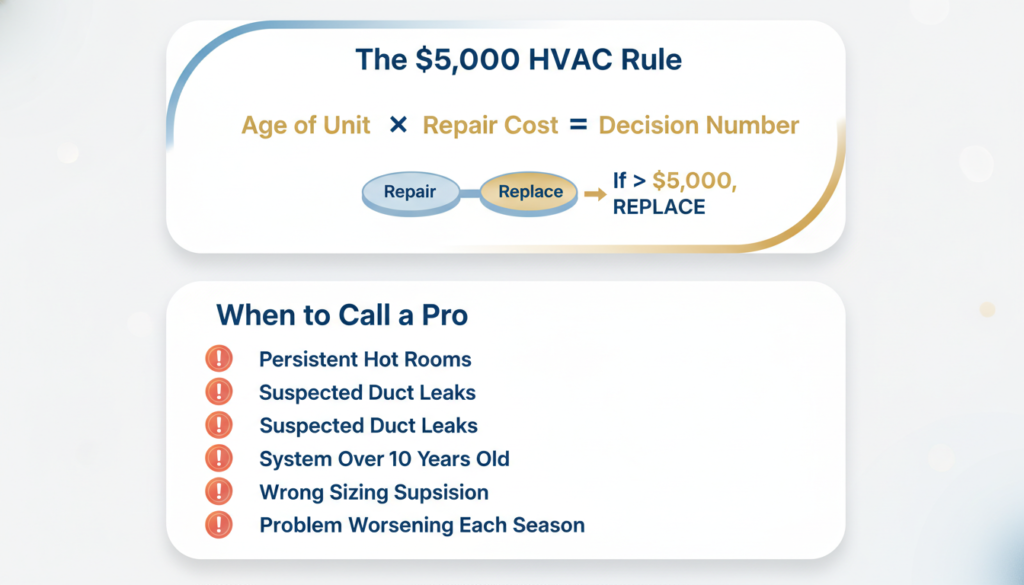
The $5,000 rule is a simple guideline to help homeowners decide whether to repair or replace an HVAC system. Here’s how it works: multiply the age of your AC unit (in years) by the cost of the repair being quoted. If the result is more than $5,000, replacing the system is usually the smarter financial decision.
For example, if your unit is 12 years old and the repair quote is $450, the calculation is 12 × 450 = $5,400. That’s above $5,000, which suggests replacement may be the better investment, especially since a unit that age is likely to need additional repairs in the coming years anyway.
This rule connects directly to uneven cooling because if your system is old, undersized, or in poor mechanical condition, no amount of patching and balancing will fully solve the problem. Sometimes the root cause of inconsistent temperatures throughout the house is simply an HVAC system that has reached the end of its reliable service life.
At Fontenot Air Conditioning & Heating, we always give homeowners an honest assessment of repair versus replacement, including what makes financial sense for your specific situation.
Is AC Harmful for Bronchitis?
Air conditioning itself doesn’t cause bronchitis, but it can aggravate symptoms if the system isn’t well-maintained. Here’s why this matters in the context of uneven cooling and indoor air quality.
AC systems that haven’t had their filters changed regularly circulate dust, mold spores, and other airborne irritants throughout your home. For someone with bronchitis or other respiratory conditions, breathing that air can trigger coughing and irritation. Cold, dry air from an oversized AC that short-cycles (common with uneven cooling) can also dry out airways and worsen breathing discomfort.
The best practices are to keep your filter clean (every one to three months), make sure your system is properly humidifying the air, set the thermostat to a moderate temperature rather than extremely cold, and schedule regular professional maintenance to keep the coils and drain pan clean and mold-free.
If respiratory symptoms are persistent or worsening, consult a doctor, but a well-maintained, properly functioning AC system should not make bronchitis worse.
When to Call a Professional HVAC Technician
The DIY fixes above solve the majority of uneven cooling problems. But there are situations where you need a licensed HVAC professional:
You’ve done all the basic fixes, and the problem persists. If vents are open, filters are clean, and you’ve sealed the obvious leaks, but some rooms still won’t cool, the issue is likely inside the duct system or with the equipment itself.
You suspect duct leaks in inaccessible areas. A professional can perform a duct blaster test that measures exactly how much air is escaping your duct system and locates where the leaks are.
Your system is more than 10 years old and is losing efficiency. A technician can check refrigerant levels, test the blower motor output, inspect the coils, and give you an honest picture of whether the system is still performing as it should.
You want to know if your system is properly sized. A Manual J load calculation requires software and expertise; your HVAC technician can run this assessment and tell you definitively whether your system is under- or oversized for your home.
You notice the problem getting worse each season. Gradual worsening usually points to a mechanical issue that will only get more expensive the longer it goes unaddressed.
At Fontenot Air Conditioning & Heating, our technicians perform a full system diagnostic that covers airflow measurement, duct integrity, refrigerant charge, equipment condition, and thermostat calibration, so you know exactly what’s causing the problem and what it will take to fix it.
Learn More About Common AC Problems
Frequently Asked Questions
How much does it cost to fix uneven cooling in a house?
The cost depends entirely on the cause. Replacing an air filter costs under $30. Sealing accessible duct leaks yourself costs under $50 in materials. A professional duct sealing job runs $300 to $1,000, depending on the size of your home. A new zoning system ranges from $2,000 to $5,000 installed. A full HVAC replacement is $5,000 to $12,000 or more. Starting with the free and low-cost fixes first is always the right move.
Can a dirty air filter really cause hot and cold spots?
Yes, a clogged filter is one of the most common causes of uneven room temperatures. It restricts the total airflow through your system, and the rooms at the far end of your duct runs don’t get enough cool air. Replacing a clogged filter is the single easiest fix to try first.
Should I close vents in rooms I don’t use?
No, this is a very common misconception. Closing vents increases static pressure in your duct system, which strains the blower, can cause duct leaks to worsen, and actually makes other rooms harder to cool. Keep all vents open and control comfort through thermostat settings and damper adjustment instead.
How do I know if my HVAC system is the wrong size?
Two main signs: if your system runs almost constantly without reaching the set temperature (too small), or if it reaches the set temperature very quickly but the house doesn’t feel comfortable, and humidity is high (too high). Both situations cause uneven cooling, and both require a professional load calculation to confirm.
Conclusion
Uneven cooling in a house usually comes down to one of a handful of fixable problems: blocked vents, dirty filters, leaky ducts, poor insulation, or a system that isn’t the right size for your home. Start with the simple checks: open every vent, replace the filter, and look for obvious air leaks around windows and doors. These steps alone solve the problem for a lot of homeowners.
If you’ve worked through the checklist and your home still has hot and cold zones, that’s the signal to bring in a professional. Duct issues, equipment sizing problems, and refrigerant-related causes all require proper tools and training to diagnose accurately.
The team at Fontenot Air Conditioning & Heating is here to help. Whether you need a quick tune-up or a full system evaluation, we’ll find the root cause of your uneven cooling and give you straightforward options to fix it right.
Ready to stop fighting with your thermostat? Contact Fontenot Air Conditioning & Heating to schedule a diagnostic today.