AC Repair vs Replacement in Lafayette, LA: How to Make the Right Decision
Search
Recent Posts

Tags
Follow Us on
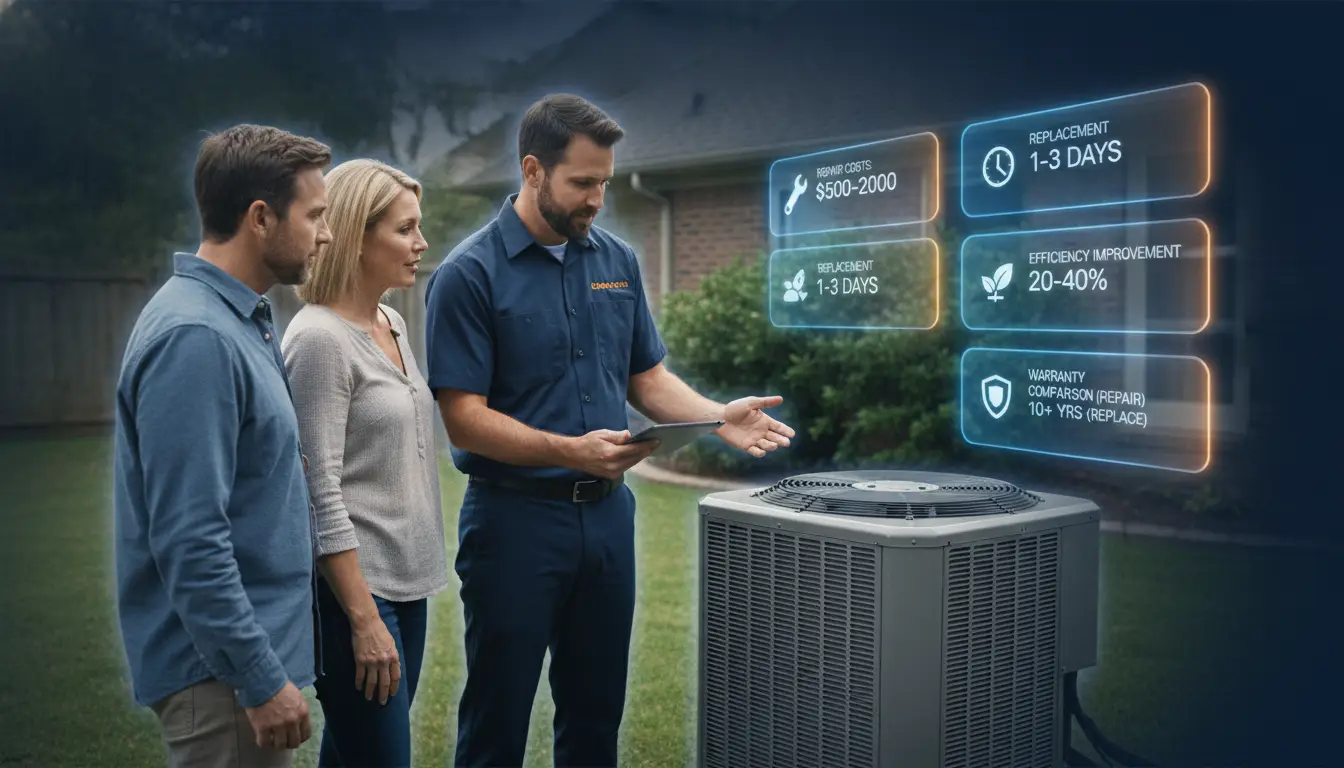
Deciding between AC repair vs replacement in Lafayette comes down to four factors: system age, repair cost relative to replacement value, frequency of breakdowns, and energy efficiency. If your unit is under 10 years old and the repair costs less than 50% of a new system, repair usually wins. If it is older, inefficient, or breaking down repeatedly, replacement typically delivers better long-term value.
Key Takeaways
- The 50% Rule: If a repair costs more than half the price of a new system, replacement is almost always the smarter financial move.
- System age matters most: AC units over 10 to 15 years old in South Louisiana’s demanding climate often cost more to keep running than a new, high-efficiency system would save.
- R-22 refrigerant is a red flag: Systems still using R-22 (Freon) face skyrocketing refrigerant costs and dwindling service options since the federal phase-out in 2020.
- Energy savings are real: A new SEER2-rated system can reduce cooling costs by 20 to 40% compared to an aging, low-efficiency unit, according to the U.S. Department of Energy.
- Local climate is a factor: Lafayette’s heat and humidity push AC systems harder than most U.S. regions, shortening lifespan and increasing the cost of doing nothing.
Your AC stopped cooling on a 95-degree July afternoon. The repair tech gives you a number that makes your stomach drop. Now you are standing in your living room, sweating, wondering if you should fix it or replace the whole thing. That is the moment almost every Lafayette homeowner dreads, and it happens more than you would think during peak cooling season.
The problem is that making the wrong call costs you either way. Repairing a dying system buys you a few more months before the next breakdown. Replacing a fixable unit wastes money you did not need to spend. Getting it right requires understanding your system, your costs, and your South Louisiana climate.
This guide walks you through every factor that matters: system age, repair costs, energy efficiency, replacement options, financing, and how HVAC professionals actually assess your unit. By the end, you will know exactly what to do and why.
What Are the Key Factors That Determine Whether to Repair or Replace Your AC?
No single number tells you whether to repair or replace. The right answer comes from weighing several factors together. Here is what carries the most weight.
Does System Age and Remaining Lifespan Matter?
Yes, system age is the single most important variable. A well-maintained central air conditioner lasts 15 to 20 years in moderate climates. In South Louisiana, however, that number drops. Lafayette’s combination of intense heat, high humidity, and extended cooling seasons pushes systems harder than most of the country.
In practice, most HVAC professionals in this region consider a system over 12 to 15 years old to be in its final stage of useful life. Even a successful repair on an aging unit may only delay the inevitable by one or two seasons.
Ask yourself: how many years of reliable cooling does this unit realistically have left? If the answer is fewer than three to five, replacement becomes the financially rational choice.
How Do Repair Costs Compare to Replacement Costs?
Cost comparison is where most homeowners get tripped up. A $400 repair sounds reasonable in isolation. But if your unit is 13 years old and has already needed $600 in repairs this year, you are looking at $1,000 in ongoing costs for a system nearing the end of its life.
A brand-new system in Lafayette generally runs between $4,000 and $8,000 installed, depending on the unit size, efficiency rating, and complexity of the installation. Compare that against what you are spending to keep an aging system alive, and the math often shifts toward replacement.
The repair-versus-replace decision is never about one bill in isolation. It is about the total cost of keeping that system running over the next three to five years.
Does Frequency of Breakdowns Indicate a Bigger Problem?
It does. One breakdown per year may be normal. Two or more in a single season is a pattern. Repeat failures signal that components are degrading across the system, not just in one isolated part.
Each breakdown also carries hidden costs: emergency service fees, lost work time waiting for a tech, and the discomfort of a home in a South Louisiana summer without cooling. Those indirect costs add up quickly and rarely get factored into the repair-versus-replace math.
How Does Energy Efficiency Affect the Decision?
An older, inefficient AC system works harder to deliver less cooling. That inefficiency shows up directly on your Entergy bill every month. According to the U.S. Department of Energy, replacing an aging, low-efficiency unit with a modern SEER2-rated system can reduce cooling energy costs by 20 to 40%.
For Lafayette homeowners running their AC eight to ten months a year, that savings compounds fast. A $120 monthly reduction in cooling costs adds up to $1,440 per year, enough to meaningfully offset the cost of a new system over time.
How Does Lafayette’s Climate Impact AC Performance?
Lafayette sits in ASHRAE Climate Zone 2A, a hot and humid zone that is among the most demanding environments for residential cooling equipment in the United States. Summer temperatures regularly exceed 90°F, and relative humidity frequently tops 80%.
That combination forces your AC system to run longer cycles just to maintain indoor comfort. Extended run times accelerate wear on compressors, fan motors, and capacitors. Systems in Lafayette simply do not last as long as identical units installed in Phoenix or Denver, and repair costs tend to accumulate earlier in the system’s life as a result.
Understanding how your local climate shortens equipment life is essential context before you decide whether a repair is worth the investment.
What Is the Difference Between AC Repair and AC Replacement?
Before making a decision, it helps to clearly understand what each option actually involves.
What Qualifies as an AC Repair?
An AC repair addresses a specific failed component or malfunction without replacing the entire system. Common examples include replacing a capacitor, fixing a refrigerant leak, clearing a clogged drain line, or repairing a faulty thermostat connection. Repairs restore the existing unit to working condition. They do not upgrade its efficiency, extend its rated lifespan, or address underlying wear across other aging components.
What Qualifies as an AC Replacement?
An AC replacement means removing the existing system entirely and installing new equipment. This typically includes the outdoor condenser unit, the indoor air handler or evaporator coil, and sometimes the refrigerant line set and thermostat. A replacement gives you a new manufacturer’s warranty, improved energy efficiency, and a fresh equipment lifespan of 15 to 20 years when properly maintained.
What Are the Pros and Cons of Repairing an AC?
Pros of repairing:
- Lower upfront cost
- Faster turnaround, often same-day or next-day service
- Makes sense when the system is newer, and the repair is minor
- Preserves existing equipment under an active warranty
Cons of repairing:
- Does not address other aging components
- Provides no efficiency improvement
- May only delay the next breakdown by weeks or months
- Costs can add up quickly if problems recur
What Are the Pros and Cons of Replacing an AC?
Pros of replacing:
- New manufacturer warranty, typically 5 to 10 years on parts
- Immediate efficiency improvement with SEER2-rated equipment
- No risk of recurring repairs on the same failing components
- Better humidity control and indoor comfort in South Louisiana’s climate
Cons of replacing:
- Higher upfront investment
- Installation typically takes one full day
- Requires selecting the right system size and type for your home
Knowing these differences makes the next question easier: which situation fits your home right now?
When Does Repairing Your Air Conditioner Make Sense?
Repair is often the smarter move. Here are the situations where it clearly wins.
Is Your System Less Than 10 Years Old?
If your air conditioner is under 10 years old, it is almost always worth repairing, assuming the repair cost is reasonable. The system still has most of its rated lifespan ahead of it, and a well-executed repair can restore it to reliable performance for several more years.
In Lafayette’s climate, a properly maintained 8-year-old system with one repair is still a better value than a premature replacement.
Is the Repair Minor and Affordable?
A repair that costs less than $500 on a system under 12 years old is almost always worth doing. Minor repairs like capacitor replacement, drain line clearing, or thermostat calibration rarely indicate broader system failure. They are routine maintenance-adjacent fixes that keep a healthy system running.
The keyword here is “minor.” A minor repair on a fundamentally sound system is money well spent.
Is the Unit Still Under Warranty?
If your equipment is still within its manufacturer’s parts warranty, repair costs may be significantly reduced. Most major brands offer a 5-year parts warranty standard, with some offering 10 years for registered equipment. Always check warranty status before authorizing any major repair.
Paying full price for a part that should be covered under warranty is a costly mistake that is easy to avoid with one quick check.
Does the System Have a Reliable Service History?
A system that has been regularly serviced, with clean coils, fresh filters, and annual tune-ups, will respond to repairs much better than a neglected unit. Consistent maintenance extends both the lifespan and the value of any individual repair investment.
If your AC has been well cared for, a repair is more likely to deliver lasting results. If it has been ignored, even a successful repair may not hold for long.
What Are Common AC Problems That Typically Require Repairs?
Capacitor Failure
Capacitor failure is one of the most common AC repairs in South Louisiana. The capacitor starts and runs the compressor and fan motors. Heat and humidity accelerate capacitor degradation. Replacement typically costs $150 to $400 and restores normal operation immediately.
Thermostat Malfunctions
A faulty thermostat can cause short cycling, uneven temperatures, or a system that simply refuses to turn on. In many cases, thermostat issues are misdiagnosed as compressor or refrigerant problems. A thermostat replacement costs $100 to $350 and is one of the most affordable HVAC fixes available.
Drain Line Clogs
Lafayette’s humidity means AC systems pull large amounts of moisture out of the air. That moisture exits through a condensate drain line. When algae or debris clog the line, water backs up into the unit or overflows into your home. A drain line clearing costs $75 to $200 and prevents serious water damage if caught early.
Fan Motor Issues
Fan motor failure causes the outdoor condenser or indoor blower to stop working, leading to overheating or no airflow. Motor replacement costs $300 to $700, depending on the unit. It is a significant repair, but well worth it on a system under 10 years old.
Electrical Component Failures
Relays, contactors, and circuit boards can fail due to power surges, age, or moisture intrusion. These repairs range from $150 to $600 and are generally worth completing on systems with good remaining lifespan.
Each of these repairs addresses a specific component, not a failing system. The next section covers the situations where the system itself is the problem.
When Is Replacing Your Air Conditioner the Better Investment?
Sometimes a repair is not the answer. Here is when replacement makes more financial sense.
Is the System More Than 10 to 15 Years Old?
Age is the clearest signal. A 14-year-old system in Lafayette has likely already exceeded its practical lifespan for this climate. Even a successful repair restores a system that is statistically close to the end of its service life. You are investing money into equipment that may not last another two to three seasons.
At that age, replacement delivers better long-term value in almost every scenario.
Are Repair Costs Becoming Frequent?
If you have paid for two or more repairs in the past 12 months, your system is sending a clear message. Recurring failures indicate systemic wear, not isolated component problems. Each repair bill is money spent on equipment moving closer to failure.
Add up what you have spent on repairs over the past two to three years. That number often surprises homeowners and makes the case for replacement clearly.
Has Cooling Performance Declined?
A system that used to cool your home comfortably but now struggles to maintain temperature is losing capacity. This happens as compressors wear, refrigerant levels drop, and coils degrade. You can feel the difference: rooms that used to be comfortable now feel warm, even when the thermostat is set lower than before.
Declining performance is not a repair issue. It reflects a system that can no longer meet your home’s cooling load.
Are Energy Bills Continuing to Increase?
Higher electricity bills without a change in usage habits or utility rates point directly to system inefficiency. An aging AC works harder to achieve the same cooling result, consuming more electricity per hour of operation. According to ENERGY STAR, older systems with SEER ratings of 8 to 10 use nearly twice the energy of modern systems rated at SEER 16 or higher.
If your Entergy bills have climbed steadily over the past two to three summers, your AC system is a likely contributor.
Does the System Use R-22 Refrigerant?
The U.S. Environmental Protection Agency completed the phase-out of R-22 (Freon) production and import in 2020. Systems still using R-22 now face dramatically higher refrigerant costs because only reclaimed R-22 from existing supplies remains available. (Source: U.S. EPA, 2020)
Repairing a refrigerant leak on an R-22 system can easily cost $600 to $1,500 or more, just for the refrigerant alone. That cost alone often makes replacement the financially superior option, regardless of the system’s age.
What Are the Repair vs. Replacement Rules of Thumb?
Two widely used guidelines help simplify the repair-versus-replace decision.
What is the 50% Rule?
The 50% Rule: If the cost of a repair exceeds 50% of the cost of a comparable new system, replacement is the better investment.
For example, if a new system costs $6,000 and your repair quote is $3,200, the rule recommends replacement. You would be spending more than half the cost of new equipment to extend the life of an old system with no warranty and no efficiency gains.
What Is the HVAC $5,000 Rule?
The $5,000 Rule: Multiply the system’s age in years by the repair cost. If the result exceeds $5,000, replace the unit.
Example: a 12-year-old system with a $450 repair quote. 12 x 450 = $5,400. That result exceeds $5,000, so the rule recommends replacement.
This method accounts for age more directly than the 50% Rule, making it useful for older systems facing moderate repair costs.
Which Rule Is More Reliable?
Both rules are useful starting points, not definitive answers. The $5,000 Rule tends to be more useful for aging systems with moderate repair costs. The 50% Rule works better when comparing a large repair on a newer system.
For the most accurate recommendation, use both rules together, then weigh the result against system age, repair history, and energy efficiency. A professional HVAC assessment adds the most reliable layer of insight to either calculation.
Should You Replace Your AC After a Major Component Failure?
Some repairs are so expensive that they shift the financial math entirely.
Is Compressor Replacement Worth It vs. a New AC Installation?
Compressor replacement is the most expensive single AC repair, typically costing $1,200 to $2,800 installed in Lafayette. The compressor is the heart of the system. When it fails on a system over 10 years old, replacement almost always makes more sense than repair.
Here is why: replacing only the compressor leaves behind an aging condenser, coil, and refrigerant system. You are installing a new component into an old system with no warranty, alignment, or efficiency improvement.
What Are the Evaporator Coil Replacement Considerations?
An evaporator coil replacement typically runs $800 to $1,800. On a newer system still under warranty, replacement makes sense. On a system over 10 years old, you face the same problem as with compressor replacement: you are investing heavily in aging infrastructure.
Always ask whether the replacement part will be under a matched warranty with the rest of the system. If it will not, the financial case for replacement grows stronger.
Should You Repair or Replace a Condenser Coil?
Condenser coil repair or replacement costs $600 to $2,000, depending on the coil type and refrigerant involved. Leaking condenser coils on older systems often signal broader refrigerant circuit wear. Repair is reasonable on units under 10 years old. On older systems, replacement is usually the smarter call.
When Does a Major Repair Still Make Financial Sense?
A major repair makes sense when three conditions are met simultaneously: the system is less than 10 years old, the repair carries a parts warranty, and no other major components show signs of imminent failure. If all three apply, even a $1,000 to $1,500 repair may deliver solid value. If even one condition does not hold, replacement deserves serious consideration.
How Long Will Your AC Last After a Repair?
Homeowners often ask how much more life a repair will buy them. The honest answer depends on several factors.
What Is the Average AC Lifespan in South Louisiana?
In South Louisiana’s climate, a properly maintained central AC system lasts 12 to 15 years on average. That is two to five years shorter than the national average of 15 to 20 years, because of the extended cooling season and high humidity load.
Systems that receive annual maintenance tune-ups consistently outlast neglected units by three to five years. For context, the U.S. Department of Energy recommends annual HVAC maintenance to preserve equipment lifespan and efficiency.
How Much Lifespan Remains After Common Repairs?
- Capacitor replacement on a 5-year-old unit: likely 8 to 10 more years of reliable service
- Capacitor replacement on a 12-year-old unit: likely 1 to 3 more years, possibly less
- Compressor replacement on an 8-year-old unit: potentially 5 to 8 more years if other components are sound
- Compressor replacement on a 13-year-old unit: likely not worth it; replacement is usually smarter
These estimates assume proper maintenance going forward. A poorly maintained system shortens each timeline significantly.
What Are Signs a Repair Is Only a Temporary Solution?
Watch for these signals that a repair is buying time rather than restoring real performance:
- The system still struggles to reach the thermostat setpoint after the repair
- The repair tech identifies additional components showing wear
- The repair resolves one symptom, but others appear within weeks
- Your energy bills do not improve after the fix
If any of these apply, treat the repair as a bridge measure while planning for replacement, not as a long-term solution.
What Does AC Repair vs. Replacement Cost in Lafayette, LA?
Understanding local cost ranges helps you evaluate quotes and make confident decisions.
What Are Average AC Repair Costs?
Repair costs in Lafayette and the surrounding South Louisiana area vary widely based on the type of repair:
- Capacitor replacement: $150 to $400
- Thermostat repair or replacement: $100 to $350
- Drain line clearing: $75 to $200
- Fan motor replacement: $300 to $700
- Refrigerant recharge (R-410A): $200 to $600
- Evaporator coil replacement: $800 to $1,800
- Compressor replacement: $1,200 to $2,800
These figures reflect installed costs in the Lafayette market and may vary depending on unit size, brand, and service timing.
What Are Average AC Replacement Costs?
A full central AC system replacement in Lafayette, LA generally costs:
- Basic replacement (standard efficiency): $3,500 to $5,500
- Mid-range replacement (SEER2 16+): $5,500 to $8,000
- High-efficiency or zoned system: $8,000 to $12,000+
Costs depend on home square footage, ductwork condition, system type, and installation complexity.
What Factors Affect Repair Pricing?
- Time of year (emergency summer repairs carry premium rates)
- Brand and availability of parts
- System accessibility (attic or crawlspace installations cost more to service)
- Refrigerant type (R-22 is far more expensive than R-410A)
- Technician labor rates in your specific zip code
What Factors Affect Installation Costs?
- Home size and required system capacity (measured in tons)
- Ductwork condition and whether modifications are needed
- Equipment brand and efficiency rating
- Permit requirements in Lafayette Parish
- Whether the installation includes thermostat upgrades or zoning controls
What Do Emergency HVAC Service Calls Cost?
Emergency service calls outside business hours, weekends, or holidays typically add $75 to $200 on top of standard repair rates in this market. During peak summer months in Lafayette, emergency call availability can also be limited, making preventive maintenance a financially sound strategy.
What Is the Long-Term Financial Impact of Repair vs. Replacement?
The true cost of any HVAC decision plays out over years, not weeks.
What Are Maintenance Costs Over Time?
Both repaired and new systems require ongoing maintenance. Annual tune-ups typically cost $80 to $150 in the Lafayette area. However, older repaired systems tend to need more frequent service visits and unplanned repairs between tune-ups.
A new system with proper annual maintenance averages significantly lower total service costs over a five-year period compared to a repaired aging system facing recurring component failures.
What Are Expected Future Repair Expenses?
Industry research from the Air Conditioning Contractors of America (ACCA) suggests that HVAC systems in their final five years of life incur repair costs at roughly two to three times the rate of systems in their first decade. Planning for that escalation when comparing repair versus replacement is essential.
If your system is 13 years old and you spend $800 on a repair today, realistic financial planning assumes another $600 to $1,200 in repairs within the next 12 to 18 months.
What Is the ROI of Repair vs. Replacement?
Repair ROI is high when: the cost is low, the system is young, and the repair restores full performance for three or more years.
Replacement ROI is high when the upfront cost is offset by energy savings, avoided repairs, and improved comfort over a 10-plus-year lifespan.
A $6,000 replacement that saves $100 per month on energy bills pays back the efficiency premium in approximately 60 months. Factor in avoided repairs of $500 to $1,000 per year on the old system, and that payback period shortens considerably.
How Do You Calculate a Replacement Payback Period?
Use this simple formula:
Payback Period = Replacement Cost ÷ Annual Savings (energy + avoided repairs)
For example, a $6,500 replacement saves $120/month in energy costs plus avoids an estimated $700 per year in repairs.
Annual savings = $1,440 + $700 = $2,140 Payback period = $6,500 ÷ $2,140 = approximately 3 years
After that payback window, every month of operation delivers net financial benefit on top of improved comfort.
What Are the Energy Efficiency and Comfort Benefits of a New AC System?
A modern system does more than just cool your home. It changes how your home feels every day.
What Are SEER2 Ratings and Why Do They Matter?
SEER2 (Seasonal Energy Efficiency Ratio 2) is the current federal standard for measuring air conditioner efficiency. It replaced the older SEER rating in 2023 to reflect more realistic operating conditions. The higher the SEER2 rating, the less electricity the unit consumes to deliver the same cooling output.
As of January 2023, the U.S. Department of Energy requires a minimum SEER2 of 14.3 for new central AC installations in the South, including Louisiana. High-efficiency systems reach SEER2 18 to 22 and beyond.
How Much Could You Save on Utility Bills in Lafayette?
Lafayette homeowners who upgrade from a SEER 8 or 10 unit to a SEER 16+ system can realistically expect 30 to 40% reductions in cooling-related electricity costs, based on U.S. Department of Energy efficiency data. For a home spending $250 per month on cooling during peak summer months, that represents $75 to $100 in monthly savings, compounding across an eight-month cooling season.
Does a New System Offer Better Humidity Control?
Yes, and in Lafayette this matters enormously. Modern variable-speed air handlers run longer at lower speeds rather than blasting on and off. That extended run time pulls significantly more moisture from indoor air than older single-speed systems.
Better dehumidification means a more comfortable home at a higher thermostat setting, which saves additional energy while improving how the space feels. In South Louisiana’s climate, humidity control is often just as important as temperature control.
Does a New AC Improve Indoor Comfort?
Beyond humidity, newer systems deliver more even temperatures throughout the home. Variable-speed technology adjusts output in real time rather than cycling between full blast and off. That eliminates the hot and cold spots that many Lafayette homeowners tolerate as “just how it is” in older homes.
Does a New System Improve Indoor Air Quality?
Modern systems pair more effectively with higher-efficiency filtration and UV air purification accessories. Combined with better airflow from properly sized equipment, a new installation can meaningfully reduce airborne allergens, mold spores, and indoor pollutants. For households with allergy or asthma concerns, this is a significant quality-of-life benefit.
Does Your Current AC System Still Meet Your Needs?
Sometimes the repair-versus-replace question is answered simply by how your home feels right now.
Are You Experiencing Uneven Temperatures Throughout the Home?
If some rooms stay cold while others stay warm regardless of thermostat settings, your system may be undersized, losing capacity, or poorly matched to your current ductwork. This is a comfort failure that repairs typically cannot fix.
Is Excess Indoor Humidity a Persistent Problem?
Excess humidity in a properly cooled home is a classic sign of a short-cycling or undersized system. Short cycling means the AC turns on, cools quickly, and shuts off before removing adequate moisture. A properly matched replacement system solves this problem structurally, where repairs cannot.
Is Airflow Noticeably Weak?
Weak airflow from vents indicates blower motor wear, duct leakage, or a coil that is partially blocked by ice or debris. While some of these are repairable, persistent airflow issues on aging systems often reflect compressor and air handler wear that is not cost-effective to address.
Are Comfort Complaints Growing?
If your household is consistently uncomfortable despite what appears to be a functioning AC system, that disconnect signals a deeper problem. Trust the discomfort. An inefficient, aging system may be “running” without actually meeting your home’s real cooling load. A professional load calculation will confirm whether your current system still matches your home’s needs.
How Do You Choose the Right Replacement System?
If replacement is the right call, selecting the right system matters as much as the decision itself.
Should You Choose a Central Air Conditioner?
Central air conditioners remain the most common choice for existing duct-based homes in Lafayette. They deliver whole-home cooling through your existing duct system and offer broad equipment availability, competitive pricing, and simple maintenance. Efficient models reach SEER2 20 and above.
Should You Consider a Heat Pump?
Heat pumps move heat rather than generating it, making them highly efficient for both cooling and heating. In South Louisiana’s mild winters, heat pumps deliver reliable heating performance without the operating costs of resistance electric or gas furnace systems. Modern cold-climate heat pumps now maintain efficiency at temperatures well below what Lafayette typically sees.
Are Ductless Mini-Split Systems Worth Considering?
Ductless mini-split systems work without ductwork, making them ideal for additions, converted garages, or specific rooms that your central system does not serve well. They offer extremely high efficiency (SEER2 ratings commonly exceed 20) and precise zone control. For whole-home applications, multi-zone mini-split systems provide a full replacement option without ductwork limitations.
How Do You Match New Equipment to Existing Ductwork?
Ductwork condition plays a major role in new system performance. Leaky or undersized ducts reduce efficiency and comfort even with a brand-new unit. Before installation, a qualified HVAC contractor should assess duct integrity, insulation levels, and sizing to ensure the new system performs as designed.
What Factors Should You Consider Before Choosing a New System?
Home Size
System capacity (measured in tons of cooling) must match your home’s square footage and construction characteristics. Oversized systems short-cycle and under-dehumidify. Undersized systems run continuously without reaching the setpoint. A proper Manual J load calculation, not a rule-of-thumb estimate, is the only reliable way to size new equipment.
Cooling Load Requirements
Lafayette’s climate demands careful load calculation. Factors include ceiling height, insulation levels, window area and orientation, roof color, and internal heat gains from occupants and appliances. Do not accept a contractor’s size recommendation based solely on your old unit’s capacity.
Energy Efficiency Goals
Higher SEER2 ratings carry higher upfront costs. The right efficiency tier depends on your annual cooling hours and electricity rate. In Lafayette, where cooling seasons run eight to ten months, higher SEER2 investments tend to pay back faster than in cooler climates.
Budget Considerations
Balance upfront equipment cost against projected energy savings, warranty value, and financing terms. A system with a 10-year parts and labor warranty costs more today but eliminates repair expenses for a decade. Factor that into your total cost comparison.
What Tax Credits, Rebates, and Financing Options Are Available?
The upfront cost of replacement is often more manageable than it appears once incentives are factored in.
Are Federal Energy-Efficiency Tax Credits Available?
Yes. The Inflation Reduction Act of 2022 extended federal tax credits for qualifying high-efficiency HVAC equipment through 2032. Homeowners can claim up to 30% of the installed cost, capped at $600 for central AC systems and up to $2,000 for qualifying heat pumps, in a single tax year. (Source: U.S. Internal Revenue Service, 2024 guidelines)
Always confirm current eligibility requirements with your HVAC contractor and tax advisor before purchase.
Are Manufacturer Rebates Available?
Most major HVAC brands, including Carrier, Trane, Lennox, and Goodman, offer seasonal rebates on qualifying high-efficiency equipment. These rebates change throughout the year and are often stackable with federal tax credits. Ask your contractor about current manufacturer promotions before finalizing your equipment selection.
Are Utility Incentives Available in Lafayette?
Entergy Louisiana periodically offers rebates and incentive programs for customers who upgrade to high-efficiency cooling equipment. Programs and eligibility requirements change, so check directly with Entergy or ask your HVAC contractor for the current available incentives in your service area.
What HVAC Financing Programs Are Available?
Most established HVAC contractors in Lafayette offer financing through third-party lenders. Common options include 12-month same-as-cash promotions, low-interest 60-month plans, and longer-term financing for larger system investments. Financing allows you to begin saving on energy bills immediately while managing the replacement cost over time. Ask about financing options when you request your replacement estimate from Fontenot Air Conditioning & Heating.
How Do HVAC Professionals Determine Whether to Repair or Replace?
A professional assessment is the most reliable input into your decision. Here is how a qualified HVAC technician actually evaluates your system.
How Do They Evaluate System Age and Condition?
A technician checks the unit’s manufacture date (typically on the serial number plate) and visually inspects the overall condition of the cabinet, coils, and refrigerant lines. Rust, corrosion, and physical deterioration are significant indicators of a system in its final stage of service life.
How Do They Review Repair History?
A contractor with access to your service records, or one willing to listen carefully to your account of past repairs, will assess whether the current failure is isolated or part of a pattern. Repeat failures across multiple components indicate systemic aging that no single repair will address.
How Do They Assess Energy Efficiency?
Some contractors use energy auditing tools to measure how much cooling a system is delivering against how much electricity it is consuming. A system operating well below its rated efficiency is costing you money every month it runs.
How Do They Inspect Major Components?
A thorough inspection covers the compressor, capacitors, contactors, refrigerant pressure, coil condition, and electrical connections. A technician who provides a repair recommendation without inspecting all major components has not given you a complete assessment.
How Do They Check Warranty Coverage?
A professional will check both the manufacturer’s warranty and any extended service warranty before recommending a repair path. Repairing a covered component out of pocket when a warranty would have covered it is a preventable error.
What Are the Signs You Should Schedule an HVAC Inspection Immediately?
Do not wait until your system fails completely. These symptoms warrant a same-week service call.
Is Warm Air Coming From Your Vents?
Warm air from supply vents is the clearest sign that something is wrong. It may indicate a refrigerant leak, a failed compressor, or a stuck reversing valve on a heat pump. None of these resolves on its own.
Are You Hearing Strange Noises?
Grinding, squealing, banging, or clicking sounds during operation signal mechanical wear inside the system. These sounds do not improve without attention and often precede a full breakdown.
Is Water Leaking Around the Unit?
Water pooling around your indoor air handler indicates a clogged condensate drain or a frozen evaporator coil. Both require prompt attention to prevent water damage to your home.
Are There Burning or Musty Odors?
Burning smells suggest an electrical component failure or an overheated motor. Musty odors point to mold growth inside the unit or ductwork. Both are health and safety concerns that justify immediate inspection.
Is the System Constantly Cycling On and Off?
Short cycling (the system turning on and off every few minutes) prevents adequate cooling and dehumidification while accelerating mechanical wear. It may indicate refrigerant issues, an oversized system, or a failing compressor.
Is Airflow Noticeably Weak From All Vents?
Consistent weak airflow across your entire home points to blower motor problems, a clogged filter, or significant duct leakage. Weak airflow from a single vent may indicate a localized duct blockage.
If you notice any of these signs, scheduling an inspection through Fontenot’s HVAC services prevents a minor issue from becoming a full system failure.
AC Repair vs. Replacement Comparison Chart
| Factor | Repair | Replacement |
| Upfront Cost | $75 to $2,800 | $3,500 to $12,000+ |
| System Lifespan | Extends existing unit (varies) | 15 to 20 years (new) |
| Energy Efficiency | No improvement | SEER2 14.3 to 22+ |
| Comfort | Restores to the prior level | Improved (variable speed, better humidity) |
| Reliability | Depends on system age | High for first 10+ years |
| Warranty | Limited (part only, if applicable) | Full manufacturer warranty (5 to 10 years) |
| Best For | Systems under 10 years, minor issues | Systems over 12 years, recurring failures |
How Do You Choose the Best Option for Your Lafayette Home?
What Questions Should You Ask Before Making a Decision?
Before committing to either path, ask yourself and your technician:
- How old is the system, and what is its repair history?
- Does this repair cost more than 50% of a comparable new system?
- What is the system’s estimated remaining useful lifespan after this repair?
- Is the system still under any active warranty coverage?
- How much am I spending on cooling electricity versus what a modern system would cost to operate?
- Does my current system still meet my home’s cooling load, or has my home changed (addition, renovation, new occupants)?
Use This Repair vs. Replacement Checklist
Consider repairing if:
- The system is under 10 years old
- Repair costs less than $800 on a system with no recent repair history
- The repair carries a parts warranty
- No other major components show signs of failure
Consider replacing if:
- The system is over 12 to 15 years old
- You have spent $500 or more on repairs in the past 12 months
- The current repair exceeds 50% of the replacement cost
- The system uses R-22 refrigerant
- Energy bills have climbed steadily for two or more summers
- Comfort complaints are increasing despite functioning equipment
Why Should You Get a Professional HVAC Assessment?
An honest assessment from a qualified technician gives you information no checklist can. A licensed HVAC professional inspects every major component, calculates remaining useful life, and gives you a repair-versus-replacement recommendation grounded in what they actually see, not what they assume.
At Fontenot Air Conditioning & Heating, our assessments are designed to give you a clear, unbiased answer, not a sales pitch.
Schedule an AC Inspection in Lafayette, LA
If your air conditioner is struggling, making noises, or simply not keeping up the way it used to, now is the time to get a professional opinion before a breakdown forces your hand.
Fontenot Air Conditioning & Heating serves Lafayette, Broussard, Scott, Youngsville, Carencro, Maurice, and Milton with licensed residential HVAC services. Whether you need a straightforward repair, a second opinion on a repair quote, or a free replacement estimate, our team is ready to help you make the right call for your home and your budget.
Visit fontenotsac.com or call us directly to schedule your AC inspection or request a free system assessment. Do not wait until your AC fails on the hottest day of the year.
Conclusion
AC repair vs. replacement in Lafayette, LA, is never a one-size-fits-all answer. The right decision comes from weighing system age, repair cost, efficiency, and your home’s comfort needs together, not from one number or one bill. Homeowners who take a complete view of their system almost always make a decision they do not regret.
South Louisiana’s climate makes this decision more urgent than in most U.S. regions. Extended cooling seasons, persistent humidity, and heat that begins in April and lingers into October push HVAC equipment hard. Knowing when to repair and when to replace is how you protect your home, your family’s comfort, and your budget.
At Fontenot Air Conditioning & Heating, we have helped Lafayette-area homeowners work through this decision for years. We provide honest, experience-backed recommendations for repair and replacement, and we service all of Lafayette, Broussard, Scott, Youngsville, Carencro, Maurice, and Milton. Visit fontenotsac.com to schedule an inspection, request a free replacement estimate, or explore financing options today.
Frequently Asked Questions
How do I know if my AC needs repair or replacement?
Check the system age first. If the unit is under 10 years old and the repair costs less than $800, repair is usually the right call. If the system is over 12 years old, has a history of breakdowns, or the repair exceeds 50% of replacement cost, replacement is likely the smarter long-term investment.
How long should an AC unit last in Louisiana?
In South Louisiana’s hot, humid climate, a properly maintained central AC system typically lasts 12 to 15 years. Annual maintenance extends that lifespan. Neglected systems often fail earlier, sometimes before the 10-year mark.
What is the 50% Rule for HVAC replacement?
The 50% Rule states that if a repair costs more than half the price of a comparable new system, replacement delivers better value. For example, if a new system costs $6,000 and your repair quote is $3,500, the rule recommends replacement over repair.
Is it worth fixing a 15-year-old air conditioner?
Rarely. A 15-year-old system in Louisiana has likely exceeded its practical service life given the region’s demanding climate. Even a successful repair delivers a limited remaining lifespan and no efficiency improvement. A replacement estimate is worth requesting before authorizing a costly repair on a system of that age.
How much does AC replacement cost in Lafayette, LA?
Central AC replacement in Lafayette generally costs $3,500 to $8,000 for most residential systems, depending on system size, efficiency rating, and installation factors. High-efficiency or zoned systems can exceed that range. Federal tax credits and manufacturer rebates can meaningfully reduce your net cost.
What is R-22 refrigerant, and why does it matter for my replacement decision?
R-22, also called Freon, was phased out by the U.S. EPA in 2020. Systems still using R-22 now rely on expensive reclaimed refrigerant, making leak repairs extremely costly. If your system uses R-22, replacement is almost always the financially superior choice, regardless of the system’s age.