
Deciding between Furnace Installation vs Replacement is a practical choice about safety, comfort, and long-term cost. Installation means putting in a new heating system where one didn’t exist before or when you’re switching to a different type of system. Replacement means swapping an existing furnace for a new unit of the same kind. Both affect your home’s comfort, AFUE rating, and monthly operating costs. This guide walks you through how to spot repair vs. replacement symptoms, how local factors in Acadiana change the equation, and when upgrading to a high-efficiency ENERGY STAR furnace typically pays off.
You’ll find a simple decision heuristic, localized cost guidance, and practical next steps to get a clear estimate and financing if you choose to move forward. We use real examples, AFUE comparisons, and checklists to help you confidently decide whether to repair, replace, or install a furnace.
What Are the Key Signs Your Furnace Needs Repair or Replacement?
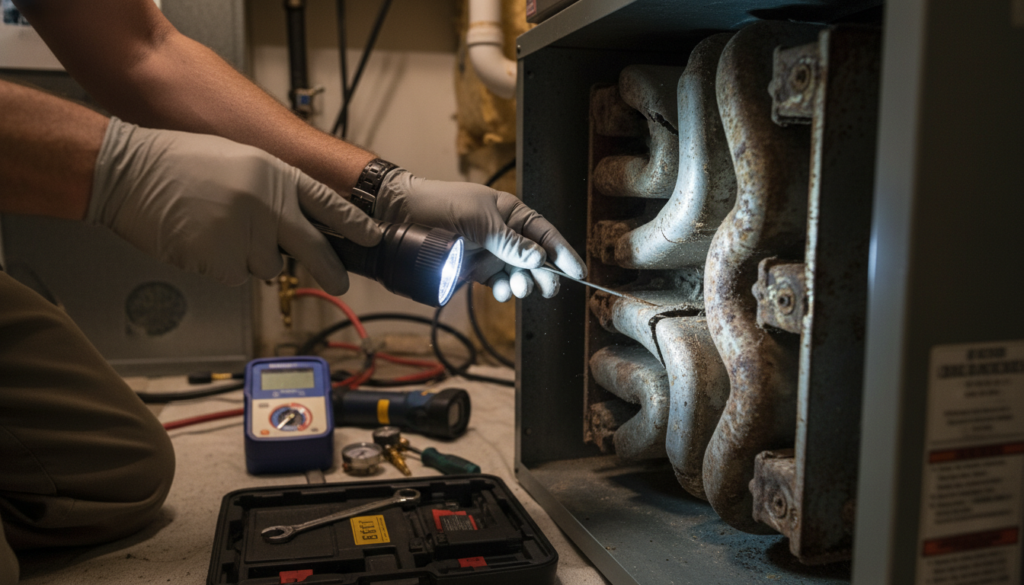
A furnace in decline gives three clear types of signals: performance, safety, and cost. Performance issues — loud or unusual noises, frequent short cycling, uneven heating, or persistent cold spots — often point to mechanical or airflow problems that might be repairable but can also indicate broader system wear. Safety warnings such as the smell of combustion gases, repeated pilot or ignition failures, or visible corrosion on the heat exchanger need immediate professional attention. Economic signals include rising energy bills despite regular maintenance and an uptick in repair visits; those usually tip the balance toward replacement for better long-term value and fewer surprises.
How to Identify Signs of a Failing Furnace
You can catch many early failure signs with a few quick checks that reveal airflow, combustion, and control issues. Listen for banging, rattling, or high-pitched squeals on startup and during operation — these noises often mean failing bearings, belts, or a stressed blower motor. Watch for short cycling, where the furnace turns on and off too frequently; common causes include oversized equipment, thermostat problems, airflow restrictions, or a failing control board. Note cycle timing and thermostat settings so a technician has clear data. Finally, if you smell burning dust at the season’s first startup, that’s normal — but persistent fuel or combustion smells require a safety inspection right away.
When Is Furnace Repair a Better Option Than Replacement?
Repair usually makes sense when the problem is isolated, the unit is relatively new, and repair costs are modest compared with replacement. Simple fixes — swapping a thermostat, replacing an igniter, or installing a new blower motor — can restore reliable operation and preserve a competitive AFUE, especially if the unit is under warranty or was recently serviced. If you plan to sell or move soon, a targeted repair can preserve value and defer a larger investment. On the other hand, repeated component failures, a cracked heat exchanger, or cumulative repairs approaching a significant portion of replacement cost generally indicate replacement is the better long-term decision.
For most homeowners, a professional diagnostic clarifies risks and cost trade-offs. Fontenot’s Air Conditioning & Heating provides focused furnace diagnostics and inspections in Acadiana to evaluate performance issues, safety concerns, and repair history, then delivers a clear, written recommendation for your home. If you spot several warning signs, schedule an inspection so immediate safety issues get addressed and you can weigh repair versus replacement with confidence.
How Much Does Furnace Installation vs Replacement Cost in Acadiana?
Costs for furnace repair, replacement, and first-time installation in Acadiana vary by equipment type, AFUE, system capacity, and job complexity — including ductwork and permitting. Expect a wide range of estimates because gas vs. electric units, ENERGY STAR models, and duct conditions all change the scope. Major drivers are the furnace price (AFUE and manufacturer), labor to remove and install the unit, duct repairs or sealing, venting or gas-line work, and permit or inspection fees. Knowing these drivers helps you compare bids and see how efficiency upgrades or duct improvements affect payback and comfort.
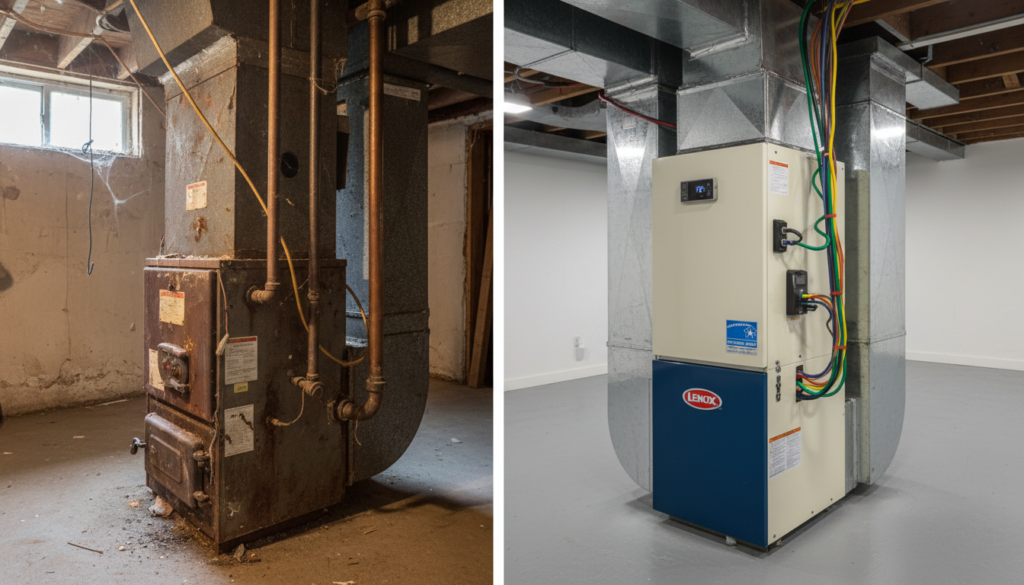
Different scenarios carry different cost components. The table below compares common repair and replacement situations and highlights when replacement typically becomes the better choice.
| Scenario | Common Cost Elements | When Replacement Is Favored |
|---|---|---|
| Minor repair (thermostat, ignitor) | Low parts and labor; fast turnaround | Repair when the unit is newer and AFUE is acceptable |
| Major repair (heat exchanger, blower) | Higher parts and labor; requires safety checks | Replace if the heat exchanger is compromised or failures repeat |
| Swap-out replacement | New unit cost + standard labor + minor duct adjustments | Choose replacement for age, low efficiency, or repeated repairs |
| First-time installation | Unit cost + ductwork, venting, gas/electrical work, permits | Install when no prior system exists or major infrastructure is needed |
What Factors Influence Furnace Replacement Cost?
Several technical and regulatory items explain why bids differ. Unit capacity and AFUE set the base equipment cost — larger homes need higher-capacity furnaces and accurate Manual J sizing to avoid short cycling. Duct condition can add significant expense if sealing, insulating, or reconfiguring is required to balance airflow and realize expected efficiency gains. Permits and code compliance may add materials and inspections, and removal/disposal of the old unit — especially if special handling is required — increases labor. That’s why line-item transparency on quotes is essential when comparing offers.
- Common cost drivers: unit capacity and AFUE, ductwork condition, venting and gas-line updates, permit fees, and disposal or remediation.
- Ask for itemized estimates so you can compare bids line by line and spot where prices differ.
- Make sure proposals include Manual J sizing and ACCA-aligned practices to avoid undersized or oversized systems.
How Does New Furnace Installation Cost Compare to Replacement?
First-time installations usually cost more than direct replacements because they often require added venting, gas routing, electrical work, or full duct design. A replacement typically fits existing infrastructure, keeping labor and disruption lower. Compatibility with existing ducts and controls determines whether a simple swap-out is possible; if ducts need resizing or balancing, costs can approach those of a new installation. In short: replacement tends to be less invasive and less expensive, but the condition of existing systems can narrow that gap.
Before you commit, get several detailed estimates that separate equipment, labor, and ductwork so you can compare long-term operating costs tied to AFUE and warranties. For Acadiana homeowners, transparent estimates and financing options often make upgrading to a high-efficiency unit more achievable — ask technicians for side-by-side comparisons when reviewing bids.
What Are the Benefits of Installing a New High-Efficiency Furnace?
A high-efficiency furnace brings measurable improvements in comfort, operating costs, and reliability by turning more fuel into usable heat and reducing wasted energy. High-AFUE units offer finer combustion control and modulation that keep temperatures steady, cut short-cycling, and often run quieter than older equipment. New furnaces also include more reliable components and longer manufacturer warranties, which reduce unexpected repairs and simplify maintenance planning. ENERGY STAR certified models meet higher performance standards and can qualify for incentives that improve payback, while lower fuel use also reduces your home’s environmental footprint.
| Furnace Category | Characteristic (AFUE Range) | Expected Long-term Benefit |
|---|---|---|
| Standard-efficiency | ~80% AFUE | Solid, reliable performance with moderate operating costs |
| High-efficiency | 90%+ AFUE | Lower fuel bills, less cycling, improved comfort |
| ENERGY STAR certified | Varies (typically 90%+) | Verified performance, possible rebates, stronger warranties |
How Does ENERGY STAR Certification Improve Furnace Efficiency?
ENERGY STAR identifies furnaces that meet stricter testing and performance standards, so units are more likely to deliver advertised AFUE in real-world use. Certified models often include advanced controls, better combustion tuning, and tighter manufacturing tolerances that boost seasonal efficiency and reduce standby losses. ENERGY STAR also makes it easier to qualify for local or federal incentives and signals a manufacturer commitment to verified performance. If rebates or long-term savings matter to you, prioritize certified models when comparing options.
What Long-Term Savings Can You Expect from a New Furnace?
Long-term savings come from higher AFUE, fewer repairs, and less downtime — but exact results depend on fuel prices, insulation, and how you use heat. Replacing an old, low-AFUE furnace with a modern high-efficiency model typically cuts annual fuel use enough to justify much of the investment over the unit’s lifespan, especially when combined with duct sealing and a smarter thermostat. Good warranty coverage and a regular maintenance plan also reduce surprise expenses, so measure total cost of ownership over 10–15 years rather than focusing only on upfront price. For an accurate estimate, ask for a site-specific analysis that considers local fuel costs and your past consumption.
When Should You Choose Furnace Installation Over Replacement?
Install a new system instead of replacing when your home lacks a compatible furnace, you’re adopting a different heating technology, or the existing system’s core components (ducting, venting, or fuel lines) won’t work with modern equipment. Installation is also the right choice if safety problems require a new design — for example, a compromised heat-exchange setup or venting that can’t meet current code. Homeowners staying long-term who want the biggest operating-cost and comfort improvements often opt for a full high-efficiency installation to capture maximum lifecycle savings. Every project should include Manual J sizing and a whole-home approach to ensure the new system performs as expected.
How Does Furnace Age Affect Installation vs Replacement Decisions?
Age is a helpful rule of thumb: units under 10 years are often worthwhile to repair, those 10–15 years need close evaluation, and units older than 15 years usually make replacement the sensible choice because efficiency and reliability decline. As furnaces age, AFUE drops, parts become harder or more expensive to source, and repeated repairs reduce the value of further investment. Older systems also lack modern safety and control features and may not work with new thermostats or zoning. When age-related decline shows up with rising repair frequency or safety concerns, a modern installation typically delivers better comfort and predictable costs.
What Role Do Repair History and Efficiency Play in Your Choice?
Repair history and measured efficiency create an evidence-based picture to choose between ongoing repairs and full replacement. The “50 percent rule” is a useful guide: if the cost to repair a major component approaches or exceeds half the cost of replacement, replacing the unit is usually wiser. Frequent small repairs add up and point to overall component fatigue, while dropping AFUE or higher energy bills provide hard proof the system is losing efficiency. Warranty coverage or recent major part replacements can justify another repair, but repeated downtime and rising bills generally favor replacement for reliability and lower lifecycle cost.
Collect repair invoices and recent energy-use data so an HVAC professional can model payback and recommend the most cost-effective path for your situation.
What Is the Furnace Installation and Replacement Process with Fontenot’s Air Conditioning & Heating?

At Fontenot’s Air Conditioning & Heating we follow a clear, transparent process to ensure correct sizing, safe installation, and measurable performance improvements for Acadiana homeowners. We start with an on-site diagnostic and Manual J load calculation to confirm your needs, then inspect ductwork, venting, and safety items that affect scope. We provide itemized proposals comparing repair, swap-out replacement, and high-efficiency options and review financing and maintenance plans to match your budget and goals. After installation we commission the system to verify combustion, airflow, and thermostat integration, and we stand behind our work with workmanship guarantees plus manufacturer warranty guidance to protect your investment.
What to Expect During Your Initial Consultation and Assessment
During the initial visit our technician documents furnace age, repair history, AFUE if available, duct condition, thermostat controls, and any safety observations to form a complete picture. We take measurements — temperature splits, static pressure, airflow — and visually inspect venting and the heat exchanger so our recommendation is evidence-based. You’ll receive a transparent estimate showing equipment options, line-item labor, and suggested duct or vent work so costs are easy to compare. This diagnostic process helps you choose between a focused repair, a swap-out, or a full new installation with confidence.
How Does Fontenot’s Ensure Quality and Customer Satisfaction?
Quality matters to us. Fontenot’s Air Conditioning & Heating uses factory-trained technicians, offers a customer satisfaction pledge, and backs installations with a workmanship policy and recommended preventive maintenance plans. We highlight manufacturer warranties and provide follow-up support so homeowners feel secure about their investment. Our local experience in Acadiana lets us recommend ENERGY STAR and high-efficiency options suited to regional fuel patterns and climate needs, and our maintenance plans help preserve efficiency and extend equipment life. These measures reduce the perceived risk of a major HVAC purchase and give a clear path for ongoing system care.
What Financing Options Are Available for Furnace Installation and Replacement?
Financing turns a large upfront cost into manageable monthly payments so high-efficiency upgrades are more accessible without draining savings. Typical options include low-interest home improvement loans, dealer or manufacturer payment plans, and short-term promotional financing that can let you replace a system quickly. Financing also makes it easier to choose higher-AFUE equipment sooner, which may speed up operational savings. Know eligibility requirements, the documentation you’ll need, and typical approval timelines so you can pick the right option and schedule work without unnecessary delay.
| Financing Type | Characteristic | Practical Impact |
|---|---|---|
| Low-interest loan | Bank or credit union term loan | Predictable monthly payments; usually requires a credit check |
| Dealer/manufacturer plan | Promotional terms offered through the contractor | May include deferred payments or lower introductory rates |
| Payment plan | Short-term in-house plan | Easier approval; may carry higher rates but offers scheduling flexibility |
How Can Financing Help Manage Furnace Replacement Costs?
Spreading the cost over monthly payments can align with expected energy savings from a higher-AFUE model and ease immediate budget pressure. Financing lets you choose better-performing equipment sooner, which can improve cash flow if monthly payments are offset by lower utility bills. Some financing options offer quick approval so you can move from estimate to installation faster — valuable during peak heating times when delays affect comfort and safety. Always compare total interest and term length to confirm the financing supports net savings over the life of the system.
What Are the Steps to Apply for Furnace Installation Financing?
Applying for financing usually follows a straightforward path: get a detailed written estimate, choose a financing option, complete the application, and schedule the work after approval. First, request an itemized proposal that lists equipment, labor, and any duct or vent work so the financed amount matches the project. Review the financing offers with your contractor, submit the application with basic documentation (ID, income proof, and the estimate), and wait for approval — decisions can be immediate or take a few days depending on the lender. Once approved, sign the contract, set the install date, and keep warranty and workmanship paperwork for your records.
- Request an itemized written estimate so the financed amount is accurate.
- Compare financing options from the contractor and third-party lenders.
- Complete the application and provide standard documentation for approval.
- Finalize scheduling after approval and store warranty paperwork in a safe place.
This guide covered practical diagnostics, Acadiana cost factors, the upside of high-efficiency furnaces, decision rules like the 50 percent heuristic, and the installation and financing steps local professionals use. If you’re seeing multiple decline signs or want a clear written comparison between repair and replacement, schedule a diagnostic inspection or request an estimate from Fontenot’s Air Conditioning & Heating for transparent options tailored to your home and budget.
Frequently Asked Questions
What is the average lifespan of a furnace?
Most furnaces last between 15 and 30 years, depending on the type and how well they’re maintained. Gas furnaces typically run about 15–20 years; electric units can last up to 30. Regular maintenance — annual inspections and timely filter changes — helps extend service life. As a furnace ages, efficiency usually falls and repairs become more frequent, so keep an eye on performance and consider replacement as the unit approaches the end of its expected life.
How can I improve my furnace’s efficiency?
Simple steps can boost efficiency: replace or clean filters regularly, seal and insulate ductwork, and improve home insulation to reduce heat loss. Upgrading to a programmable or smart thermostat helps manage settings and avoid wasted heat. For bigger gains, consider a high-efficiency furnace and pair it with duct sealing and a maintenance plan — that combination often delivers the best long-term savings.
What should I do if my furnace is making strange noises?
Address unusual sounds quickly. Banging, rattling, or squealing can indicate loose parts, worn bearings, or other mechanical issues. Turn off the furnace if you suspect a safety problem, then call a licensed HVAC technician to diagnose and fix the issue. Ignoring strange noises can lead to bigger, costlier repairs.
Are there any tax credits or rebates for high-efficiency furnace installations?
Yes — many homeowners qualify for tax credits or utility rebates when they install high-efficiency or ENERGY STAR furnaces. Programs vary by state and local utility, so check with your local energy office, utility provider, or contractor for available incentives in your area. Keep purchase and installation records to claim any credits or rebates.
How often should I have my furnace serviced?
We recommend annual service, ideally before the heating season starts. A yearly tune-up helps keep the system running safely and efficiently, reduces the chance of breakdowns, and extends equipment life. During service a technician will inspect, clean, and adjust components and point out any issues that could become bigger problems.
What are the signs that I should upgrade to a high-efficiency furnace?
Consider upgrading if your furnace is over 15 years old, needs frequent repairs, or has a low AFUE rating. Rising energy bills despite maintenance and inconsistent heating around the house are also signs a high-efficiency model could provide better comfort and lower operating costs. An upgrade can improve comfort, reduce bills, and increase home value while lowering your environmental impact.
Conclusion
Choosing between furnace installation and replacement affects comfort, safety, and long-term costs. By watching for performance and safety signs, understanding local cost drivers in Acadiana, and weighing the benefits of high-efficiency equipment, you can make a choice that fits your home and budget. For personalized advice and clear, itemized estimates, schedule a diagnostic inspection with Fontenot’s Air Conditioning & Heating — we’ll help you find the most practical, cost-effective path forward.