

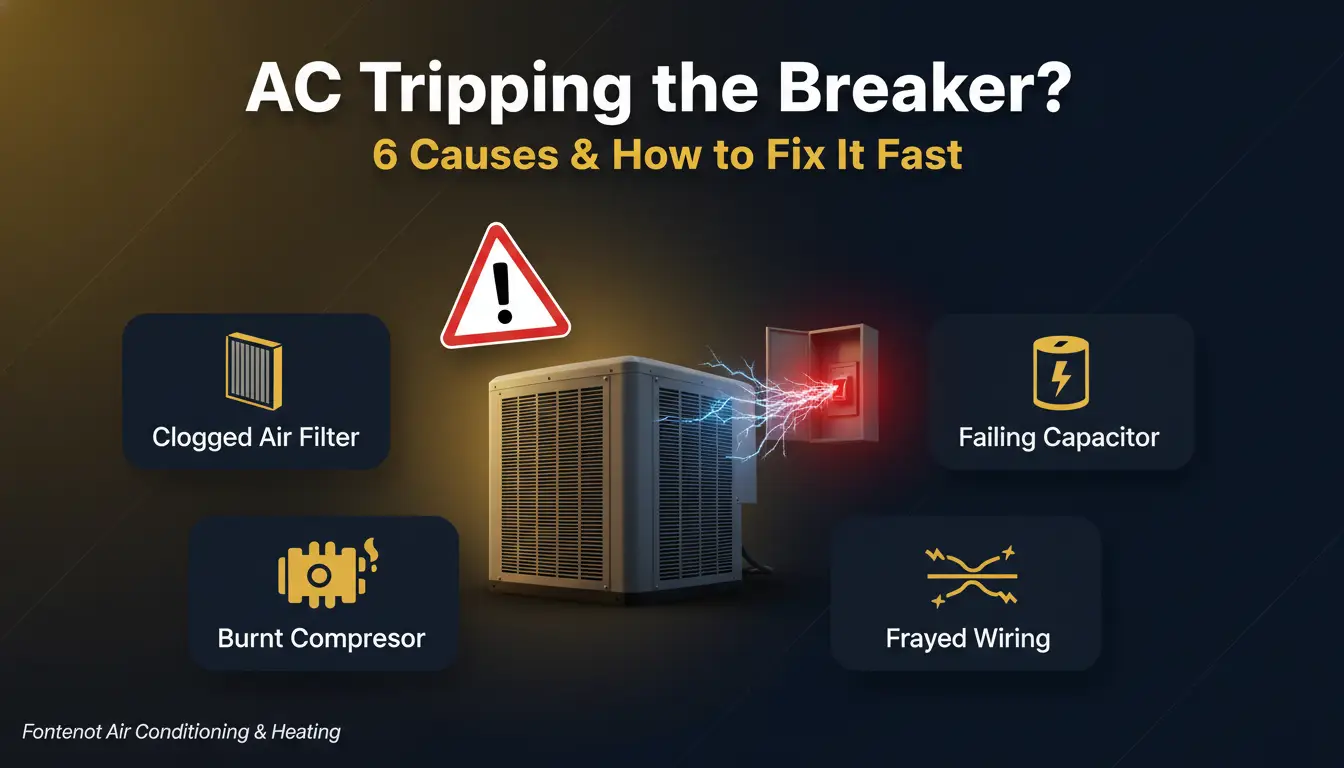
If your AC tripping breaker, stop what you’re doing, and whatever you do, don’t keep resetting it.
Your air conditioner is tripping the breaker because it’s pulling more electricity than the circuit can safely handle. This usually happens because of dirty coils, a failing capacitor, a bad compressor, or a wiring problem. The breaker isn’t the villain here; it’s doing exactly what it’s supposed to do. It’s protecting your home and your HVAC system from a much bigger problem.
Resetting the breaker over and over without fixing the root cause can permanently damage your AC unit. And trust me, a $200 repair can turn into a $3,000 replacement real fast.
In this guide, we’ll walk you through every major reason an AC trips the breaker, how to troubleshoot it safely, and when it’s time to call a professional, like our team at Fontenot Air Conditioning and Heating.
Why Does My AC Keep Tripping the Breaker?
Your AC keeps tripping the breaker because the system is drawing more amps than the circuit is rated for. Every circuit breaker has a limit, for most central AC units, that’s a dedicated 240-volt, 15 to 60-amp circuit depending on the system size. When the AC exceeds that limit, the breaker cuts power to prevent overheating, electrical fires, or damage to the unit.
Here’s a simple way to think about it:
The breaker is like a bouncer at a club. When too many people (amps) try to get in at once, the bouncer shuts the door. The problem isn’t the bouncer; it’s whatever is causing the overcrowding.
There are two ways this overcrowding happens:
The AC system itself is the problem. A mechanical failure inside the unit, like a bad capacitor, a grounded compressor, or dirty coils, is forcing the system to draw way more power than it should.
The electrical circuit is the problem. The breaker is old, worn out, or the AC is sharing a circuit with other appliances, and there simply isn’t enough power to go around.
One quick diagnostic tip: pay attention to when the breaker trips.
- Trips immediately when you turn the AC on → This usually means a short circuit. Something is directly grounding out inside the system.
- Trips after running for 10–30 minutes → This usually means an overload. The system is working too hard, overheating, and pulling too many amps over time.
Knowing which one you’re dealing with helps a lot before you call for service.
The 6 Most Common Causes of an AC Tripping Breaker
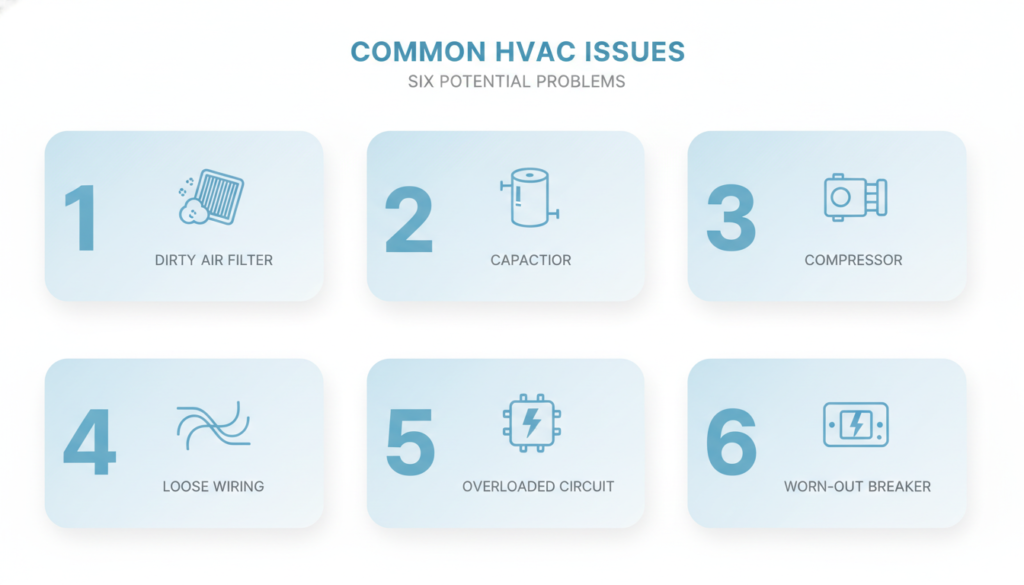
1. Dirty Air Filter or Clogged Condenser Coils
This is the most common and most preventable reason your AC is tripping the breaker.
When your air filter gets clogged with dust and debris, airflow through the system gets choked off. The blower motor has to work harder to push air through. Working harder means pulling more amps. More amps than the circuit allows means a tripped breaker.
It gets worse outside, too. Your outdoor condenser unit releases heat from your home into the outside air. If the condenser coils are packed with dirt, grass clippings, or debris, they can’t release that heat properly. The system overheats. The compressor strains. The breaker trips.
The good news? This one is usually a DIY fix. Change your air filter and clean around your outdoor unit, and you might solve the problem entirely.
2. Failed Run Capacitor
The run capacitor is a small cylinder inside your AC unit that stores electrical energy and gives the motors, the blower motor, and the compressor motor the extra boost they need to start up and keep running.
When a capacitor starts failing, the motors don’t get that boost. So they try to compensate by drawing a massive surge of current directly from the circuit. That surge is often enough to trip the breaker immediately or within a few minutes of startup.
Signs your capacitor might be failing:
- The AC hums but doesn’t start right away
- You hear a clicking sound before startup
- The outdoor unit fan spins slowly or not at all
Capacitor replacement is one of the most common AC repairs we handle at Fontenot Air Conditioning and Heating. It’s relatively affordable (usually $150–$400 parts and labor) and can save you from a much costlier compressor replacement if caught early.
3. Faulty or Grounded Compressor
The compressor is the heart of your AC system. It pumps refrigerant through the system to move heat out of your home. It’s also the most expensive component.
When a compressor starts to fail internally, especially when the motor windings short out and make contact with the compressor shell, it becomes what’s called a “grounded compressor.” This creates a direct path to ground for electrical current, which trips the breaker instantly every single time you reset it.
If your AC trips the breaker immediately every time you reset, no delay, no brief moment of running, there’s a strong chance your compressor is grounded.
An aging compressor that hasn’t fully failed yet might also draw excessive amperage at startup. In some cases, a hard start kit can be installed to give the compressor an extra electrical kick at startup, reducing that initial amp surge enough to stop the tripping. Your HVAC technician can test whether a hard start kit is a viable solution or whether a full compressor replacement is needed.
4. Loose Wiring or Short Circuit
Inside your AC system, inside the electrical disconnect box near the outdoor unit, and inside your breaker panel, there are dozens of wire connections. Over years of vibration, heat cycling, and normal wear, these connections can loosen.
A loose wire connection creates arcing, small electrical sparks that generate heat, trip breakers, and, over time, can cause fires.
Rodents are another culprit here. Mice, squirrels, and rats frequently chew through electrical wiring inside HVAC units, especially in outdoor compressor units that are dormant during winter. A chewed wire creates a direct short circuit, which will trip the breaker every time.
Check the disconnect box near your outdoor unit for any visible signs of burnt or melted wire insulation. If you see burnt wires, black scorch marks, or smell something burning near your unit, stop, do not reset the breaker. Call a licensed HVAC technician or electrician immediately.
5. Overloaded Circuit
Your central AC should be on a dedicated circuit, meaning it’s the only thing drawing power from that breaker. If your AC is sharing a circuit with other appliances (a refrigerator, a washer, a space heater), the combined electrical load can easily exceed the breaker’s capacity.
This is more common in older homes where the electrical panel wasn’t designed for modern HVAC systems. The fix is having a licensed electrician install a dedicated circuit for your AC, not just a larger breaker. Swapping in a higher-amp breaker without upgrading the wiring is dangerous and against electrical code.
6. The Breaker Itself Is Worn Out
Breakers aren’t designed to last forever. After years of tripping and resetting, the internal components of a breaker wear down, and it starts to trip at lower and lower thresholds, even when the electrical load is perfectly normal.
How do you know the breaker is the problem and not the AC? If a certified HVAC technician tests your AC system and finds no electrical faults, no overcurrent, and no mechanical issues, but the breaker still trips, then the breaker itself is likely worn out.
Breaker replacement costs around $150–$300 with a licensed electrician.
Can a Dirty Filter Cause an AC Breaker to Trip?
Yes, absolutely. A dirty air filter is one of the most underestimated causes of an AC tripping the breaker, and it’s the first thing you should check before calling anyone.
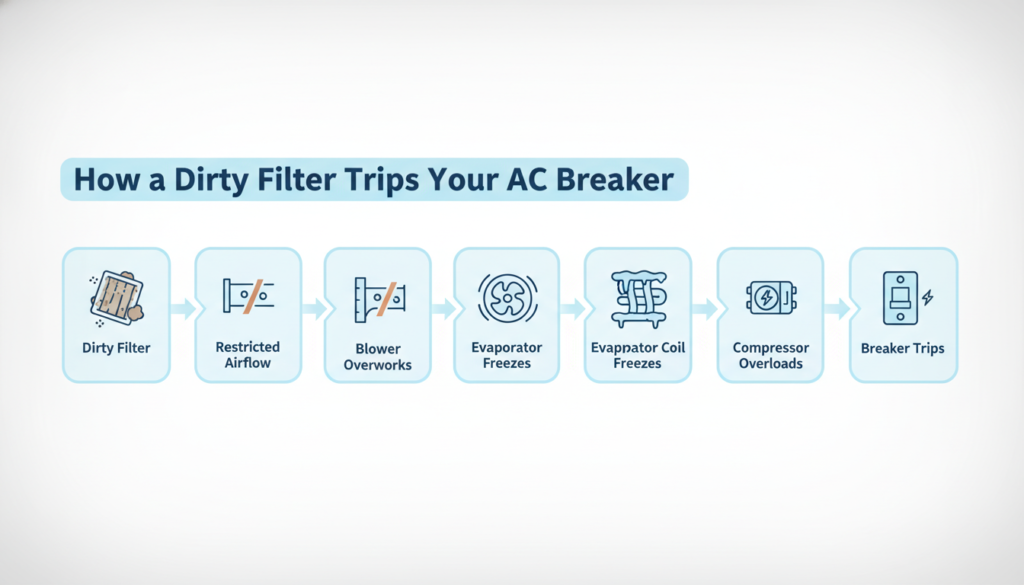
Here’s the chain reaction a clogged filter sets off:
Dirty filter → Restricted airflow → Blower motor overworks → Evaporator coil freezes → System strains to push refrigerant → Compressor overloads → Breaker trips.
A frozen evaporator coil is especially sneaky. The AC might run fine for 20–30 minutes, then as the coil ices over and airflow drops to near zero, the compressor spikes in amp draw and the breaker trips. Many homeowners think it’s a compressor problem when all they needed was a $10 filter.
How often should you change your filter? Every 1–3 months for standard 1-inch filters. Every 6–12 months for thicker 4–5 inch media filters. If you have pets or live in a dusty area, lean toward the shorter end.
For the outdoor condenser coils, rinse them gently with a garden hose (spray from the inside out) once a year to remove debris buildup. Keep at least 2 feet of clear space around the outdoor unit at all times.
Will a Bad Compressor Trip a Breaker?
Yes, and when it does, it’s usually the most serious scenario.
A failing compressor will trip the breaker in two ways:
Hard starting. As a compressor ages, it struggles to build up enough torque to start against the high refrigerant pressure in the system. During this struggle, it draws 3–5 times its normal running amperage for a few seconds. If those startup amps exceed the breaker rating, the breaker trips.
Grounded compressor. When the internal motor windings of the compressor fail completely and short to the compressor shell, it creates a ground fault. The breaker will trip instantly, every single time, with no delay.
Signs your compressor is causing the breaker to trip:
- The outdoor unit makes a loud buzzing or clanking sound before the breaker trips
- The breaker trips within seconds of reset
- The system is more than 10–12 years old
- Your HVAC tech has already replaced the capacitor, and it didn’t fix the problem
If a hard start kit doesn’t solve the issue and your compressor is confirmed to be grounded, you’re looking at either a compressor replacement ($1,200–$2,500) or a full system replacement. For any system over 10 years old, replacing the entire unit often makes more economic sense. Your HVAC technician can help you weigh the options.
How Can I Tell If My AC Breaker Is Bad?
Not every tripped breaker means your AC has a problem. Sometimes the breaker itself is the failure point. Here’s how to tell the difference.
Signs your AC breaker is bad:
- The breaker trips even when the AC is barely running or during light use
- The breaker feels warm or hot to the touch (a properly functioning breaker should be close to room temperature)
- You see burn marks, discoloration, or smell something burning near the breaker panel
- The breaker won’t stay in the “On” position even after resetting; it flips back immediately
- The breaker handle feels loose or mushy rather than snapping firmly into position
Signs your AC is the problem, not the breaker:
- The breaker only trips when the AC is running at full capacity (hot days, continuous use)
- You can hear the AC struggling, buzzing, humming, and clicking before the trip
- A different breaker of the same amperage trips the same way when tested by an electrician
Never replace a breaker with a higher-amp breaker to try to “fix” the tripping problem. A 30-amp breaker on 30-amp rated wiring exists for a reason. Putting a 40-amp breaker on that same wiring means the wiring can overheat and catch fire before the breaker ever trips. Always consult a licensed electrician for breaker issues.
Step-by-Step Troubleshooting Guide
Before you call a technician, here’s what you can safely check yourself.
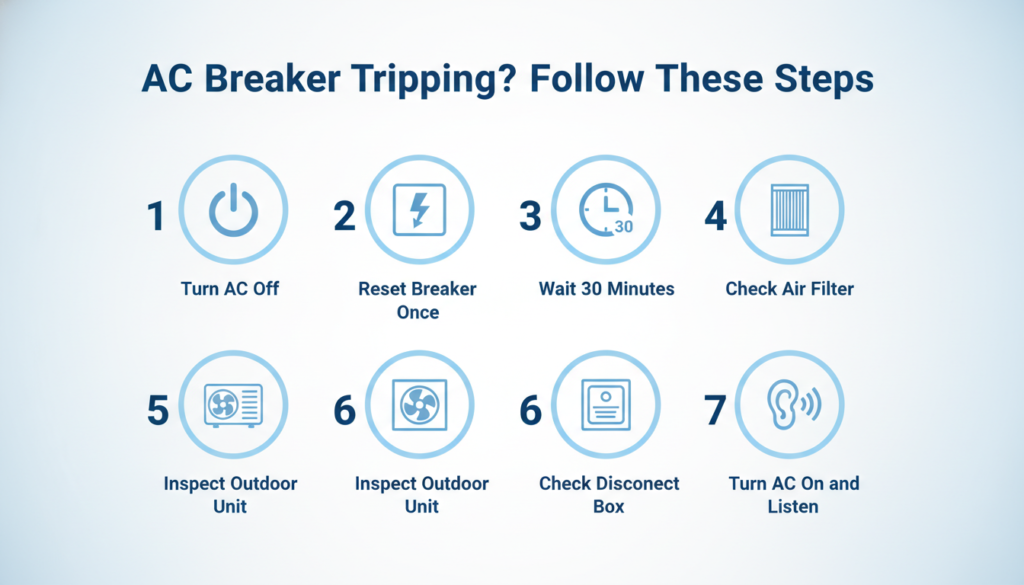
Step 1: Turn the AC completely off
Go to your thermostat and switch the system to “Off”, not just “Fan.” You want the compressor to fully stop before you do anything else.
Step 2: Reset the breaker, but only once
Go to your electrical panel, find the tripped breaker (it’ll be in the middle position or fully tripped to “Off”), and reset it. Do this only one time. Repeated resets without finding the cause can damage the compressor.
Step 3: Wait 30 minutes.
This gives the system, especially the compressor, time to equalize refrigerant pressure. Starting a compressor before the pressure equalizes puts massive strain on the motor.
Step 4: Check your air filter
Pull the filter and hold it up to a light. If you can’t see light through it, it’s clogged. Replace it before turning the system back on.
Step 5: Inspect the outdoor unit.
Look around and inside the outdoor condenser unit for debris, leaves, grass, and dirt packed around the fins. Clear everything within 2 feet of the unit. If the coils look matted with grime, rinse them with a garden hose.
Step 6: Check the disconnect box
The disconnect box is the small gray box on the wall near your outdoor unit. Open it and look for any visible burnt wires, melted plastic, or scorch marks. If you see any, close the box and call a professional; do not turn the system on.
Step 7: Turn the AC back on and listen
Turn the system on and stand near the outdoor unit. Listen for buzzing, clicking, or grinding. Watch to see if both the fan and the compressor start running. If the breaker trips again within seconds, stop and call a licensed HVAC technician.
When to stop and call a pro:
- Breaker trips immediately on reset (potential short circuit or grounded compressor)
- You see burnt wires or smell burning
- The AC runs, but the breaker trips after a few minutes, even with a clean filter
- You’ve replaced the filter and cleaned the unit, and it still trips
How to Prevent AC Breaker Trips
Most AC breaker trips are preventable with basic maintenance. Here’s what we recommend at Fontenot Air Conditioning and Heating:
Change your air filter regularly:
This one thing prevents more AC problems , including breaker trips, than almost anything else. Set a calendar reminder.
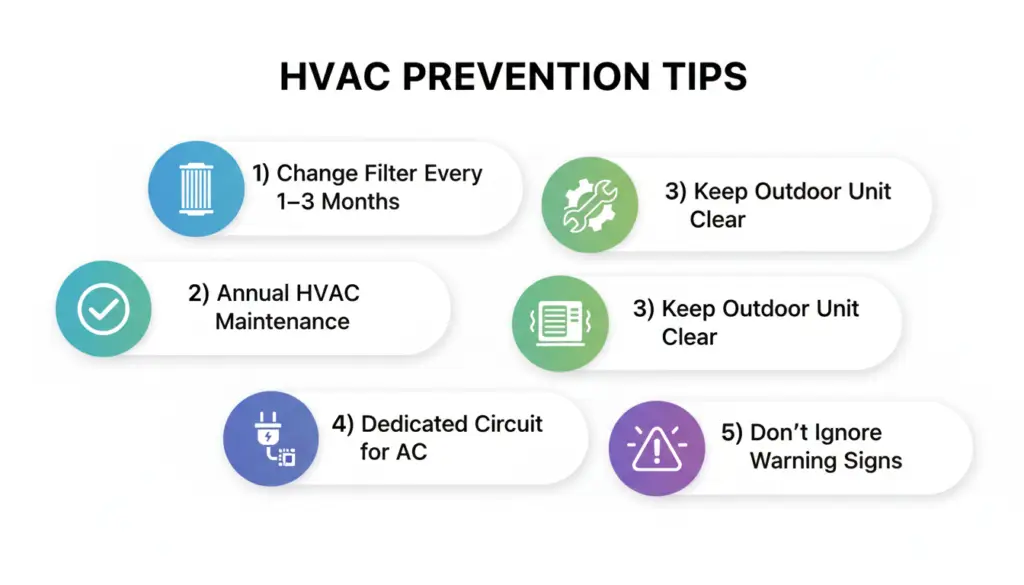
Schedule annual HVAC maintenance:
A professional tune-up catches failing capacitors, loose wiring, low refrigerant, and dirty coils before they become emergency calls. Most HVAC companies, including ours, offer affordable maintenance plans.
Keep the outdoor unit clean and clear:
Trim back any bushes or plants to maintain at least 2 feet of clearance. Rinse the coils once a year. In the fall, check for nesting animals or rodent damage.
Don’t run the AC on a shared circuit:
If you’re in an older home and your AC shares a breaker with other appliances, talk to an electrician about adding a dedicated circuit.
Don’t ignore warning signs:
If your system is running longer than usual, making new sounds, or the house isn’t cooling as well as it used to, get it checked. Small AC problems almost always become big ones if left alone.
When to Call an HVAC Professional
Some AC breaker problems are genuinely DIY-friendly, such as a clogged filter, a dirty outdoor unit, and debris clearance. But most of them require a licensed HVAC technician with the right diagnostic tools.
Call a professional if:
- The breaker trips immediately every time you reset it
- You suspect a capacitor, compressor, or wiring issue
- Do you see any burnt components or smell burning
- Your system is over 10 years old and tripping repeatedly
- You’ve done all the DIY steps, and the breaker is still tripping
At Fontenot Air Conditioning and Heating, we diagnose AC breaker problems every day. Whether it’s a simple capacitor swap or a full system evaluation, our licensed technicians will find the real cause, not just reset your breaker and hope for the best.
Having AC problems beyond a tripped breaker? Check out our complete AC Problems guide for everything from refrigerant leaks to frozen coils to airflow issues.
Frequently Asked Questions
u003cstrongu003eWhy does my AC keep tripping the breaker?u003c/strongu003e
Your AC keeps tripping the breaker because it’s drawing more electrical current than the circuit can handle. The most common causes are dirty air filters, clogged condenser coils, a failing capacitor, a faulty compressor, or a short circuit caused by loose or damaged wiring.
u003cstrongu003eHow can I tell if my AC breaker is bad?u003c/strongu003e
A bad AC breaker typically feels warm to the touch, shows burn marks, won’t stay in the u0022Onu0022 position, or trips under normal electrical loads that shouldn’t cause a trip. If a certified HVAC technician finds no fault with the AC system itself, but the breaker still trips, the breaker is likely worn out and needs replacement by a licensed electrician.
u003cstrongu003eCan a dirty filter cause an AC breaker to trip?u003c/strongu003e
Yes. A clogged air filter restricts airflow, forces the blower motor to overwork, and can cause the evaporator coil to freeze, all of which put excessive strain on the compressor and cause it to draw too many amps, tripping the breaker. Replacing a dirty filter is the first thing you should check.
u003cstrongu003eWill a bad compressor trip a breaker?u003c/strongu003e
Yes. A failing compressor can trip the breaker in two ways: by drawing excessive startup amps (hard starting) or by shorting internally and creating a ground fault (grounded compressor). A grounded compressor trips the breaker immediately every time you reset it and requires professional diagnosis.
u003cstrongu003eIs it safe to keep resetting a tripped AC breaker?u003c/strongu003e
No. Repeatedly resetting a tripped breaker without fixing the underlying problem can cause permanent damage to the AC compressor and poses a fire risk if there’s a wiring issue involved. Reset the breaker only once, and if it trips again, call a licensed HVAC technician.
u003cstrongu003eHow much does it cost to fix an AC that keeps tripping the breaker?u003c/strongu003e
The cost depends on the cause. A capacitor replacement typically runs $150–$400. A hard start kit is $100–$300 installed. A compressor replacement can cost $1,200–$2,500 or more. A worn-out breaker replacement costs $150–$300 with a licensed electrician. In some cases, especially for older systems, full unit replacement may be the most cost-effective path.