
What Is SEER2 Rating and What Score Do You Need?
Search
Recent Posts

Tags
Follow Us on
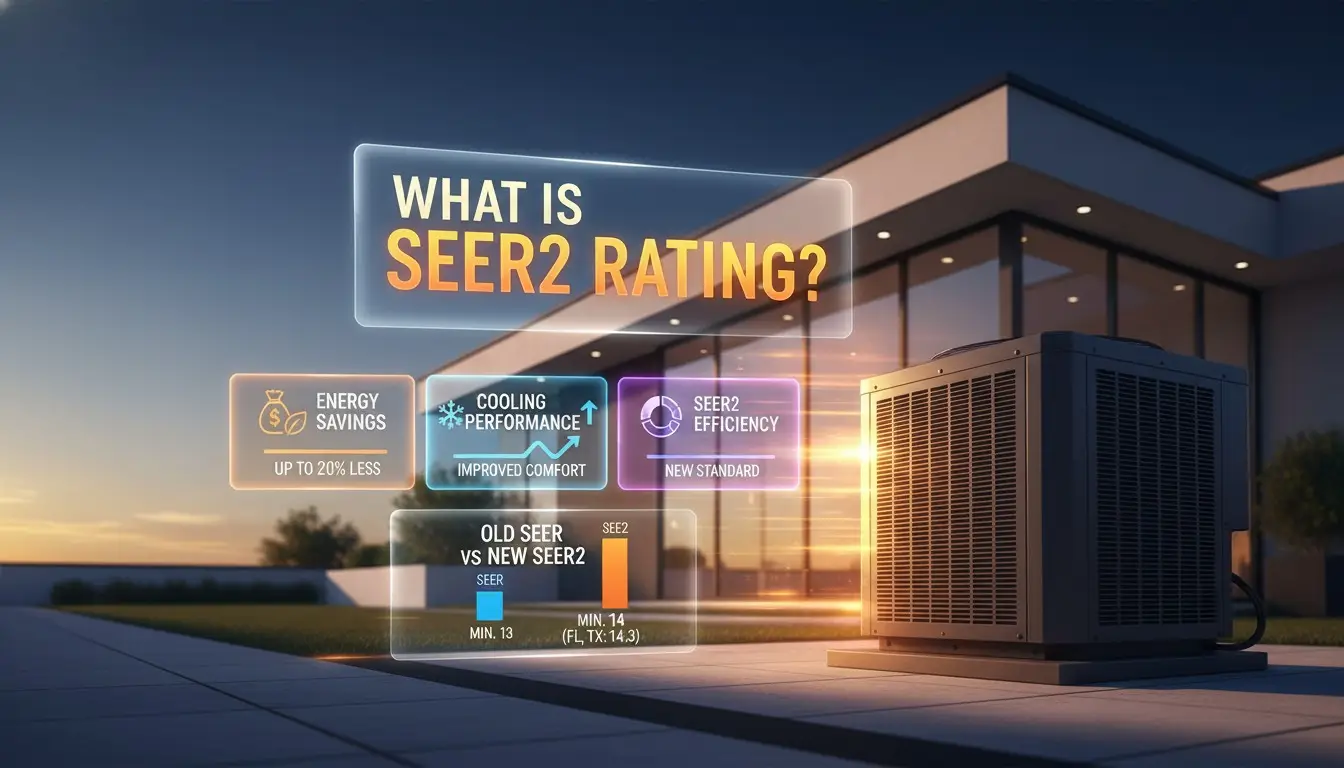
SEER2 (Seasonal Energy Efficiency Ratio 2) measures how efficiently an air conditioner or heat pump cools your home over an entire cooling season. The higher the SEER2 number, the less electricity the system uses to deliver the same amount of cooling. In Louisiana, the 2025 minimum is 14.3 SEER2 for split system air conditioners.
Key Takeaways
- SEER2 replaced the old SEER standard in 2023 and uses stricter M1 testing that better reflects real-world operating conditions.
- The federally required minimum SEER2 for split system air conditioners in the Southern U.S. region, including Louisiana, is 14.3 SEER2.
- A higher SEER2 rating means lower monthly energy bills, but the right score depends on your home size, budget, and how long you plan to stay in the house.
- ENERGY STAR-certified systems in 2025 require at least 15.2 SEER2, qualifying you for federal tax credits of up to $600.
- Proper system sizing matters just as much as SEER2. An oversized high-efficiency unit will still waste energy and fail to dehumidify properly.
What Is SEER2 Rating?
If you have ever shopped for a new air conditioner, you have probably seen a yellow EnergyGuide sticker with a number on it. That number is an efficiency rating, and since January 2023, the relevant one for most homeowners is SEER2.
Understanding what that number means before you sign any contract can save you thousands of dollars over the life of your system.
Definition of SEER2 (Seasonal Energy Efficiency Ratio 2)
SEER2: A measurement of an HVAC system’s cooling output over a full cooling season divided by the total electrical energy it consumes during that same period.
In plain terms, SEER2 tells you how much cooling you get per dollar of electricity spent. A system rated at 18 SEER2 delivers more cooling per kilowatt-hour than one rated at 14.3 SEER2, all else being equal.
The “2” in SEER2 signals that this rating uses a newer, more demanding testing protocol introduced by the U.S. Department of Energy. It is not simply a rebrand of the old number. It is a stricter measurement designed to give homeowners more accurate efficiency expectations.
Why SEER2 Replaced the Old SEER Rating
The original SEER standard had been in use since the 1980s. Over time, energy experts recognized that the lab conditions used to calculate it did not accurately reflect how systems perform in actual homes.
The Department of Energy responded by updating the testing protocol, effective January 1, 2023. The new standard uses what is called the M1 testing method, which applies more external static pressure to the system, simulating real duct resistance that the old test ignored.
As a result, a system that rated 15 SEER under the old standard typically scores around 14.3 SEER2 under the new one. The equipment has not gotten less efficient. The measurement has simply gotten more honest.
What SEER2 Measures in HVAC Performance
SEER2 captures seasonal performance, meaning it accounts for varying outdoor temperatures across an entire cooling season, not just peak heat conditions. This matters because your air conditioner does not always run at full capacity. On milder days, it cycles on and off, and that part-load operation significantly affects real-world efficiency.
Think of it like a car’s fuel economy rating. The EPA highway rating looks great, but city driving tells a different story. SEER2 is the HVAC equivalent of a combined city/highway rating, and that makes it far more useful for comparing systems.
What Is a Good SEER2 Rating?
Here is the honest answer most salespeople skip: a “good” SEER2 rating depends entirely on your climate, your home, and your energy costs. There is no single right answer for every homeowner.
Good vs Better vs Best SEER2 Ranges
| SEER2 Range | Classification | Best For |
| 13.4–15 SEER2 | Standard Efficiency | Mild climates, budget-focused buyers |
| 15–18 SEER2 | Mid-High Efficiency | Most Southern U.S. homes |
| 18–22 SEER2 | High Efficiency | Hot, humid climates with long cooling seasons |
| 22+ SEER2 | Premium Efficiency | Maximum savings, long-term ownership |
For most homeowners, the 15 to 18 SEER2 range represents the best balance between upfront cost and ongoing savings. Going above 20 SEER2 delivers real returns only when your cooling season is long, your electricity rates are high, and you plan to stay in the home for at least seven to ten years.
Recommended SEER2 for Louisiana Homes
Louisiana sits in one of the most demanding cooling climates in the country. Summers in Lafayette routinely see temperatures above 90°F with humidity levels that make the air feel closer to 100°F or higher.
In this environment, a 16 to 18 SEER2 system is the practical sweet spot for most homeowners. You get lower energy bills meaningfully compared to a minimum-efficiency unit, without paying the steep premium for systems above 20 SEER2.
If you run your air conditioner eight or more months per year, which is common in Lafayette, the energy savings from a 17 or 18 SEER2 system can realistically pay for the upgrade within five to seven years.
Cost vs Efficiency Sweet Spot Explained
Higher SEER2 systems cost more upfront. A 14.3 SEER2 unit might cost $3,500 to $5,000 installed, while a comparable 18 SEER2 system could run $6,000 to $8,500 or more, depending on size and brand.
The question you need to answer is not “which system is cheapest?” It is “which system costs the least over ten years?” Factor in your electricity rate, annual cooling hours, and available rebates, and the higher-efficiency unit often wins by a wide margin in a climate like Lafayette’s.
How SEER2 Is Calculated
The SEER2 Efficiency Formula Explained
The SEER2 formula is straightforward:
SEER2 = Total Cooling Output (BTUs) ÷ Total Electrical Energy Used (Watt-Hours)
The result is expressed as a ratio. A higher ratio means the system produces more cooling for every watt of electricity consumed.
The calculation is performed across a range of outdoor temperatures and operating conditions, not just at peak capacity. This is what makes it a seasonal measurement rather than a snapshot.
Cooling Output vs Energy Consumption
Cooling output is measured in British Thermal Units (BTUs). A typical residential air conditioner might produce anywhere from 18,000 BTUs (1.5 tons) to 60,000 BTUs (5 tons) per hour.
Energy consumption is measured in watt-hours. A system with a high SEER2 rating achieves the same BTU output while consuming fewer watt-hours, which translates directly to lower electricity costs every month your system runs.
Why Higher SEER2 Means Better Efficiency
A system with a 20 SEER2 rating uses roughly 30% less electricity than a 14.3 SEER2 unit delivering the same amount of cooling. Over a full Louisiana cooling season, that difference can add up to $300 to $600 in annual savings for an average-sized home, depending on your system size and utility rates.
Higher SEER2 ratings are typically achieved through variable-speed compressors, advanced heat exchangers, and smart control systems that modulate output based on demand rather than cycling on and off at full power.
M1 Testing Standard and Real-World Performance
What Is M1 Testing?
M1 Testing Standard: The updated laboratory testing protocol adopted by the Department of Energy in 2023 that applies increased external static pressure to HVAC systems during efficiency measurements.
Before M1, lab tests used 0.1 inches of water column (IWC) of external static pressure. M1 testing raised that to 0.5 IWC for most systems. That pressure more accurately simulates what a system experiences pushing conditioned air through real ductwork in a real home.
How SEER2 Reflects Real Operating Conditions
The original SEER test essentially measured a system operating in near-ideal conditions. Ducts in actual homes create resistance. They have bends, joints, and sometimes restrictions that force the blower to work harder.
By testing under conditions that reflect that resistance, SEER2 ratings tell you what to expect from a properly installed system in your actual home, not in a controlled lab with perfect airflow.
Why SEER2 Is More Accurate Than SEER
According to the Air-Conditioning, Heating, and Refrigeration Institute (AHRI), the shift to SEER2 ratings gives homeowners efficiency data that correlates much more closely with actual field performance. That means the number on the EnergyGuide label is no longer an optimistic best-case scenario. It is a realistic expectation.
This accuracy matters most when you are comparing systems and calculating payback periods. With SEER, those projections were often overly optimistic. With SEER2, they hold up better in the real world.
SEER2 vs SEER: Key Differences
If you are replacing an older system or comparing quotes, you may encounter both SEER and SEER2 ratings. Here is what you need to know to avoid confusion.
Changes in Testing Conditions
| Factor | SEER (Old) | SEER2 (New) |
| Effective Date | Pre-January 2023 | January 1, 2023 onward |
| Static Pressure | 0.1 IWC | 0.5 IWC |
| Testing Protocol | ARI Standard 210/240 | AHRI Standard 210/240-2023 |
| Real-World Accuracy | Lower | Higher |
Rating Differences and Conversions
Because SEER2 uses a stricter test, the same physical unit will score lower under SEER2 than it did under SEER. The approximate conversion is:
SEER2 ≈ SEER × 0.95
So a 15 SEER unit is roughly equivalent to a 14.3 SEER2 unit. The system has not changed. Only the measuring stick has.
What This Means for Homeowners
When comparing quotes, confirm whether the contractor is quoting SEER or SEER2. Comparing a 15 SEER unit to a 15 SEER2 unit is not an apples-to-apples comparison. The 15 SEER2 unit is meaningfully more efficient. If a contractor quotes SEER on equipment sold after January 2023, ask them to confirm the SEER2 rating on the AHRI certification sheet.
SEER2 vs EER2: What’s the Difference?
SEER2 is not the only efficiency rating on your equipment. You may also see EER2, especially on packaged units. These two numbers measure different things.
What EER2 Measures
EER2 (Energy Efficiency Ratio 2): A measurement of cooling efficiency at a single, fixed outdoor temperature (typically 95°F), rather than across a full season.
Where SEER2 averages performance across varying temperatures, EER2 captures performance at peak heat. Think of EER2 as a stress test and SEER2 as the average performance test.
When EER2 Matters More Than SEER2
EER2 is most relevant when your system will regularly operate during the hottest part of the summer, for example, in commercial buildings, server rooms, or homes in consistently hot desert climates.
For most Louisiana homeowners, SEER2 is the more useful number because it reflects the full range of temperatures your system will encounter from May through October. However, if your home routinely hits 95°F or higher indoors before the AC kicks in, a strong EER2 rating indicates the system will perform well under those peak conditions.
SEER2 vs EER2 for Hot and Humid Climates
In hot, humid climates like Lafayette, a well-balanced system should perform well on both metrics. A high SEER2 with a weak EER2 may underperform during the hottest weeks of August. When reviewing specifications, look for a system with strong marks on both ratings for the most reliable year-round comfort.
Related HVAC Efficiency Ratings Explained
What Is HSPF2 for Heat Pumps?
HSPF2 (Heating Seasonal Performance Factor 2): The efficiency rating for the heating mode of a heat pump, measured under the updated M1 testing standard.
Just as SEER2 measures cooling efficiency, HSPF2 measures how efficiently a heat pump converts electricity into heat during the heating season. In Louisiana, where winters are mild but heating still occurs, a heat pump with a strong HSPF2 rating keeps your year-round energy costs lower.
The current ENERGY STAR minimum for heat pumps is 7.5 HSPF2 for split systems.
How EER2 Differs from SEER2
The key difference is scope. EER2 is a point-in-time measurement at 95°F outdoor conditions. SEER2 is a weighted average across many temperatures and part-load conditions throughout the season.
A system can have a high SEER2 and a lower EER2, or vice versa. The two ratings measure different aspects of performance, and for complete efficiency knowledge, you should check both.
Why Multiple Efficiency Ratings Matter
No single number tells the whole story about an HVAC system. SEER2 tells you about seasonal cooling efficiency. EER2 tells you about peak performance. HSPF2 tells you about heating efficiency. Together, these ratings give you a complete picture, especially if you are comparing a heat pump to a traditional air conditioner for your home.
2023 Department of Energy SEER2 Requirements
The Department of Energy’s updated minimum efficiency standards took effect January 1, 2023. These are federal minimums. States or regions may enforce higher standards.
Minimum SEER2 for Packaged HVAC Units
Packaged units, which house all components in a single outdoor cabinet, must meet a minimum of 13.4 SEER2 nationwide as of 2023. This applies to both heat pump and air conditioner packaged systems.
Minimum SEER2 for Split System Heat Pumps
Split system heat pumps, which have separate indoor and outdoor units, must meet 14.3 SEER2 in the Northern U.S. and 15 SEER2 in the Southern U.S. region, which includes Louisiana.
Minimum SEER2 for Split System Air Conditioners
Split system air conditioners must meet a minimum of 13.4 SEER2 in the Northern region and 14.3 SEER2 in the Southern region. Louisiana falls under the Southern standard, so any new split system AC installed in Lafayette must be rated at least 14.3 SEER2.
(Source: U.S. Department of Energy, Energy Efficiency Standards for Residential HVAC)
SEER2 Requirements in Louisiana (Lafayette Homeowners Guide)
Louisiana is classified as part of the DOE’s Southern climate region, which means your state has stricter minimum requirements than states in the North.
Minimum SEER2 Standards for the Southern Region
For Lafayette homeowners, the minimums are:
- Split system air conditioners: 14.3 SEER2
- Split system heat pumps: 15 SEER2
- Packaged units (AC or heat pump): 13.4 SEER2
Any contractor installing equipment below these standards after January 1, 2023, is violating federal law. If a quote includes equipment below these minimums, that is a red flag.
What Systems Are Required in Lafayette, LA
Because Lafayette sits in ASHRAE Climate Zone 2, a hot and humid zone, split system air conditioners and heat pumps are the most common residential choices. Packaged units appear more often in commercial applications or mobile homes.
For most single-family homes in the Lafayette area, a split system rated between 15 and 18 SEER2 is the practical standard for new installations in 2025.
Why Higher SEER2 Matters in Hot and Humid Climates
Lafayette averages more than 2,500 cooling degree days per year. That is significantly higher than the national average of around 1,000 to 1,500 cooling degree days for most of the country.
More cooling degree days mean your AC runs longer, works harder, and costs more to operate. Every point of SEER2 efficiency you gain translates directly into measurable dollar savings in a climate like this. Higher efficiency is not just a nice-to-have here. It is a smart financial decision.
SEER2 Ratings by HVAC System Type
Not all HVAC systems achieve the same SEER2 ranges. The technology inside each system type determines how high the ratings can go.
Central Air Conditioners (Split Systems)
Standard single-stage central AC units typically range from 14.3 to 18 SEER2. Two-stage compressors push ratings into the 18 to 21 SEER2 range. Variable-speed compressors allow the highest efficiencies, often reaching 22 to 26+ SEER2.
Packaged HVAC Units
Packaged systems generally max out at lower SEER2 ratings than split systems because their design requires all components to fit in a single cabinet. Most packaged units range from 13.4 to 16 SEER2. High-efficiency packaged units can reach 17 to 19 SEER2 in some product lines.
Heat Pumps (Ducted Systems)
Ducted heat pumps are among the most efficient residential systems available. Standard models range from 15 to 18 SEER2. Premium inverter-driven heat pumps from brands like Mitsubishi, Bosch, and Carrier can reach 20 to 24+ SEER2, making them an excellent long-term investment for Louisiana homeowners.
Ductless Mini-Split Systems
Ductless mini-splits consistently deliver the highest SEER2 ratings on the market. Many standard models achieve 18 to 22 SEER2, while premium units regularly exceed 25 SEER2. Because they eliminate duct losses, which can account for 20 to 30% of energy waste in a conventional system, their real-world performance often exceeds their already impressive ratings.
Typical SEER2 Ratings for Modern HVAC Systems
Standard Efficiency Range (13–25+ SEER2)
The full range of SEER2 ratings on the market spans from the federal minimum up to 26+ for premium residential equipment. Here is how that breaks down practically:
- 13.4–14.3 SEER2: Entry-level, code-compliant units. Lowest upfront cost, highest operating cost.
- 15–17 SEER2: Mid-efficiency units. Good balance of cost and performance for most homeowners.
- 18–21 SEER2: High-efficiency units. Meaningful energy savings, moderate premium price.
- 22+ SEER2: Premium units. Best long-term savings in high-use climates.
High-Efficiency Systems (18+ SEER2)
Systems rated 18 SEER2 and above almost always feature variable-speed or two-stage compressors. This technology does more than save energy. It also improves comfort by running longer at lower speeds, which removes more humidity from your home and maintains a more consistent indoor temperature.
In a humid climate like Lafayette’s, that dehumidification benefit alone can make an 18+ SEER2 system feel dramatically more comfortable than a cheaper single-stage unit, even at the same thermostat setting.
Benefits of Higher SEER2 Ratings
Lower Energy Bills and Operating Costs
The math is straightforward. According to the ENERGY STAR program, replacing a 10 SEER system with a 20 SEER2 system cuts cooling energy consumption by roughly 50%. Even upgrading from a 14.3 SEER2 to an 18 SEER2 unit delivers approximately 20 to 25% in energy savings.
For a typical Louisiana home spending $180 to $250 per month on cooling during peak summer months, that kind of reduction makes a real difference on the monthly bill.
Improved Indoor Comfort and Performance
Higher SEER2 systems do not just run more efficiently. They run differently. Variable-speed technology allows the system to modulate its output, running at 40% or 60% capacity on mild days rather than slamming on at 100% and cycling off repeatedly.
This produces more consistent temperatures throughout your home, fewer hot spots, and significantly better humidity control. If you have ever felt clammy even with the AC running, an undersized or inefficient single-stage unit is often the cause.
Environmental Impact and Energy Savings
Residential air conditioning accounts for about 17% of total U.S. home energy use, according to the U.S. Energy Information Administration. Choosing a higher-efficiency system reduces your home’s carbon footprint and decreases strain on the regional power grid during peak demand periods.
For homeowners who care about both their bills and their environmental impact, a high-SEER2 system delivers on both fronts without requiring any lifestyle changes.
SEER2 and ENERGY STAR® Certification
Minimum SEER2 for ENERGY STAR Qualification
Not every code-compliant system earns ENERGY STAR certification. The program requires performance above the federal minimum. As of 2025, ENERGY STAR requires:
- Split system central AC: 15.2 SEER2 or higher
- Split system heat pump: 15.2 SEER2 / 8.1 HSPF2 or higher
- Packaged AC unit: 14 SEER2 or higher
(Source: ENERGY STAR Certified Residential HVAC)
How ENERGY STAR Impacts Efficiency and Savings
ENERGY STAR-certified systems are independently tested and verified to meet performance thresholds that go beyond minimum compliance. Choosing a certified system gives you documented evidence that the unit performs as rated, which matters when you are calculating long-term savings.
Additionally, ENERGY STAR certification is often a requirement to qualify for utility rebate programs and federal tax incentives.
Why ENERGY STAR Matters for Homeowners
If you are planning to claim the federal energy efficiency tax credit under the Inflation Reduction Act, ENERGY STAR certification is a prerequisite for most HVAC equipment categories. That credit is worth up to $600 for central AC units and up to $2,000 for qualifying heat pumps. Skipping ENERGY STAR-certified equipment could mean leaving hundreds of dollars in tax savings on the table.
SEER2 and Energy Costs in Lafayette, LA
How SEER2 Affects Monthly Utility Bills
Your monthly cooling cost depends on three main variables: how much cooling work your system does (measured in BTUs), how efficiently it does that work (SEER2), and what your utility charges per kilowatt-hour.
Louisiana Power and Light (Entergy Louisiana) rates vary, but residential customers typically pay between $0.10 and $0.13 per kilowatt-hour. At those rates, even modest SEER2 improvements produce noticeable monthly savings during the long Lafayette cooling season.
Estimated Annual Savings by SEER2 Level
For a 3-ton (36,000 BTU) system operating 2,000 hours per year in Lafayette:
| SEER2 Rating | Annual kWh Used | Est. Annual Cost (@$0.12/kWh) | Savings vs 14.3 SEER2 |
| 14.3 SEER2 | 5,035 kWh | $604 | Baseline |
| 16 SEER2 | 4,500 kWh | $540 | $64/year |
| 18 SEER2 | 4,000 kWh | $480 | $124/year |
| 20 SEER2 | 3,600 kWh | $432 | $172/year |
Assumptions made: Louisiana utility rate estimated at $0.12/kWh for illustrative calculations. Annual operating hours are estimated at 2,000 for a typical Lafayette home. Savings figures are estimates for comparison purposes only and will vary based on home size, insulation, usage, and actual utility rates.
These are estimates for illustrative purposes. Actual savings depend on your home’s insulation, duct condition, thermostat settings, and usage patterns.
Long-Term ROI vs Upfront Investment
A 20 SEER2 system might cost $2,000 to $3,500 more upfront than a 14.3 SEER2 unit. At $172 in annual savings, the raw payback period is 12 to 20 years at current energy rates alone.
However, factor in rebates, tax credits, rising energy rates over time, and the improved comfort of a variable-speed system, and that payback period shrinks considerably. For homeowners planning to stay in their home long-term, the investment almost always pays off in Lafayette’s climate.
SEER2 Rebates, Tax Credits, and Incentives
Federal Energy Efficiency Tax Credits (IRA)
The Inflation Reduction Act (IRA) extended and expanded federal tax credits for energy-efficient HVAC equipment. For systems installed in 2025:
- Central air conditioners: Up to $600 tax credit (must meet ENERGY STAR requirements)
- Air source heat pumps: Up to $2,000 tax credit (must meet ENERGY STAR requirements)
These are non-refundable tax credits, meaning they reduce your tax liability dollar for dollar, up to the specified cap. You will need to file IRS Form 5695 to claim them.
Local and Utility Rebates in Louisiana
Entergy Louisiana periodically offers rebate programs for qualifying high-efficiency HVAC equipment. Rebate availability and amounts change, so you should contact Entergy directly or check their current residential programs to confirm what is available when you are ready to purchase.
Some equipment manufacturers also offer additional rebates stacked on top of utility incentives, which can further reduce your net cost.
How to Qualify and Maximize Savings
To qualify for both federal credits and utility rebates:
- Choose ENERGY STAR-certified equipment at or above the qualifying SEER2 threshold.
- Use a licensed HVAC contractor for installation.
- Keep all documentation, including the equipment model number, AHRI certificate, and installation invoice.
- File IRS Form 5695 with your federal return for the year of installation.
- Submit rebate paperwork to your utility within their specified window, usually 30 to 90 days after installation.
What SEER2 Rating Should You Choose?
Best SEER2 for Small vs Large Homes
Smaller homes (under 1,500 square feet) typically use 1.5 to 2-ton systems. Because the system capacity is smaller, the absolute dollar savings from a higher SEER2 are also smaller, which can push the payback period longer. A 15 to 16 SEER2 system is often the practical sweet spot for smaller homes.
Larger homes (2,500 square feet and above) use bigger systems that consume more electricity, which means the energy savings from a higher SEER2 are proportionally larger. For these homes, investing in 18 to 20 SEER2 equipment makes strong financial sense.
Ideal SEER2 for Lafayette Climate Conditions
Given Lafayette’s long cooling season, high humidity, and above-average cooling degree days, the ideal SEER2 for most homeowners falls between 16 and 18 SEER2 for standard installations. If your current system is more than 12 to 15 years old and rated below 13 SEER, almost any modern system will represent a dramatic efficiency improvement.
For homeowners who want maximum comfort along with maximum savings and plan to stay in their home for ten or more years, an 18 to 20 SEER2 system with variable-speed technology is worth the additional investment.
When a Higher SEER2 System Is Worth the Cost
A higher SEER2 system is worth the premium when:
- You run your AC more than six months per year (common in Lafayette)
- Your current system is inefficient and driving high utility bills
- You plan to stay in the home long enough to recoup the investment
- You are sensitive to indoor humidity and want better dehumidification
- You qualify for tax credits or rebates that reduce the net upfront cost
If your budget is tight and you are planning to sell your home within three years, a code-minimum 14.3 SEER2 system may be the more practical choice.
Is a Higher SEER2 Rating Always Worth It?
When Higher Efficiency Pays Off
Higher SEER2 consistently pays off when the cooling load is high and operating hours are long. In Lafayette, where air conditioners often run eight months a year, the conditions for a strong return on a high-efficiency system are nearly always present.
Variable-speed systems in the 18 to 22 SEER2 range also deliver comfort benefits that a SEER2 number alone cannot capture. Quieter operation, less temperature swing, and better humidity control are real quality-of-life improvements that many homeowners value independent of the energy savings.
When It May Not Be Necessary
A 22 SEER2 premium system may not be necessary if your cooling load is minimal, your home is well-insulated, you keep your thermostat at moderate settings, or you plan to sell within a few years. In those scenarios, a 15 to 16 SEER2 ENERGY STAR system may hit the best balance point.
The goal is not to buy the highest SEER2 number available. The goal is to choose the right efficiency level for your specific home, budget, and usage patterns.
Payback Period Explained
Payback period is the number of years required for your energy savings to offset the higher upfront cost of a more efficient system.
Simple Payback Formula: Additional Upfront Cost ÷ Annual Energy Savings = Payback Years
For example, if an 18 SEER2 system costs $1,500 more than a 14.3 SEER2 unit and saves $150 per year in energy costs, the simple payback period is 10 years. Add in rebates and tax credits, and that number often drops to six or seven years.
SEER2 and Proper HVAC System Sizing
Why Efficiency Alone Is Not Enough
A 20 SEER2 system installed incorrectly, or sized wrong for your home, will not perform the way the rating promises. SEER2 ratings are achieved under standardized test conditions with proper airflow and system sizing. Deviate from those conditions in the real world, and performance suffers regardless of what the label says.
This is one of the most important things to understand before you sign a contract: efficiency and sizing are separate problems, and both must be solved correctly.
Importance of Load Calculations
A proper HVAC sizing starts with a Manual J load calculation. This engineering calculation accounts for:
- Your home’s square footage and layout
- Insulation levels in walls, attic, and floors
- Window area, type, and orientation
- Local climate data
- Number of occupants and internal heat sources
Without a Manual J, a contractor is guessing. An oversized system will cool the space quickly, but short-cycle before removing enough humidity. An undersized system will run continuously and still fail to keep up on the hottest days.
Risks of Oversized or Undersized Systems
An oversized system, even a high-SEER2 one, will short-cycle. That means it turns on, blasts cold air, and shuts off before completing a full dehumidification cycle. The result is a home that feels cold but clammy. In Lafayette’s humid climate, that is not comfortable.
An undersized system runs non-stop during peak heat and still cannot maintain your set temperature. This drives up energy bills and accelerates wear on the equipment.
The right SEER2 rating paired with the wrong sizing is still the wrong system. Always ask your contractor for documentation of the load calculation before approving any new installation.
Common SEER2 Mistakes to Avoid
Choosing Based on Price Alone
The cheapest system is rarely the least expensive option over time. A minimum-efficiency 14.3 SEER2 unit installed today may save $800 upfront but cost $200 or more per year in additional energy compared to a 17 SEER2 alternative. Over ten years in Lafayette’s climate, that decision could cost more than $1,200 in excess energy bills.
Always compare the total cost of ownership, not just the purchase price on the quote.
Ignoring Installation Quality
A 2010 study by Pacific Gas and Electric found that improper installation can reduce system efficiency by 30% or more in real-world conditions. Even the best SEER2 rating on the market cannot overcome a poor installation.
Factors like incorrect refrigerant charge, improper airflow, duct leakage, and incorrect thermostat placement all reduce real-world performance significantly. Choose a contractor with verified installation experience and ask for a commissioning report after installation is complete.
Misunderstanding Efficiency vs Performance
SEER2 is an efficiency rating. It tells you how much energy the system uses relative to the cooling it produces. It does not tell you how well the system controls humidity, how quietly it operates, or how long it will last.
A complete system evaluation considers SEER2 alongside SEER2 compatibility with your duct system, brand reliability data, warranty terms, and contractor support. Efficiency is one piece of the puzzle, not the whole picture.
When to Upgrade to a Higher SEER2 System
Signs Your Current AC System Is Inefficient
Ask yourself these questions about your current system:
- Is your system more than 12 to 15 years old?
- Has your monthly cooling bill increased significantly without a change in usage habits?
- Does your home feel humid even when the AC is running?
- Are you scheduling repairs more than once per year?
- Does your system struggle to maintain temperature on the hottest days?
If you answered yes to two or more of these, your current system is likely operating well below its original efficiency and possibly below modern code minimums. An upgrade will almost certainly pay for itself faster than you expect.
Repair vs Replacement Decision Guide
A common rule of thumb in the HVAC industry: if the repair cost multiplied by the system’s age exceeds the cost of a new system, replace it. This is sometimes called the “5,000 rule” (repair cost × age in years; if over $5,000, replace).
However, for systems over 10 years old and running below 13 SEER, even a moderately expensive repair may not be worth it. You are paying to keep a low-efficiency system alive when a modern 15 to 17 SEER2 replacement would save money within a few years.
System Age and Performance Benchmarks
| System Age | Original SEER Rating | Recommended Action |
| Under 5 years | 14.3+ SEER2 | Maintain and optimize |
| 5 to 10 years | 13 to 14 SEER | Monitor efficiency, consider upgrade |
| 10 to 15 years | 10 to 12 SEER | Strong candidate for replacement |
| 15+ years | Below 10 SEER | Replace immediately for savings |
Frequently Asked Questions About SEER2 Ratings
Is SEER2 the Same as SEER?
No. SEER2 uses a stricter testing protocol called M1 that better reflects real-world operating conditions. The same physical unit will receive a lower numerical rating under SEER2 than under the old SEER standard. As a rough conversion, SEER2 ≈ SEER × 0.95. All new residential HVAC equipment sold in the U.S. after January 1, 2023, is rated in SEER2.
What SEER2 Rating Is Required in Louisiana?
Louisiana falls in the DOE’s Southern climate region. As of 2023, the minimum SEER2 for new split system air conditioners in Louisiana is 14.3 SEER2. Split system heat pumps must meet 15 SEER2. Packaged units must meet 13.4 SEER2. These are federal minimums, and your contractor is legally required to install equipment that meets or exceeds them.
Is a Higher SEER2 Always Better?
Not always. A higher SEER2 system costs more upfront and provides the best return in climates with long cooling seasons and high electricity rates. In moderate climates with short summers, the payback period on premium-efficiency equipment may be longer than the homeowner plans to stay in the property. The right SEER2 depends on your specific situation.
How Much Can You Save with Higher SEER2?
Upgrading from a 14.3 SEER2 to an 18 SEER2 system can reduce cooling energy consumption by approximately 20 to 25%. For a typical Lafayette home spending $150 to $250 per month on cooling, that translates to $30 to $60 per month in savings, or $360 to $720 per year. Over ten years, those savings add up to $3,600 to $7,200, often well above the cost premium of the higher-efficiency system.
Key HVAC Terms Related to SEER2
Central Air Conditioning
Central air conditioning: A system that cools an entire home by distributing conditioned air through a network of ducts and registers from a central unit. Central AC systems use SEER2 as their primary efficiency rating and are the most common cooling solution for homes in the Southern U.S., including Lafayette.
Heat Pumps
Heat pump: A system that moves heat rather than generating it, providing both cooling and heating from a single unit. Heat pumps carry both a SEER2 rating (for cooling mode) and an HSPF2 rating (for heating mode), making them a versatile, year-round option in Louisiana’s mild winters.
M1 Testing Standard
M1 Testing Standard: The laboratory testing protocol adopted by the Department of Energy in 2023, which increased external static pressure requirements for HVAC efficiency testing. M1 testing produces efficiency ratings that more accurately reflect how systems perform in real homes with real ductwork, replacing the more optimistic results of the older testing approach.
Energy Efficiency Ratings Overview
The HVAC industry uses several ratings that measure efficiency from different angles. SEER2 covers seasonal cooling. EER2 covers peak cooling performance. HSPF2 covers seasonal heating for heat pumps. AFUE (Annual Fuel Utilization Efficiency) covers gas furnace efficiency. Understanding which rating applies to which function helps you evaluate equipment honestly, rather than being guided by a single number that only tells part of the story.
Professional SEER2 Guidance in Lafayette, LA
Why Expert HVAC Evaluation Matters
Choosing the right SEER2 rating is not something a spec sheet can do for you. The right system depends on your home’s square footage, insulation quality, duct condition, sun exposure, and how you actually use your home.
An experienced HVAC technician can run the Manual J calculations, inspect your existing ductwork, and recommend equipment that will perform as expected rather than just look impressive on paper.
The team at Fontenot’s AC has been serving Lafayette homeowners with honest, expert guidance through every stage of AC selection and installation. Their technicians understand the specific demands of the local climate and can match you with a system that delivers real comfort and real savings.
What to Expect from a SEER2 Consultation
During a proper SEER2 consultation, a technician should:
- Review your current system’s age, condition, and measured performance
- Perform or review a Manual J load calculation for your home
- Discuss your budget, energy goals, and how long you plan to stay in the home
- Present equipment options with clear SEER2 ratings, AHRI certifications, and installed cost estimates
- Explain available rebates and tax credits that apply to your situation
A contractor who skips these steps and jumps straight to a quote based on square footage alone is not giving you a real evaluation.
Schedule Your AC Efficiency Assessment
If your current system is more than 10 years old, your summer bills have been climbing, or you are planning a new build or major renovation, now is the time to get a professional efficiency assessment.
You have all the information you need to ask the right questions. The next step is putting it to work.
Contact Fontenot’s AC for expert AC installation in Lafayette and find out exactly what SEER2 rating makes sense for your home, your budget, and the Lafayette climate. Whether you are ready to schedule now or just want an honest answer to your questions, their team is ready to help.