

You turn on your AC, and it’s running, but barely any air is coming out of the vents. The system sounds fine, but your room just isn’t cooling down the way it should.
Sound familiar?
Weak airflow from AC vents is one of the most common AC problems homeowners deal with, especially during hot summers. The good news? A lot of the time, you can find the cause yourself, and some fixes take less than 10 minutes.
In this guide, we’ll walk you through every reason your AC might have low airflow, exactly how to troubleshoot it step by step, and when it’s time to call a professional HVAC technician.
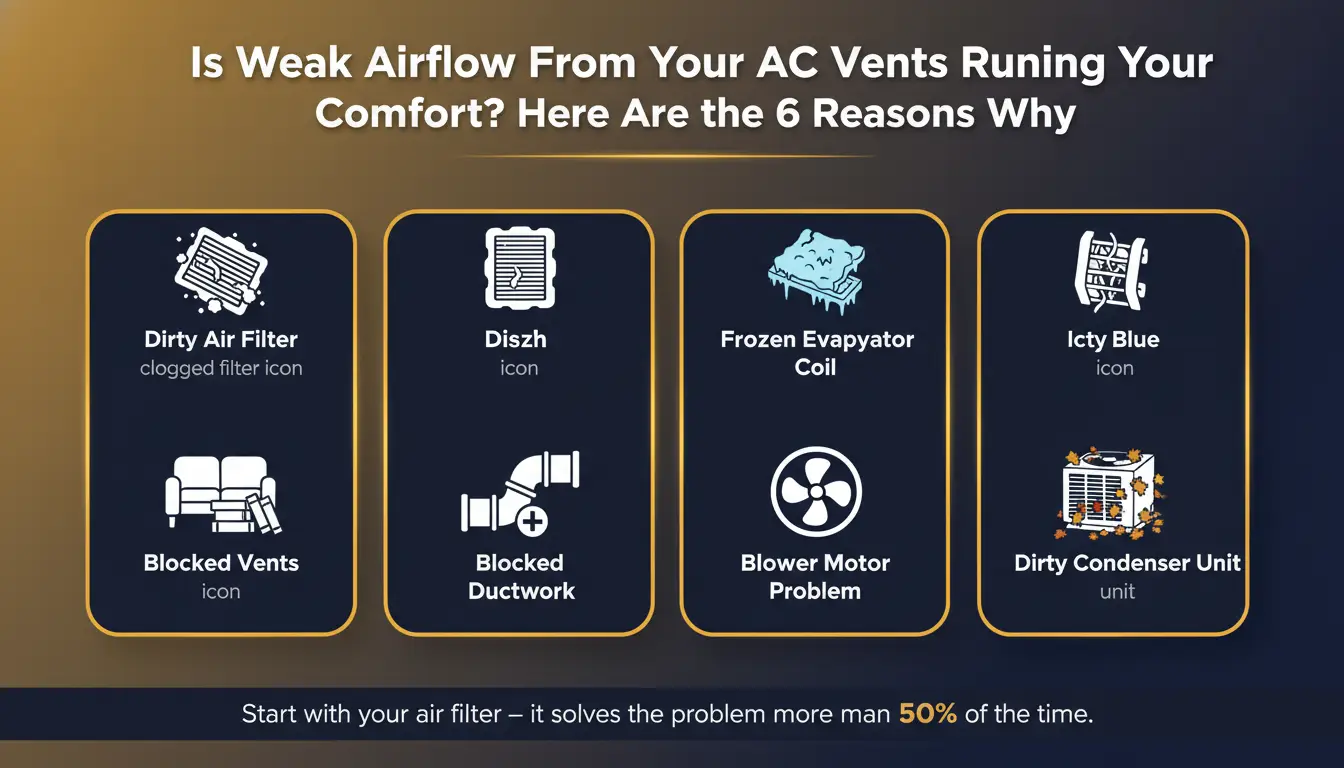
Quick Answer: Weak airflow from AC vents is usually caused by a clogged air filter, frozen evaporator coils, or a blower motor problem. Other common causes include blocked vents, leaky ductwork, or a dirty outdoor condenser unit. Start by checking and replacing your air filter; it solves the problem more than half the time.
6 Common Causes of Weak Airflow from AC Vents
Before you start fixing anything, you need to understand what’s actually causing the problem. Here are the six most common reasons your AC isn’t blowing strongly.
Dirty or Clogged Air Filter
This is the number one cause of weak AC airflow, and it’s also the easiest to fix.
Your air filter traps dust, dirt, pet hair, and other particles before air enters the system. Over time, all that buildup restricts airflow. It also affects your home’s indoor air quality. The more clogged the filter, the harder your system has to work, and the less air actually makes it through.
Most filters need to be replaced every 1 to 3 months. If you have pets or allergies, you may need to change it even more frequently. A filter that hasn’t been changed in six months is almost always the first thing we check when a customer calls us about low AC airflow.
A clogged filter doesn’t just restrict airflow, according to the U.S. Department of Energy, a dirty filter can reduce your AC’s energy efficiency significantly and cause dirt to bypass into the evaporator coil.
Frozen Evaporator Coil
If your AC is blowing air that feels cold but very weak, a frozen evaporator coil is often the culprit.
The evaporator coil sits inside your indoor unit and absorbs heat from the air. When airflow is restricted or when refrigerant levels are low, the coil gets too cold, and ice starts forming on it. That ice blocks airflow even further, creating a frustrating cycle.
You might notice ice forming around the indoor unit or see water dripping near it as the ice melts. If either of those things is happening alongside weak airflow, a frozen coil is likely your problem.
Blocked or Leaky Ductwork
Your ducts are the highways that carry cool air from your AC system to every room in your home. If those highways have a roadblock or a hole, airflow suffers.
Common ductwork problems include:
- Crushed or kinked flex ducts (especially in attics or crawlspaces)
- Disconnected duct joints where air is escaping into unconditioned spaces
- Debris or pest nests blocking a duct section
Leaky ducts are more common than most people realize. Studies show that the average home loses 20 to 30 percent of conditioned air through duct leaks. That’s a significant amount of air that never reaches your vents.
Blower Motor or Fan Problems
The blower motor is what pushes air through your entire system. If it’s failing, slowing down, or caked with dust, your AC simply can’t move enough air, regardless of how well the rest of the system is working.
Signs of a blower motor problem include a low humming noise coming from the unit, the fan spinning slower than normal, or the system taking longer than usual to reach the set temperature. A weak blower can also cause the evaporator coil to freeze over time, making the problem even worse.
Blocked Vents or Registers
This one gets overlooked all the time. If furniture, curtains, rugs, or any other object is sitting in front of or directly over a supply register, that vent isn’t going to deliver much air.
Closed registers are another common issue. Some homeowners close vents in unused rooms to “save energy,” but this actually creates back-pressure in the duct system and reduces overall airflow throughout the home. Keep all your registers open, even in rooms you don’t use often.
Dirty or Blocked Outdoor Condenser Unit
Your outdoor unit releases the heat that your AC pulls out of your home. When leaves, grass clippings, dirt, or other debris clog the condenser coils, the system can’t release heat efficiently.
This affects overall system performance, including airflow. After heavy storms or during pollen season, the outdoor unit is especially prone to buildup. If it’s been a while since you’ve cleaned around it, that could be contributing to your weak airflow problem.
How to Fix Weak Airflow from AC Vents, Step by Step
Work through these steps in order. Most of the time, you’ll find and fix the problem before reaching the end of the list.
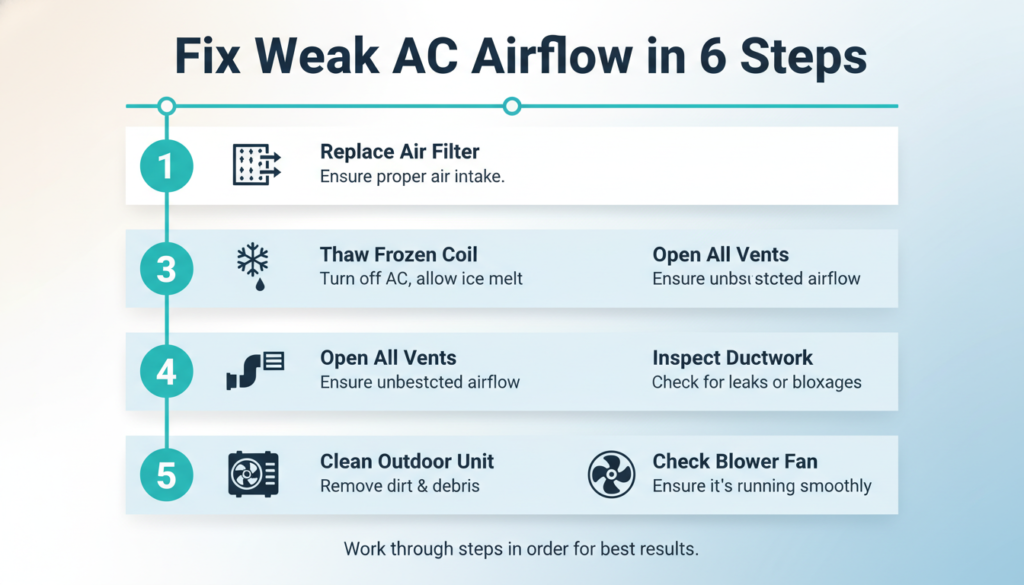
Step 1: Replace the Air Filter
Locate your filter , it’s usually in the return air vent on a wall or ceiling, or in the air handler unit itself. Pull it out and hold it up to a light source. If you can’t see light through it, it needs to go.
Replace it with a new filter of the same size. For most homes, an MERV 8 to MERV 11 filter gives you the best balance of air filtration and airflow. Going too high on the MERV rating (13 or above) can actually restrict airflow in residential systems not designed for it.
After replacing the filter, run the system for 20 to 30 minutes and check whether airflow has improved.
Step 2: Check for a Frozen Evaporator Coil
Turn your thermostat to “fan only” mode, not cooling. Let the system run like this for about an hour to give the coils time to thaw. You can also switch the system completely off and just run the fan.
Once thawed, switch back to cooling mode and check airflow. If it improves but the freezing keeps coming back, you likely have a refrigerant issue that needs a licensed HVAC technician to diagnose and fix.
Step 3: Open and Clear All Vents
Walk through every room in your home and check every supply register and return vent. Make sure they’re all fully open, and nothing is blocking them, not furniture, not curtains, not boxes.
If you find a closed register somewhere, open it. Your duct system was designed to move air through the entire home, and blocking one section affects the whole network.
Step 4: Inspect Your Ductwork
If you have access to your attic or crawlspace, take a look at your flex ducts. You’re looking for sections that are kinked, crushed, or visibly disconnected. Sometimes animals chew through ducts, or a section simply comes loose from a joint.
Small disconnections can be sealed with HVAC-rated foil tape or mastic sealant as a temporary fix, but a professional duct inspection is the best way to find every problem and seal it properly.
Step 5: Clean the Outdoor Condenser Unit
Turn the power off to the outdoor unit at the disconnect switch before cleaning it. Clear any leaves, grass, or debris from around the unit, aiming for at least two feet of clear space on all sides.
You can rinse the condenser coils gently with a garden hose, spraying from the inside out to push debris out through the fins. Don’t use a pressure washer, as it can bend the delicate fins.
Step 6: Check the Blower Fan
On the indoor air handler unit, there’s usually an access panel. With the power off, open it and take a look at the blower wheel. If the blades are caked with dust and debris, airflow will definitely be reduced.
You can carefully brush or vacuum the blades. However, if the motor itself seems to be running slower than normal, making unusual noises, or not starting at all, that’s a job for a professional.
DIY Fix vs. Call a Pro: How to Decide
Not every airflow problem requires a service call. Here’s a simple way to think about it:
You can handle it yourself:
- Replacing the air filter
- Opening and clearing vents and registers
- Rinsing the outdoor condenser unit
- Checking for obvious duct disconnections in accessible areas
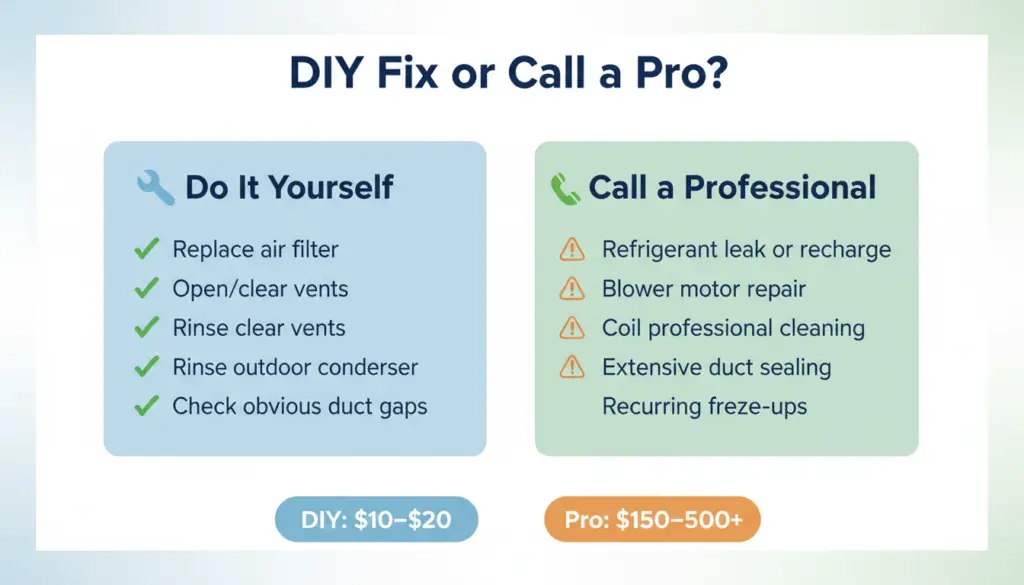
Call a licensed HVAC technician:
- Refrigerant is low or leaking (you legally cannot handle refrigerant without certification)
- The blower motor needs repair or replacement
- Evaporator or condenser coils need professional cleaning
- Ductwork needs extensive sealing or replacement
- The system keeps freezing up even after you’ve addressed basic causes
As a general guide, DIY fixes like a filter change cost almost nothing, maybe $10 to $20 for a quality filter. Professional repairs for a blower motor or refrigerant recharge typically run between $150 and $500 or more, depending on the issue and your system.
At Fontenot Air Conditioning and Heating, we always recommend starting with the free checks first. If the filter, vents, and outdoor unit look fine and you’re still dealing with weak airflow, that’s when you give us a call.
Why is the airflow weak in Only One Room?
If the rest of your home feels fine but one room has noticeably weak airflow, the issue is usually specific to that part of your duct system, not the whole AC.
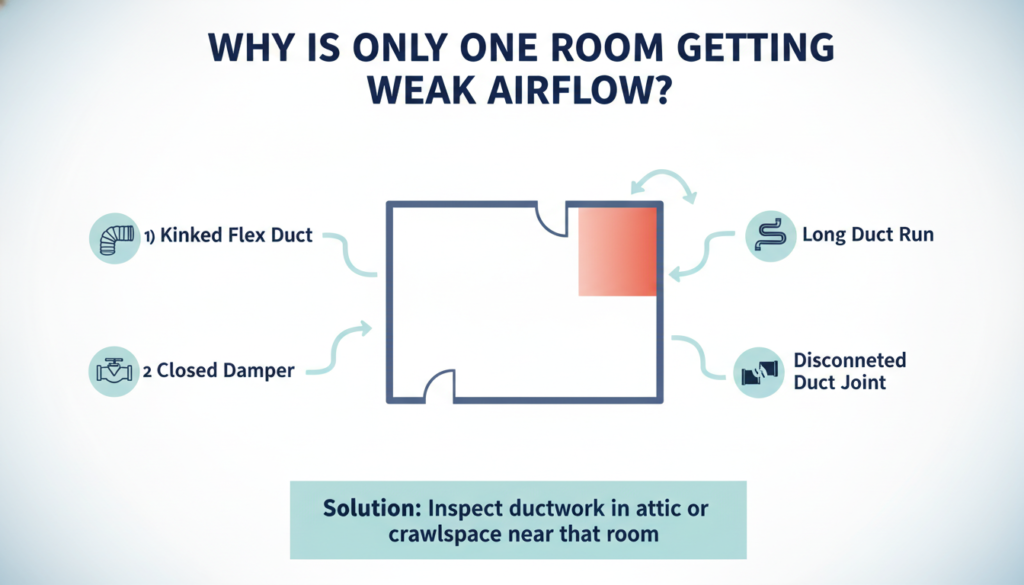
Here’s what typically causes uneven airflow in one room:
Distance from the air handler. Rooms that are farther from the indoor unit naturally receive slightly less pressure. If the duct run to that room is also long or poorly designed, the difference becomes significant.
A closed or stuck damper. Inside your ductwork, there are dampers, small adjustable plates that control how much air goes to different zones. If a damper in the branch leading to that room has shifted closed, it will choke off airflow to just that area.
A kinked or crushed flex duct. This is very common in attics. When a flex duct gets bent too sharply around a corner or has weight resting on it, airflow to that specific room drops dramatically.
A duct booster fan is one solution for a room that consistently gets less airflow. It installs in the duct branch and helps push more air to that space. However, make sure the root cause is addressed first; a booster fan on a leaky duct is just blowing conditioned air into your attic.
Preventive Maintenance to Keep Airflow Strong
The best way to avoid dealing with weak airflow from your AC vents is to stay ahead of the problem with regular maintenance.
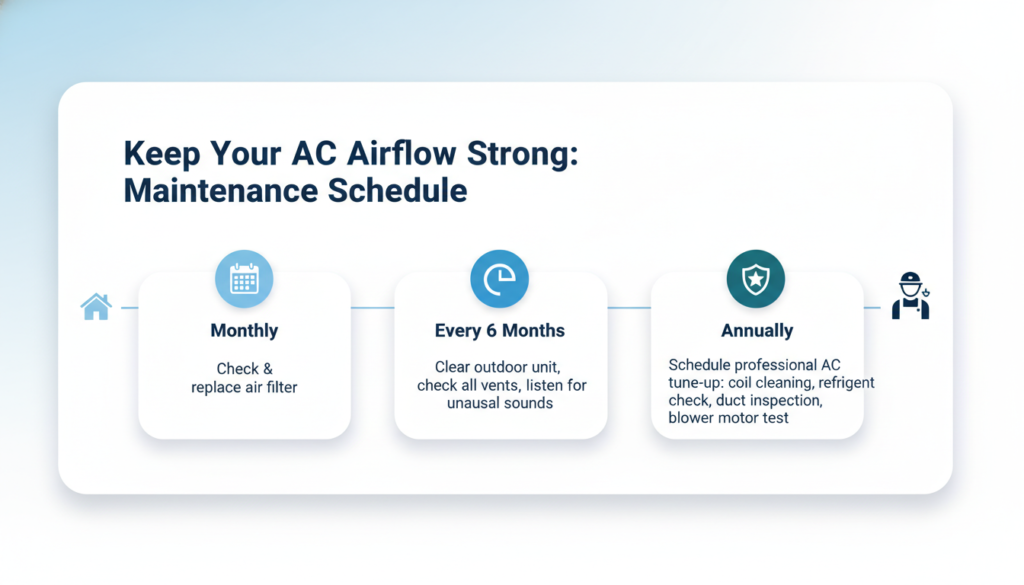
Every month: Check your air filter. If it looks gray and clogged, replace it. If it still looks relatively clean, check again next month.
Every 6 months: Clear the area around your outdoor condenser unit. Check all supply and return vents for blockages. Listen for any unusual sounds when the system runs.
Once a year: Schedule a professional AC tune-up. You can use the ENERGY STAR maintenance checklist as a reference to know exactly what a thorough annual service visit should cover. A certified HVAC technician will clean the evaporator and condenser coils, check refrigerant levels, inspect your ductwork, test the blower motor, and make sure everything is running the way it should.
Annual maintenance from a trusted local company like Fontenot Air Conditioning and Heating catches small problems before they turn into expensive repairs, and keeps your airflow strong all season long.
Frequently Asked Questions
u003cstrongu003eWhy is my AC running but not blowing hard?u003c/strongu003e
The most common reasons are a clogged air filter, a frozen evaporator coil, or a failing blower motor. Start by checking and replacing your filter. If that doesn’t improve things, check for ice around the indoor unit and follow the thawing steps above.
u003cstrongu003eCan a dirty filter really cause that much of a difference in airflow?u003c/strongu003e
Absolutely. A severely clogged filter can reduce airflow by 50 percent or more. It’s the single most common cause of weak AC airflow and the easiest fix. When in doubt, replace it.
u003cstrongu003eHow do I know if my evaporator coil is frozen?u003c/strongu003e
Look for ice forming on the refrigerant lines near the indoor unit, water pooling around the base of the unit as ice melts, or air that feels cold but very weak at the vents. Switching to fan-only mode for an hour and then back to cooling will tell you if a frozen coil was the cause.
u003cstrongu003eWhy does only one vent have weak airflow when the rest are fine?u003c/strongu003e
The problem is almost always in the duct branch feeding that specific room, a kinked flex duct, a closed damper, or a disconnected joint. Check the ductwork in the attic or crawlspace near that room.
u003cstrongu003eHow often should I change my AC filter?u003c/strongu003e
Every 1 to 3 months for most homes. If you have pets, allergies, or live in a dusty area, check it monthly. A good rule of thumb: if you can’t see light through the filter when you hold it up, replace it immediately.
u003cstrongu003eCan leaky ducts cause weak airflow throughout the whole house?u003c/strongu003e
Yes. Leaky ductwork is one of the most underdiagnosed causes of low AC airflow. Air that escapes into your attic or crawlspace through duct leaks never makes it to your vents. Professional duct sealing can make a noticeable difference in both comfort and energy bills.
u003cstrongu003eHow much does it cost to fix weak airflow from AC vents?u003c/strongu003e
It depends on the cause. A new air filter costs $10 to $20. Cleaning the outdoor condenser unit yourself is free. If you need a professional for a refrigerant recharge, blower motor repair, or duct sealing, expect to pay anywhere from $150 to $500 or more, depending on the scope of work.
u003cstrongu003eIs weak AC airflow something I should ignore?u003c/strongu003e
No. Beyond the comfort issue, weak airflow puts stress on your entire system. Your AC runs longer to reach the set temperature, which increases wear and energy costs. A frozen evaporator coil left unaddressed can also cause compressor damage, the most expensive AC repair there is.
Conclusion
Weak airflow from AC vents is frustrating, but in most cases, it’s a problem you can start diagnosing right now. Check the air filter first; it’s free, it takes two minutes, and it solves the problem more often than anything else.
If the filter is fine, work through the rest of the checklist: frozen coils, blocked vents, ductwork issues, blower fan, and the outdoor condenser unit. Most homeowners find the culprit within the first three steps.
And if you’ve checked everything and the airflow is still weak, or if you suspect a refrigerant leak, a failing blower motor, or significant duct damage, that’s exactly what the team at Fontenot Air Conditioning and Heating is here for. We offer professional AC services of all kinds.
We diagnose and fix AC problems of all kinds, from simple filter changes to full system tune-ups. Don’t let weak airflow turn into a bigger, more expensive issue. Contact Fontenot Air Conditioning and Heating today and let us get your system blowing strong again.
Whether it’s a residential home or a business, our team provides commercial HVAC services to keep every space cool and comfortable.