

Have you ever wondered how your entire house stays cool on a hot summer day? The answer is central air conditioning! If you’re asking yourself, “What is central air conditioning?” you’re in the right place. Let’s learn all about it in a simple way that anyone can understand.
What is central air conditioning? It’s a cooling system that makes your whole house cool and comfortable at the same time. Think of it like a big machine that takes hot air from every room in your house, makes it cold, and sends it back. Pretty amazing, right?
In this guide, we’ll explore everything you need to know about central air – how it works, what it costs, and whether it’s the right choice for your home. By the end, you’ll be a central air expert!
What is a Central Air Conditioning System?
Central air conditioning is a cooling system that makes your whole house cool and comfortable. Think of it like a big machine that takes hot air from every room in your house, makes it cold, and sends it back.
It’s different from a window AC unit that only cools one room. Central air cools your bedroom, living room, kitchen, and all other rooms at the same time!
The word “central” means it works from one main place to cool your entire home. Pretty cool, right?
How Does Central Air Conditioning Work?
Let’s break down how central air keeps you cool in simple steps:
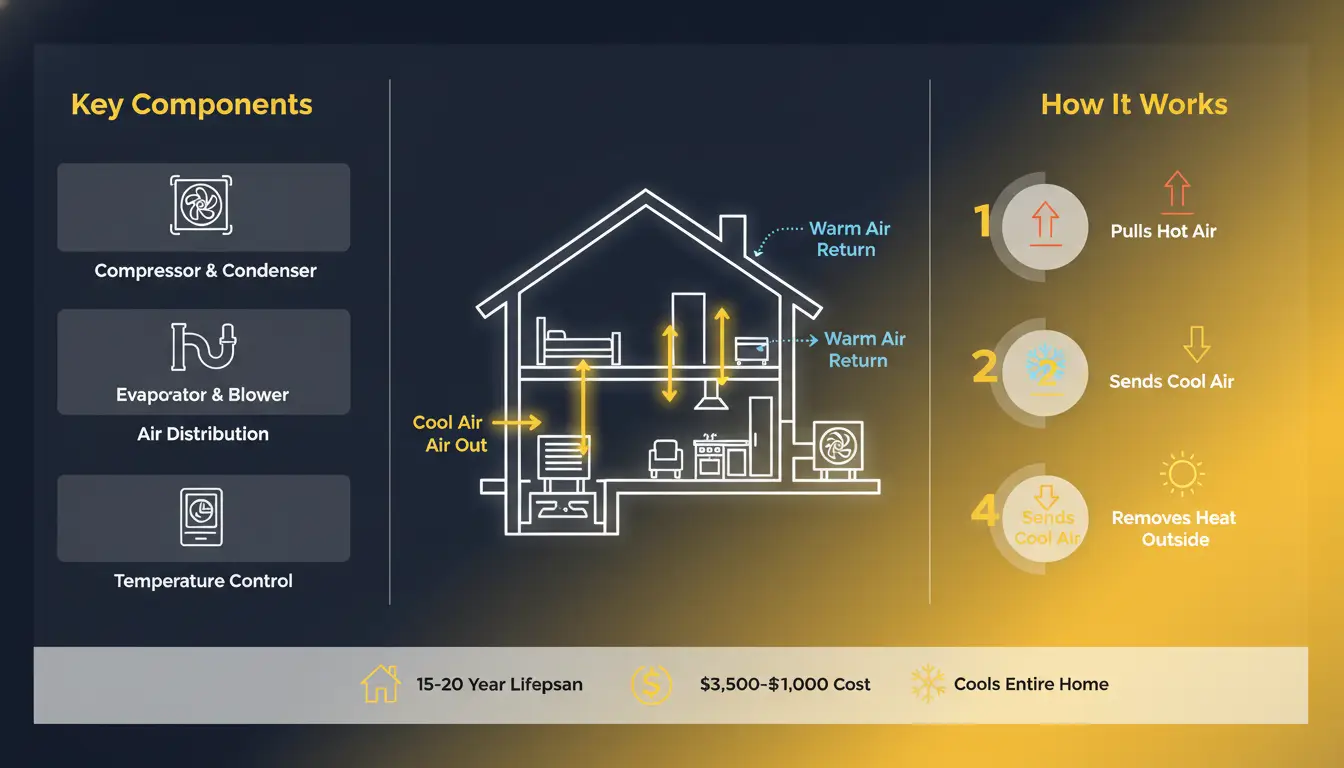
Step 1: Taking Out Hot Air: The system pulls warm air from your rooms through special openings called return vents. You might have seen these on your walls or ceiling.
Step 2: Making the air cold: The hot air goes to a special part called the evaporator coil. This coil is very cold. When hot air touches it, the air becomes cool. It’s like when you hold an ice cube, and your hand gets cold!
Step 3: Sending Cool Air Back: A big fan called a blower pushes the cool air back into your rooms through different vents. These are called supply vents.
Step 4: Getting Rid of Heat: The heat that was taken from your house needs to go somewhere. It goes to a unit outside your house. This outdoor unit blows the hot air outside. That’s why you feel warm air near the outdoor unit!

Bonus: Taking Out Wetness: Central air also removes moisture from the air. This makes your home less sticky and more comfortable. The water drips outside through a small pipe.
Key Components of a Central Air Conditioner
Central air has several important parts. Let’s learn about each one:
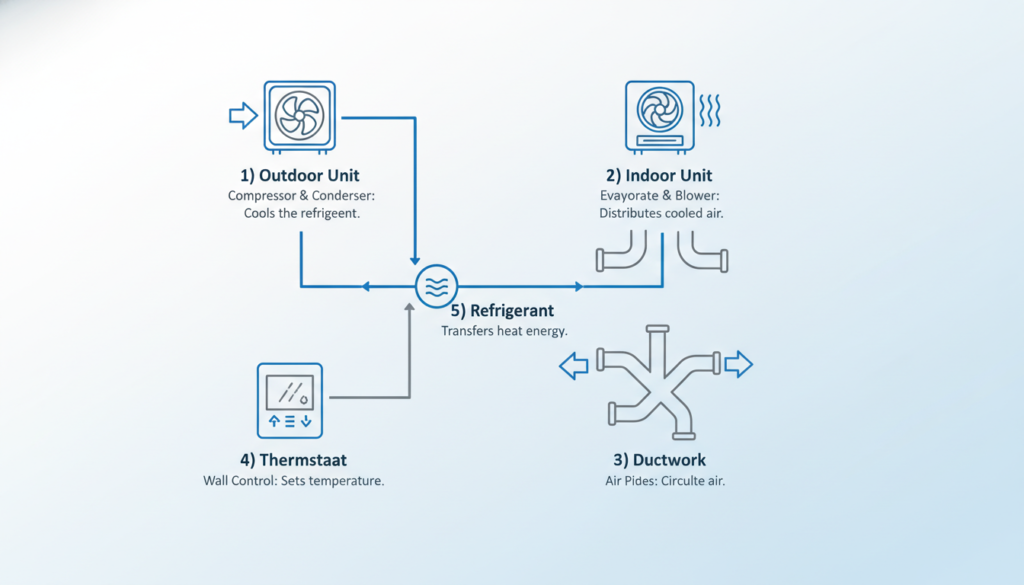
Outdoor Unit: This is the big box you see outside your house. Inside it has:
- A compressor (squeezes special cooling liquid)
- A condenser coil (releases heat outside)
- A fan (blows hot air away)
Indoor Unit: This part is usually in your basement, attic, or a closet. It has:
- An evaporator coil (makes air cold)
- A blower (pushes cool air to rooms)
Ductwork: These are like big tubes hidden in your walls and ceiling. They carry air to every room. Some ducts bring cool air (supply ducts). Other ducts take warm air back (return ducts).
Thermostat: This is the small screen on your wall where you set the temperature. It tells the system when to turn on and off. Some new ones are smart and learn when you want your house to be cool!
Refrigerant: This is a special liquid that moves between the indoor and outdoor units. It picks up heat from inside your house and carries it outside. Think of it as a heat carrier!
Types of Central Air Conditioning Systems
There are different types of central air systems. Let’s look at the main ones:
Split System (Most Popular): This is what most homes have. It has two parts – one inside your house and one outside. They work together to cool your home. About 75% of homes use this type!
Best for: Houses with space inside for the indoor unit and a yard for the outdoor unit.
Packaged System: This type has everything in one big box. The whole system sits outside your house, usually on the roof or on a concrete pad on the ground.
Best for: Homes without much indoor space, or commercial buildings.
Heat Pump Systems: This is a special type that can cool your house in summer AND heat it in winter! It’s like getting two machines in one. Heat pumps are becoming very popular because they save energy and money.

Best for: Places with mild winters and people who want one system for all year.
Benefits of Central Air Conditioning
Why do people love central air? Here are the top reasons:
- Every Room Stays Cool: Unlike a window unit, central air cools your whole house evenly. Your bedroom won’t be freezing while your kitchen is hot!
- Cleaner Air: Central air has filters that catch dust, pollen, and other tiny particles. This means you breathe cleaner air. This is great for people with allergies!
- Less Noise: The noisy parts are outside or in the basement. Your rooms stay quiet. You can sleep, work, or watch TV without loud buzzing sounds.
- Saves Energy for Big Homes: If you have a large house, one central air system uses less electricity than putting window units in every room.
- Removes Humidity. Central air takes moisture out of the air. This makes hot days feel less sticky and uncomfortable. You’ll feel cooler even at higher temperatures!
- Increases Home Value: Homes with central air are worth more money. If you ever sell your house, buyers will be happy to see you have it.
- Looks Better: No bulky window units blocking your view! Everything is hidden except for small vents on your walls or ceiling.
Central Air vs. Other Cooling Options
How does central air compare to other ways to cool your home? Let’s see:
Central Air vs. Window Units
- Window units cool only one room. Central air cools the whole house.
- Window units are cheaper to buy but cost more to run if you need many of them.
- Window units are noisy. Central air is quiet.
- Window units block windows. Central air doesn’t.
Central Air vs. Ductless Mini-Splits
- Mini-splits don’t need ducts. Central air does.
- Mini-splits are good for adding cooling to one or two rooms. Central air is better for whole-home cooling.
- Mini-splits cost less if you don’t have ducts already.
Central Air vs. Portable AC Units
- Portable units need to be moved around. Central air is permanent.
- Portable units cool small spaces. Central air cools everything.
- Portable units are the cheapest to buy but the most expensive to run.
The Winner? For most whole homes, central air conditioning is the best choice!
Installation and Location Considerations
Installing central air is a big job. Here’s what you need to know:
You need a Professional Central air installation is not a do-it-yourself project. You need trained HVAC technicians. They make sure everything is safe and works correctly. If you’re in the Acadiana area, Fontenot’s AC provides professional AC installation services with certified technicians.
Indoor Unit Location: The indoor unit usually goes in:
- Basement (most common)
- Attic (second choice)
- Large closet or utility room
It needs to be central to your home so air can reach all rooms easily.
Outdoor Unit Location: The outdoor unit should be:
- On a flat, level surface
- Away from bedrooms (it makes some noise)
- In a shady spot, if possible (helps it work better)
- At least 2-3 feet away from walls and plants
- Easy to reach for maintenance
Ductwork Needs: If your home doesn’t have ducts, they need to be installed. This is the most expensive part! Ducts are usually installed:
- In the attic
- Under the floor
- Inside walls (for new construction)
How Long Does Installation Take?
- If you have ducts: 1-2 days
- If you need new ducts: 3-5 days or more
Choosing or Upgrading Your Central Air Conditioner
Picking the right central air system is important. Here’s how to choose:
Size Matters (Tonnage): Central air is measured in “tons.” This doesn’t mean weight! It means cooling power.
- Small homes (under 1,200 sq ft): 1.5-2 tons
- Medium homes (1,200-1,800 sq ft): 2-3 tons
- Large homes (1,800-2,500 sq ft): 3-4 tons
- Very large homes (over 2,500 sq ft): 4-5 tons
Too small won’t cool well. Too big wastes energy and doesn’t remove humidity properly. Get a professional to measure your home!
SEER Rating (Energy Efficiency): SEER stands for Seasonal Energy Efficiency Ratio. Higher numbers mean better efficiency and lower electric bills.
- Basic systems: 13-14 SEER
- Good systems: 15-16 SEER
- Great systems: 17-20 SEER
- Top systems: 20+ SEER
New systems must be at least 14 SEER in northern states and 15 SEER in southern states.
Budget Considerations: Think about two costs:
- Upfront cost: What you pay to buy and install it
- Running cost: Your monthly electric bills
A cheaper system costs less now but more to run. A more efficient system costs more now but less to run. Over 15 years, the efficient system usually saves you money!
Climate Factors:
- Hot, humid places: Get a system good at removing moisture
- Very hot places: Get a higher SEER rating to save on cooling costs
- Mild climates: Consider a heat pump for heating and cooling
Brand and Warranty: Look for brands known for reliability. Good brands include Carrier, Trane, Lennox, Rheem, and Goodman. Check the warranty:
- Parts warranty: Usually 5-10 years
- Compressor warranty: Often 10 years
- Labor warranty: 1-2 years (sometimes extra cost)
How Much Does Central Air Conditioning Cost?

Let’s talk about money. Here are the costs for 2026:
Installation Costs
- Basic system: $3,500 – $5,500
- Mid-range system: $5,500 – $8,000
- High-efficiency system: $8,000 – $12,000
- Premium system: $12,000 – $15,000+
What Affects the Price?
- Size of your home (bigger = more expensive)
- If you need new ducts (adds $3,000-$7,000)
- System efficiency (higher SEER costs more)
- Your location (cities cost more than small towns).Your location affects pricing too. For homeowners in Youngsville and surrounding areas, Fontenot’s AC offers competitive pricing with transparent quotes and no hidden fees.
- Difficulty of installation
Operating Costs: Running central air costs about $150-$500 per month in summer, depending on:
- How hot it is outside
- How cool you keep your house
- How efficient your system is
- Your electricity rates
- How well your home is insulated
Maintenance Costs:
- New filter every 1-3 months: $5-$30 each
- Annual professional checkup: $75-$200
- Occasional repairs: $150-$500 on average
Is It Worth the Money? For most homes, yes! You get comfort, clean air, and the value of your home goes up by about 50% of what you spent.
Central Air Conditioning Maintenance and Lifespan
Taking care of your central air helps it last longer and work better.

How Long Does It Last? A well-maintained central air system lasts 15-20 years. Some last even longer! The outdoor unit usually needs replacing first.
Monthly Maintenance (You Can Do This!): Check and change your air filter. Dirty filters make your system work harder and waste energy.
- If you have pets: Change monthly
- Regular homes: Change every 2-3 months
- High-efficiency filters: Follow package directions
Annual Professional Maintenance: Once a year (before summer), have an HVAC technician:
- Clean the outdoor coils
- Check refrigerant levels
- Test all parts
- Clean the drain line
- Tighten electrical connections
- Measure system performance
This costs $75-$200 but prevents expensive repairs! It’s like taking your car for an oil change. Fontenot’s AC offers comprehensive HVAC maintenance plans to keep your system running efficiently year-round.
Seasonal Checks In spring, before you start using it:
- Clear leaves and debris from the outdoor unit
- Make sure there’s 2 feet of clear space around it
- Check that all vents inside are open and not blocked
- Test the thermostat
Signs Your System Needs Replacement: Replace your central air if:
- It’s more than 15 years old
- It needs frequent repairs (more than 2-3 times a year)
- Your energy bills keep going up
- Some rooms never get cool
- It makes loud, strange noises
- Repair costs are more than half the cost of a new system
If you notice any of these warning signs, don’t wait until your system breaks down completely. Fontenot’s AC provides fast and reliable AC repair services throughout Broussard, Lafayette, and surrounding areas.
Energy Efficiency Tips for Central Air
Saving energy not only reduces your bills but also extends your system’s lifespan. Fontenot’s AC specializes in energy-efficient HVAC solutions for Acadiana homeowners. Want to save money on your cooling bills? Try these easy tips:
Set Your Thermostat Smart
- Keep it at 78°F when you’re home (this is the sweet spot!)
- Raise it to 82-85°F when you’re away
- Every degree higher saves about 3% on cooling costs
- Use a programmable thermostat to do this automatically
Use a Smart Thermostat: Smart thermostats learn your schedule. They cool your house before you get home and save energy when you’re away. They can cut cooling costs by 10-20%!
Keep Your Home Sealed:
- Close windows and doors when the AC is running
- Seal cracks around windows and doors
- Add weatherstripping to old doors
- Insulate your attic (this is huge for savings!)
Change Filters Regularly: Dirty filters make your system work harder. Remember: clean filter = lower bills!
Give Your Outdoor Unit Shade: If possible, plant a tree or bush to shade the outdoor unit. Keep it 2-3 feet away, though! A shaded unit works 10% better.
Use Ceiling Fans: Fans make you feel 3-4 degrees cooler. This means you can set your thermostat higher. Run fans only when people are in the room.
Close Vents in Unused Rooms: If you don’t use a guest room, close the vent. This sends more cool air to rooms you actually use. Don’t close more than 20% of vents, though!
Keep Heat-Producing Appliances Off: Ovens, dryers, and dishwashers make heat. Use them in the early morning or evening when it’s cooler outside.
Close Blinds and curtains: Sunlight coming through the windows heats your home. Close curtains during the hottest part of the day, especially on south and west-facing windows.
Don’t Block Vents: Make sure furniture, curtains, or toys don’t cover vents. Air needs to flow freely!
Is Central Air Worth It for Your Home?
Should you get central air? Let’s figure it out:
Central Air Makes Sense If:
- You have a medium to large home (over 1,200 square feet)
- You already have ductwork
- Multiple people live in your home
- If you live in hot climates like Acadiana, central air is almost essential for comfortable living. Fontenot’s AC has been serving Broussard homeowners with reliable cooling solutions for years.
- You plan to stay in your home for many years
- You can afford the upfront cost
- Comfort is important to you
Consider Alternatives If:
- You have a small home or apartment
- You don’t have ducts (and don’t want to add them)
- You only need to cool one or two rooms
- You’re renting
- You’re on a tight budget
- Your climate is mild
Homes Without Existing Ductwork: Adding ducts costs $3,000-$7,000 extra. If your home doesn’t have ducts, consider:
- Ductless mini-split systems (good for 1-4 rooms)
- Window units (cheapest but less comfortable)
- Portable units (easy but not efficient)
- Adding ducts if you plan to stay for many years
Cost-Benefit Analysis: Let’s say you spend $7,000 on central air:
- Your home value increases by $3,500-$5,000
- You save $50-$150/month vs. running multiple window units
- You get better comfort and air quality
- System lasts 15-20 years
Over 15 years, central air often costs about the same as using multiple window units, but gives you way better comfort!
Frequently Asked Questions About Central Air Conditioning
-
Is it OK for central AC to run all day?
Yes, it’s fine! Central air is designed to run as long as needed to keep your home cool. On very hot days, it might run for hours or all day. This is normal. If it NEVER shuts off, even at night, that might mean:
1. Your system is too small
2. Your home isn’t insulated well
3. You have air leaks
4. The system needs service -
What’s the difference between AC and central air?
“AC” means air conditioning in general. It includes window units, portable units, and central air. “Central air” is a specific type of AC that cools your whole house from one main system. So all central air is AC, but not all AC is central air!
-
Is central air cheaper than multiple-room units?
For whole-home cooling, yes! Running 3-4 window units costs more in electricity than one central air system. But window units cost less to buy upfront. If you only need to cool 1-2 rooms, window units are cheaper.
-
Can you add central air to an older home?
Yes! Many older homes get central air added later. The hard part is adding ductwork if your home doesn’t have it. An HVAC company can tell you if it’s possible and how much it will cost.
-
How does central air work in apartments and multi-family buildings?
Some apartments have their own central air system. Others have a big system that cools the whole building (this is less common). Many apartments just have window units or no cooling at all. If you rent, ask your landlord what cooling options you have.
-
Does central air increase home value?
Yes! Homes with central air sell for more money. You usually get back about 50-70% of what you spent on installation when you sell. In hot climates, homes without AC are very hard to sell!
Next Steps: Getting Central Air Installation
Ready to get central air? Here’s what to do:
Step 1: Find Qualified HVAC Contractors– Look for contractors who are:
- Licensed and insured
- Certified by NATE (North American Technician Excellence)
- Have good reviews online
- Have been in business for at least 5 years
Ask friends and neighbors who they used. If you’re in Lafayette, Fontenot’s AC is a trusted local HVAC contractor with years of experience and excellent customer reviews.
Step 2: Get Multiple Quotes– Get at least 3 quotes. This helps you:
- Compare prices
- See what’s normal in your area
- Spot any red flags (super low or super high prices)
- Get different opinions on what size you need
Step 3: Ask Important Questions– When talking to contractors, ask:
- What size system do I need and why?
- What SEER rating do you recommend?
- What brand and model are you proposing?
- What’s included in the price?
- How long will installation take?
- What’s the warranty?
- Do you do the work or hire subcontractors?
- Can I see proof of license and insurance?
- Do you offer financing?
Step 4: Check the Contract– Before signing, make sure the contract includes:
- Total price with no hidden fees
- System model numbers
- Installation timeline
- Warranty information
- Payment schedule (never pay everything upfront!)
- Who’s responsible if something goes wrong
Step 5: Timeline Expectations
- Getting quotes: 1-2 weeks
- Ordering equipment: 1-2 weeks (sometimes longer)
- Installation: 1-5 days, depending on complexity
- Best time to install: Spring or fall (contractors are less busy)
Step 6: Permits and Regulations– Most areas require permits for central air installation. Your contractor should:
- Get the permit (it’s usually included in their price)
- Make sure everything meets local building codes
- Have the work inspected if required
Final Tips
- Don’t always pick the cheapest quote – quality matters!
- Read reviews of the contractor
- Make sure you understand the warranty
- Ask about maintenance plans
- Keep all paperwork in a safe place
Conclusion
Central air conditioning is a wonderful way to keep your entire home cool and comfortable. It works by taking hot air from your rooms, making it cold, and sending it back. The main parts are an outdoor unit, an indoor unit, ductwork, and a thermostat.
There are different types – split systems (most common), packaged systems, and heat pumps. The benefits include cooling your whole house evenly, cleaner air, less noise, and adding value to your home.
Installing central air costs between $3,500 and $15,000, depending on your home and the system you choose. It lasts 15-20 years with proper care. Simple maintenance, like changing filters and annual checkups, helps it work better and last longer.
Whether central air is right for you depends on your home size, budget, and cooling needs. For most homes, it’s a great investment that pays off in comfort and convenience! Ready to install, repair, or maintain your central air system? Contact Fontenot’s AC today for expert service you can trust. We’re here to keep your home comfortable all year long!
FAQ Answers
What’s the difference between AC and central air?
AC (air conditioning) is a general term for any cooling system – window units, portable ACs, mini-splits, and central air.
Central air is one specific type of AC that cools your entire home from one central location using ducts.
Think of it this way: AC is like saying “vehicle.” Central air is like saying “SUV” – it’s one specific type.
Key Differences:
Central Air:
1. Cools whole house
2. Uses hidden ducts
3. One thermostat
4. Costs $3,500-$15,000
5. Quieter
6. Better for large homes
Other AC (Window/Portable):
1. Cools one room
2. Sits in window or floor
3. Cheaper ($150-$500)
4. DIY install
5. Noisier
6. Better for small spaces
What is the disadvantage of a central air conditioning system?
1. Expensive to Install Costs $3,500-$15,000. Adding ducts costs $3,000-$7,000 more.
2. Higher Energy Bills Cools entire house even if you only use a few rooms. Bills can be $150-$500/month in summer.
3. Needs Professional Help Can’t install yourself. Must hire HVAC technicians.
4. Requires Ducts If your home doesn’t have ducts, installation is difficult and expensive.
5. Regular Maintenance Must change filters monthly and get yearly professional checkups.
6. Can’t Move It Stays with the house. You can’t take it when you move.
7. Expensive Repairs Fixing problems costs $150-$1,500. Major parts cost even more.
8. Takes Up Space Needs room for indoor unit (basement/attic) and outdoor unit (yard).
Despite these downsides, most homeowners think the comfort is worth it!
How do I know if I have central air?
Easy Ways to Tell:
1. Look for Vents Check your walls, ceiling, or floor for rectangular metal grates in multiple rooms. These blow cool air.
2. Find the Outdoor Unit Go outside. Look for a large metal box (2-3 feet wide) sitting on concrete near your house. Has a fan on top.
3. Check Your Thermostat Does it have a “COOL” button or snowflake symbol? If yes and you don’t see window units, you have central air.
4. Check Basement/Attic Look for a large metal cabinet with pipes. This is the indoor unit.
5. No Window Units If your whole house gets cool but no AC units are in windows, you have central air.
6. Feel the Vents Put your hand near wall vents. Feel air blowing out when cooling? That’s central air.
7. Still unsure? Ask your landlord or call an HVAC company for a free inspection!
What is the meaning of central air conditioning?
Simple Definition: Central air conditioning is one main cooling system that cools your entire home from a central location.
Breaking It Down:
1. Central = From one main place
2. Air Conditioning = Cooling air to make rooms comfortable
3. Together = One system cooling your whole house
Why “Central”?
1. Controlled from one thermostat
2. Equipment in one location (basement/attic)
3. Distributes cool air from this central point to all rooms
What Makes It Different:
1. Cools your whole house, not just one room
2. Uses hidden ducts in walls and ceiling
3. One control for entire home
4. Built-in, not portable
In Simple Terms: When you say “I have central air,” you mean your house has a built-in system that keeps every room cool from one control point – no need for separate units in each room!
Example: “Our house has central air conditioning, so we stay cool everywhere without needing window units.”