
When Is the Best Time to Install a New AC in Louisiana?
Search
Recent Posts

Tags
Follow Us on
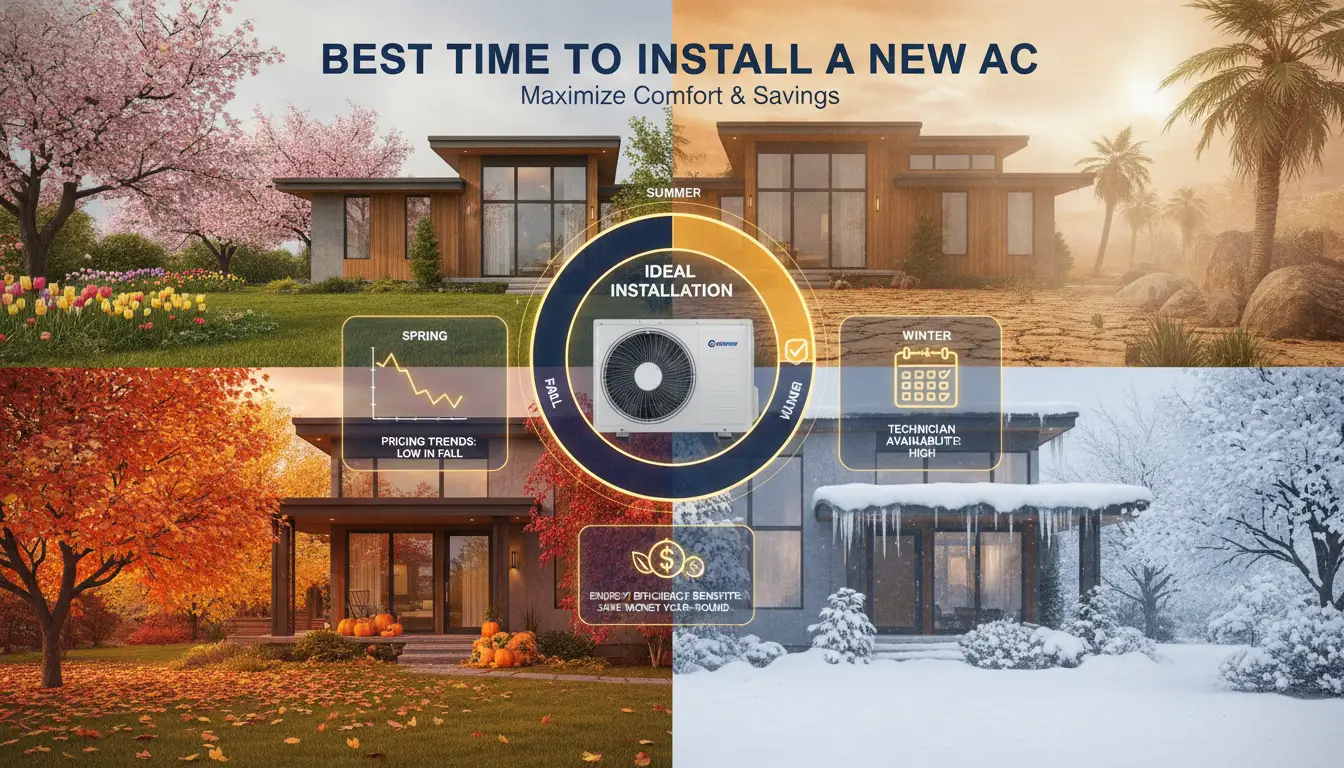
The best time to install a new AC in Louisiana is fall (October through November) or early spring (February through March). Demand for HVAC contractors drops sharply in these shoulder seasons. As a result, you get faster scheduling, lower labor costs, and better access to manufacturer rebates. Summer is consistently the worst season for AC replacement in Louisiana.
Key Takeaways
- Fall (October-November) is the single best window for AC installation in Louisiana — contractors have open schedules, and costs are typically lower.
- Spring (February-March) is the second-best option; book at least 4-6 weeks before the heat arrives.
- Summer installations in Louisiana often mean longer wait times, rushed jobs, and potentially higher prices due to peak demand.
- Louisiana’s long cooling season and high humidity shorten AC lifespans — the average system lasts 12-15 years here, not the national 15-20 year estimate.
- If your AC is over 10 years old and needs a repair costing more than 50% of a new system’s price, replacement is almost always the smarter move.
Your AC just limped through another Louisiana summer, and you already know it will not survive the next one. You have two choices: wait until it dies on a 98-degree August afternoon, or make a plan now while you still have options. The timing of your AC installation matters more than most homeowners realize. It affects your cost, your wait time, and your stress level.
Louisiana’s climate does not follow national HVAC norms. Our cooling season runs roughly nine months. Humidity levels stay punishing even in October. That means HVAC contractors here see demand patterns unlike anywhere else in the country. Knowing those patterns gives you a real financial advantage.
In this article, you will learn exactly which months offer the best conditions for AC replacement in Louisiana, how far in advance to schedule, what to watch for with your aging system, and how to decide between repair and replacement. By the end, you will have a clear, confident plan.
Why Does Timing Matter When Replacing an AC System?
Timing your AC installation around contractor demand cycles can save you hundreds of dollars and weeks of waiting. Most homeowners do not think about replacement until their system fails. At that point, they have zero leverage. They take the first available contractor at whatever price is quoted. Planning even one season ahead changes everything.
Does Off-Peak Installation Really Lower Your Costs?
Yes, and the difference is meaningful. HVAC contractors across Lafayette and the surrounding areas run leaner schedules from October through February. Competition for bookings is lower. Some contractors offer seasonal discounts or promotions to fill their calendars.
According to the U.S. Department of Energy, heating and cooling account for nearly 50% of a home’s total energy use. A system sized and installed correctly from the start, without the rush of peak demand, delivers better long-term efficiency (source: energy.gov).
Is Contractor Availability Better in the Off-Season?
Significantly better. During summer in Louisiana, contractors are fully booked weeks out. In fall or early spring, you can often get a quote, a site visit, and an installation scheduled within the same week. That flexibility lets you plan around your schedule, not theirs.
Are There More Rebates and Promotions in Certain Seasons?
Fall and late winter are prime windows for manufacturer promotions and utility rebates on high-efficiency systems. Entergy Louisiana, for example, has offered rebates on qualifying ENERGY STAR equipment at various points throughout the year. Off-season timing aligns well with these programs.
Does Off-Season Scheduling Give You More Flexibility?
Absolutely. When a contractor is not juggling 10 emergency calls per day, your installation gets more attention. The technician takes time to do the load calculation correctly, verifies ductwork condition, and tests the system thoroughly before leaving. That quality difference shows up in your energy bills.
Now that you understand why timing matters, here is what the calendar actually looks like for Louisiana homeowners.
What Are the Best Seasons to Install a New AC in Louisiana?
Fall is the single best season for AC installation in Louisiana, followed closely by early spring. Both windows share the same advantages: lower contractor demand, better pricing opportunities, and enough lead time to avoid the summer crunch. Here is how each season plays out.
Why Is Fall the Best Time for AC Installation?
October and November hit a sweet spot for Louisiana homeowners. The brutal summer demand has passed. Contractors who spent June through September running emergency calls now have breathing room. You benefit from:
- Faster scheduling, often within 5-10 business days
- More attention to detail during installation (no rush, no backlog pressure)
- Seasonal promotions from manufacturers and distributors
- Enough time to identify any issues before the following spring
Think of it this way: replacing your AC in October is like buying a snow blower in July. You are shopping when everyone else is not, and that puts you in a stronger position.
Why Is Spring the Second-Best Time for AC Installation?
February and March work well for homeowners who missed the fall window. Demand has not yet spiked. You can still book quickly and negotiate reasonable pricing. One caution: the closer you push toward April, the tighter contractor schedules become.
A spring installation also gives your new system time to run through a full commissioning cycle before summer hits. Any minor calibration issues get caught early, not on the hottest day of the year.
Is Winter a Good Time to Install a New AC in Louisiana?
December and January are acceptable times in Louisiana, with one consideration. While contractor availability is good, some equipment shipments slow down around the holidays. If you go this route, book in early December before the holiday slowdown hits distributor networks.
With the best windows clear, the next step is understanding why summer is the season to avoid.
Why Is Summer Usually the Worst Time to Replace an AC in Louisiana?
Summer AC replacement in Louisiana means higher demand, longer wait times, and less contractor flexibility. This is not speculation. Every HVAC company in the Lafayette area sees its busiest call volume from May through September. When your system fails in July, you are competing with dozens of other homeowners for the same technicians.
How Does Increased Demand Affect HVAC Services in Summer?
HVAC companies in Louisiana receive a surge of calls starting in late April. By June, most reputable contractors are booking 10-21 days out for non-emergency installs. Emergency repair calls get priority, which pushes non-emergency replacement jobs even further down the queue.
How Much Longer Are Wait Times in Summer?
In fall or winter, you might schedule a full replacement within a week. In summer, that same job can take three to four weeks if you are not in emergency mode. Every day you wait in the July heat without a working AC creates both physical discomfort and financial pressure to accept the first quote you receive.
What Happens With Emergency Replacement in Summer?
When your AC dies in August, and you have no backup cooling, everything changes. You are under pressure. You may accept a contractor who is not the right fit, a system that is not properly sized, or a rushed installation. Emergency replacements also tend to skip the careful load calculation step, which leads to undersized or oversized systems that cost more to operate.
Are Summer Installation Costs Actually Higher?
Not every contractor raises prices in summer, but the competitive pressure you would have in fall disappears. You are less likely to negotiate, less likely to compare quotes carefully, and less likely to benefit from promotional pricing. The net result is that most homeowners pay more when they wait until summer, even if the published rates look similar.
How Far in Advance Should You Schedule an AC Installation?
For a fall installation, begin planning in August or September. For spring, start in December or January. Getting ahead of the rush by 6-8 weeks gives you time to gather quotes, choose the right system, and book a slot without pressure.
What Does Planning for a Fall Installation Look Like?
Here is a practical timeline for a fall installation:
- August or early September: Request quotes from two or three licensed HVAC contractors
- Mid-September: Review quotes, compare system options, and confirm financing if needed
- Late September or early October: Book your installation date
- October or November: Installation day, system testing, and review of warranty documentation
What Does Planning for a Spring Installation Look Like?
Spring moves faster, so the timeline is tighter:
- December or January: Get quotes and assess your current system’s condition
- Late January or early February: Select a contractor and system
- February or early March: Complete the installation before April demand picks up
What Factors Affect Scheduling Timelines?
Several factors can extend your timeline beyond the typical window:
- Equipment availability: High-efficiency systems or specific brands may require 2-4 weeks for delivery
- Ductwork condition: If ductwork needs repair or replacement, add 1-2 days to the job
- Permit requirements: Most Louisiana HVAC installations require a permit; allow 3-5 business days for processing
- Financing approval: If using a financing plan, start that process early to avoid delays
How Does Louisiana’s Climate Affect AC Installation Timing?
Louisiana’s climate creates HVAC challenges that most national guides do not address. This state runs hotter longer, stays more humid, and faces storm season risks that directly influence when and how you should replace your AC.
How Does Louisiana’s Long Cooling Season Change the Math?
Most of the U.S. runs its AC from June to August. Louisiana homeowners run their systems from April through October, sometimes longer. That extended run time means more wear cycles per year. A system that lasts 15 years in Minnesota may only last 12 in Lafayette.
How Does High Humidity Stress Your AC System?
Louisiana’s average relative humidity sits between 75% and 90% during the warmer months. Your AC does not just cool the air. It also pulls moisture out of it. That dehumidification work adds strain to the system’s compressor and coils. Over time, this humidity load accelerates wear on components that would last longer in a drier climate.
What Do Hurricane Season Considerations Mean for Timing?
Hurricane season runs from June through November, with peak activity in August and September. If you are planning a fall installation, aim for October or November after the active storm window passes. Installing a new system right before a major storm creates exposure: equipment can be damaged, and your new warranty may have exclusions for storm-related issues.
From a timing standpoint, late October is the sweet spot: past the storm window, still ahead of the holiday slowdown.
How Does Louisiana’s Climate Shorten AC Lifespan?
The combination of long cooling seasons, high humidity, and occasional storm damage means Louisiana ACs typically cycle through more total operating hours than systems in northern states. According to the Environmental Protection Agency, proper maintenance can extend system life, but climate factors in the Gulf South are genuinely harder on equipment (source: EPA.gov).
How Long Do AC Systems Typically Last in Louisiana?
In Louisiana, most central AC systems last 12 to 15 years under regular maintenance. The national average estimate of 15 to 20 years applies in cooler, drier climates. Louisiana homeowners should plan for the shorter end of that range.
What Is the Average AC Lifespan?
A central air conditioning system in Louisiana typically runs strong for 10 to 12 years before efficiency starts to decline. By year 14 or 15, most systems need increasingly frequent repairs. By year 17 or 18, replacement is almost always more cost-effective than continued repair.
What Factors Affect System Longevity?
Several variables determine whether your system hits the high end or low end of its lifespan:
- Annual maintenance: Systems that receive professional tune-ups each year last noticeably longer
- Filter changes: A clogged filter forces the system to overwork; change filters every 1-3 months in Louisiana
- Installation quality: A properly sized and installed system from the start outlasts a rushed or improperly sized one
- Refrigerant levels: Chronically low refrigerant stresses the compressor faster than any other single factor
- Coil condition: Dirty evaporator or condenser coils reduce efficiency and accelerate wear
What Are the Signs Your System Is Near the End of Its Life?
Your system will give you warnings before it completely fails. The key is recognizing them early enough to plan on your timeline, not in a crisis.
The next section covers those warning signs in detail.
What Are the Signs It May Be Time to Replace Your AC?
The clearest sign your AC needs replacing is a pattern of problems, not a single incident. One repair over five years is normal. Three repairs in one summer is a pattern. Here are the most important signals to watch for.
How Frequent Is Too Frequent for AC Repairs?
If your system needed repairs twice in the past two years, and especially if those repairs involved the compressor or refrigerant lines, that pattern rarely reverses. Each repair costs money and adds more wear. Most HVAC technicians recommend the 5,000-rule: if the repair cost exceeds $5,000 and the system is more than 10 years old, replacement is typically the better financial decision.
Why Are Rising Energy Bills a Warning Sign?
A 10% to 20% rise in your electric bill during comparable cooling months, without any change in your usage habits, often signals declining system efficiency. As components wear, the system runs longer cycles to reach the same thermostat setting. That extra runtime shows directly on your Entergy bill.
What Does Poor Cooling Performance Tell You?
If your home struggles to reach the set temperature on a 90-degree day, your system is either undersized (a problem from installation) or losing capacity with age. In Louisiana, an AC system that cannot maintain 75 degrees on a typical summer afternoon is not performing adequately.
Why Do Uneven Temperatures Signal a Problem?
Hot spots in certain rooms, while others feel fine, often point to ductwork issues or a system that can no longer distribute conditioned air evenly. Sometimes duct sealing solves this. Other times, the system itself has lost the capacity to maintain balanced airflow throughout the home.
At What System Age Should You Start Planning Replacement?
If your system is 12 years old or older, start thinking about replacement timing now, even if it is still running. Proactive planning lets you install during a favorable season at a price you can research carefully. Waiting for failure locks you into a summer emergency replacement on someone else’s schedule.
The next question is whether you should repair or replace. Here is how to think through that decision clearly.
Should You Repair or Replace Your Existing AC?
The repair-versus-replace decision comes down to system age, repair cost, and whether the problem is likely to repeat. No single formula works for every situation, but a few clear principles apply consistently in Louisiana’s climate.
When Does Repairing Your AC Make Sense?
Repair is the right call when your system is under 8 years old, the repair cost is modest (under $1,000 for most single-component repairs), and the failure is isolated rather than a sign of system-wide decline. A failed capacitor on a five-year-old system does not mean you need a new AC.
When Is Replacement the Better Investment?
Replacement makes more sense when your system is 12 or more years old, when repair costs approach or exceed 50% of a new system’s price, or when the same component fails repeatedly. Replacing an aging compressor, for example, can cost $1,500 to $2,500 on a 14-year-old system that will likely need another major repair within two years.
How Do Repair Costs and Replacement Costs Compare?
This table gives you a general framework for the decision:
| Scenario | System Age | Repair Cost | Recommended Action |
| Capacitor or minor part failure | Under 8 years | Under $500 | Repair |
| Single major component (e.g., blower motor) | 8-12 years | $500-$1,200 | Repair, assess overall condition |
| Compressor failure | 10-14 years | $1,500-$2,500 | Replacement usually better |
| Multiple component failures | Any age | Over 50% of the new unit cost | Replacement |
| Refrigerant leak on the R-22 system | Any age | Varies | Replacement (R-22 no longer produced) |
How Do You Evaluate Long-Term Savings?
A modern high-efficiency system (16 SEER2 or higher) can reduce your cooling costs by 20% to 40% compared to an aging 10-SEER unit. Over a 15-year lifespan, those savings add up to a meaningful offset against the upfront replacement cost. Factor that into your decision alongside the repair quote.
Once you decide to move forward, here is what the installation process actually looks like.
What Should You Expect During an AC Installation?
A professional AC installation in a typical Louisiana home takes one to two days from start to finish. The process has four main phases, and each one matters for long-term system performance.
What Happens During the Home Evaluation and Load Calculation?
Before any equipment is ordered, a qualified technician should perform a Manual J load calculation. This calculation accounts for your home’s square footage, ceiling height, insulation level, window orientation, and Louisiana’s specific climate data. It determines the correct system size. A system that is too large will short-cycle, wasting energy and causing humidity problems. One that is too small will run constantly and never adequately cool your home.
How Is the Existing System Removed?
The technician disconnects and removes the old air handler and condenser unit. If the system uses R-22 refrigerant (an older refrigerant phased out under EPA regulations as of 2020), it must be properly recovered by a certified technician. This step is not optional and is required by federal law.
What Does the New Unit Installation and Testing Involve?
The new indoor air handler and outdoor condenser are mounted, leveled, and connected to your ductwork and refrigerant lines. The technician then charges the system to the manufacturer’s specifications and runs a full commissioning test. This includes checking static pressure, supply and return air temperatures, and thermostat calibration.
How Long Does a Typical Installation Take?
For a straightforward replacement of an existing system in a home with existing ductwork, most installations in Lafayette and the surrounding area take one full day. Add half a day if ductwork modifications are needed. Complex jobs, such as adding a second zone or replacing ductwork, may take two days.
Choosing the right system is just as important as timing the installation correctly.
How Do You Choose the Right AC System for a Louisiana Home?
The right AC system for Louisiana must handle high humidity, long run seasons, and extreme summer heat. Not every system sold nationally is well-suited for the Gulf South climate. Here is what to consider.
Are Central Air Conditioning Systems Still the Best Choice?
Central air conditioning remains the most common and practical choice for whole-home cooling in Louisiana. A split system, with an indoor air handler and an outdoor condenser, works well in homes with existing ductwork. Look for a minimum SEER2 rating of 15 for Louisiana’s climate; 16 or above delivers better efficiency meaningfully and often qualifies for rebates.
Are Heat Pumps a Good Fit for Louisiana Climates?
Heat pumps work exceptionally well in Louisiana. Because winters here are mild, heat pumps can provide both heating and cooling efficiently without needing a separate furnace. A modern heat pump rated at 16 SEER2 or higher will handle Louisiana winters without needing supplemental heat on most days. If you currently have a gas furnace, a heat pump can be a strong long-term upgrade depending on your energy costs.
What Energy-Efficient Options Are Worth Considering?
Variable-speed systems, also called inverter-driven compressors, are worth considering in Louisiana. Unlike single-stage systems that run at full capacity or off, variable-speed units modulate their output based on demand. In Louisiana’s humid climate, this means the system runs at lower capacity for longer periods, which is far better at removing humidity than short, high-power bursts.
Why Does Proper System Sizing Matter for Efficiency?
Oversizing is the most common mistake in Louisiana AC installations. Contractors sometimes default to bigger units, assuming more capacity means more cooling. In reality, an oversized unit cools the air quickly but shuts off before it can pull adequate humidity out of the air. You end up with a cool but clammy home, and the short cycles cause faster compressor wear. Always insist on a Manual J calculation before accepting any equipment recommendation.
The right system, installed at the right time, by the right contractor, is the combination that pays off over a Louisiana lifetime.
Conclusion
The best time to install a new AC in Louisiana is during the fall shoulder season, specifically October and November, or in early spring before demand picks up in April. Both windows give you access to better contractor availability, more competitive pricing, and the time to make a careful, informed decision rather than a rushed one. Louisiana’s climate makes timing even more important than it is elsewhere in the country.
If your system is 12 years or older, showing signs of declining performance, or requiring repeated repairs, now is the time to plan. You do not need to wait for a complete failure. A proactive replacement in the right season costs less, delivers better results, and removes the risk of a summer emergency. Every season you delay when the signals are already there is a season of extra repair costs and higher energy bills.
At Fontenot Air Conditioning & Heating, we have installed and serviced AC systems across Lafayette, Broussard, Scott, Youngsville, Carencro, Maurice, and Milton for over 15 years. We know how Louisiana’s climate affects your equipment, and we will help you choose the right system at the right time. Schedule a free AC replacement consultation today, or call us now for a same-day HVAC assessment. We make it easy to get ahead of the heat on your schedule.
Frequently Asked Questions
How much money can I save by installing an AC in the fall versus the summer?
While savings vary by contractor, fall installations often come with promotional pricing and manufacturer rebates not available during peak season. More importantly, you avoid the rush pricing that happens when contractors are overbooked. Homeowners in Lafayette who plan ahead typically get 2-3 competitive quotes, which drives down the final price.
Can my AC system be installed in one day?
In most cases, yes. A standard split-system replacement in a home with existing ductwork takes one full day for a qualified crew. If your ductwork needs modifications or if the job involves adding a second system or zone, expect one and a half to two days. Your contractor should give you a firm timeline before the installation date.
What SEER rating should I look for in Louisiana?
For Louisiana’s climate, a minimum of 15 SEER2 is recommended. A 16 SEER2 or higher system provides meaningfully better efficiency and often qualifies for Entergy Louisiana rebates or federal tax credits available through the Inflation Reduction Act. Higher SEER2 systems cost more upfront but typically pay back the difference within 3-5 years in energy savings.
Is it safe to install an AC right before hurricane season?
If you install between February and April, you are well ahead of hurricane season (June through November). Avoid scheduling installations during August or September, the peak storm months. If you choose a fall installation, October and November offer the best combination of low contractor demand and minimal storm risk.
What happens if my AC fails completely during the summer? Do I have any options?
You do. Emergency replacements are available, but they come with higher urgency fees and longer wait times. A window unit can provide temporary cooling while you wait for a proper installation. If you are in this situation, call early in the morning when contractors first open. Afternoons during summer are when most emergency calls come in, and scheduling is hardest.
How do I know if my AC is properly sized for my home?
Ask your contractor to perform a Manual J load calculation before recommending any equipment. This is an industry-standard calculation that accounts for your home’s square footage, insulation, windows, and local climate. Any reputable contractor should provide this as part of the quoting process. If a contractor recommends equipment without a load calculation, that is a warning sign.