
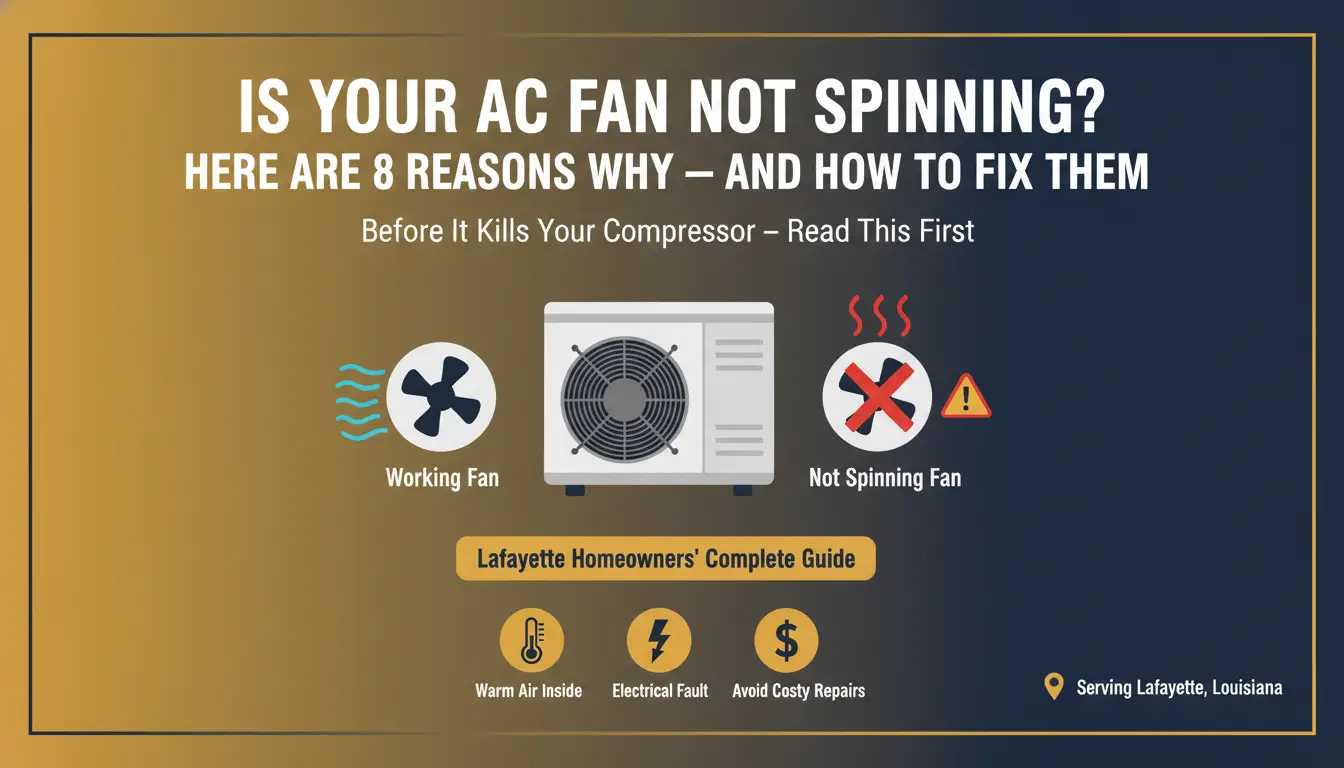
It is the middle of summer in Lafayette, and your AC is running, but something feels off. The air coming out is warm, or nothing is coming out at all. You walk outside and notice the outdoor unit is on, but the fan is just sitting there, not moving. Sound familiar?
An AC fan not spinning is one of the most common air conditioning problems homeowners in Lafayette deal with. The good news is that not every cause requires a big repair bill. Some fixes are simple. Others need a professional. Either way, knowing what is wrong is the first step.
In this guide, we will walk you through the 8 most common reasons your AC fan stopped spinning, what each one means, and what you can do about it. This article is part of our complete AC Problems guide, where we cover everything from cooling issues to electrical faults.
Quick Answer: Why Is Your AC Fan Not Spinning?
An AC fan not spinning is most commonly caused by a faulty capacitor, a tripped circuit breaker, or a burnt-out fan motor. Other causes include debris blocking the fan blades, a bad contactor, wrong thermostat settings, frozen evaporator coils, or damaged fan blades. Start by checking your thermostat and circuit breaker before calling a professional.
How Does an AC Fan Work?
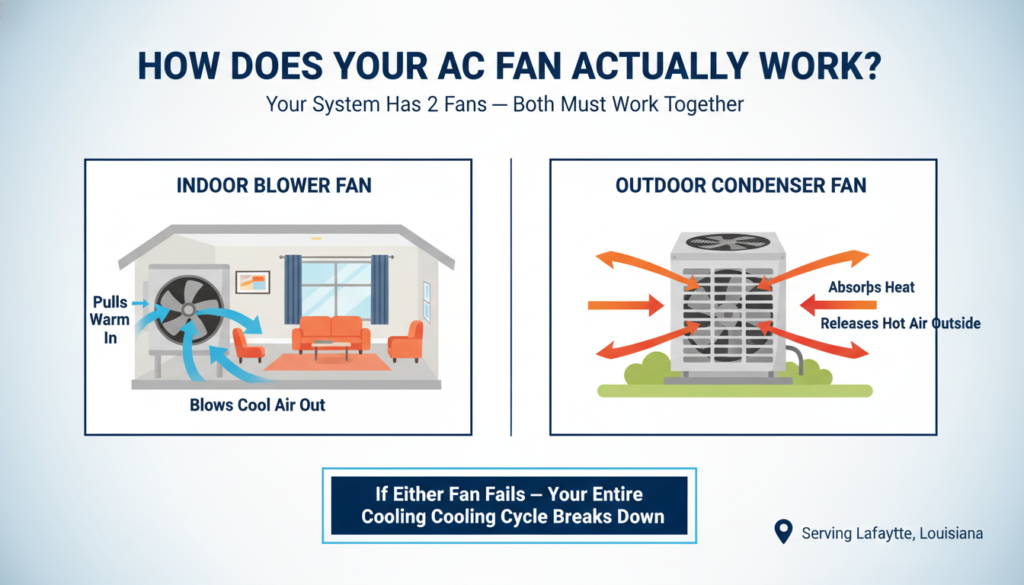
Before jumping into causes, it helps to know the basics. Your air conditioning system actually has two fans:
The indoor blower fan sits inside your home. It pulls warm air from your rooms, pushes it over the evaporator coil to cool it down, and then blows that cool air back through your vents.
The outdoor condenser fan sits in your outdoor unit. Its job is to pull heat from the refrigerant and push that hot air outside, away from your home.
Both fans need to work together for your AC to cool properly. If either one stops spinning, the whole cooling cycle breaks down. Understanding which fan has the problem will help you narrow down the cause. For a deeper look at how your whole system works, check out our AC Problems guide.
What Happens If You Ignore an AC Fan That Is Not Spinning?
This is not something you want to leave alone. Here is why:
When your outdoor condenser fan stops working, heat builds up inside the outdoor unit. The compressor, which is the most expensive part of your AC, can overheat and fail. A compressor replacement in Lafayette can cost $1,500 or more. Catching the fan problem early can save you from that expense.
When your indoor blower fan stops working, warm air just sits in your home. Your evaporator coil can freeze over, which adds another layer of problems. Your energy bills also go up because the system keeps running without cooling anything.
Bottom line: if your AC fan is not spinning, turn the system off and figure out why.
8 Reasons Your AC Fan Is Not Spinning
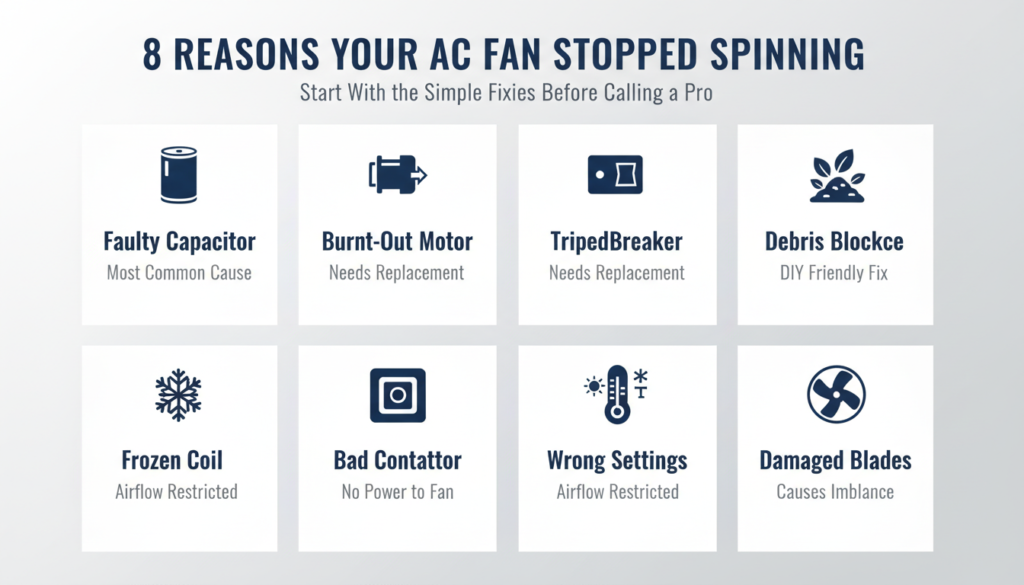
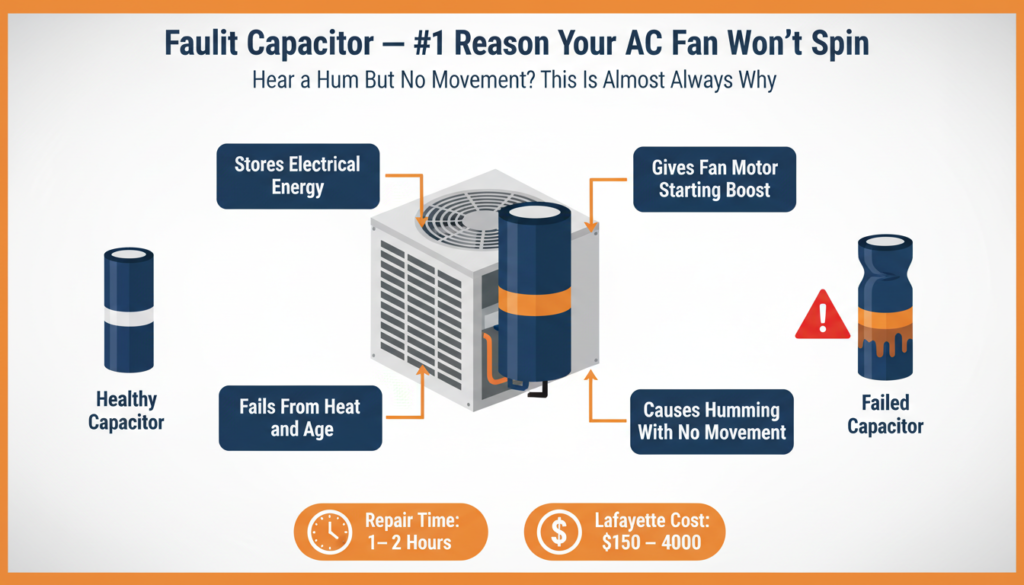
1. Faulty Capacitor (The Most Common Cause)
If you hear a humming sound from your outdoor unit but the fan is not moving, a bad capacitor is almost always the reason. This is the single most common cause of an AC fan not working.
The capacitor is a small, cylinder-shaped component inside your outdoor unit. It stores electrical energy and gives the fan motor a boost to start spinning. When the capacitor fails, the motor cannot get that starting jolt, so it just hums and sits still.
Signs of a bad capacitor: – Humming or buzzing from the outdoor unit with no fan movement – Fan starts slowly or takes a long time to get going – Fan spins if you give it a gentle nudge (with the power OFF) but then slows down again – Visible bulging or leaking on the capacitor itself
What to do: Turn off your AC immediately. Do not try to keep running the system. Capacitors hold an electrical charge even after the power is off, so this is not a safe DIY repair. Call an HVAC technician. A capacitor replacement in Lafayette typically costs between $150 and $400, including parts and labor.
2. Tripped Circuit Breaker or Blown Fuse
Sometimes the fix is as simple as a tripped breaker. Your AC has a dedicated circuit in your electrical panel. If there was a power surge, the breaker may have tripped as a safety measure, cutting power to the fan.
Signs of a tripped breaker: – The outdoor unit or indoor air handler is completely unresponsive – The circuit breaker for the AC is in the middle position (not fully on or off)
What to do: 1. Go to your electrical panel and find the breaker labeled for your AC (it is usually a double breaker) 2. Switch it fully to OFF, then back to ON 3. Wait 30 minutes before turning your AC back on.Thiss gives the system time to reset
If the breaker trips again right away, do not keep resetting it. A breaker that keeps tripping means there is a bigger electrical problem. At that point, call a professional.
3. Burnt-Out Fan Motor
The fan motor is what actually makes the blades spin. Over time, motors wear out. Overheating, lack of lubrication, and just plain age can cause the motor to burn out completely.
Signs of a bad fan motor: – A burning smell coming from the outdoor or indoor unit – Grinding, screeching, or rattling noise before the fan stopped working – The fan does not spin at all, even after resetting the breaker – The motor feels very hot to the touch (with the power OFF)
What to do: This one requires a professional. A fan motor replacement in Lafayette costs between $300 and $700, depending on your system. If your AC is 12–15 years old and the motor has failed, it may make more sense financially to consider a full system replacement. Talk to your HVAC technician about your options.
4. Debris or Obstruction Blocking the Fan Blades
Your outdoor unit is exposed to the elements year-round. Leaves, sticks, grass clippings, and even small animals can get inside and jam the fan blades. This is one of the few AC fan problems you can actually fix yourself.
Signs of a debris blockage: – You can see or hear something rattling inside the outdoor unit – The fan seems to try to spin but stops immediately – There is visible debris around or inside the unit
What to do: 1. Turn off the AC at the thermostat AND at the circuit breaker 2. Remove the top grille of the outdoor unit (usually held by a few screws) 3. Carefully remove any debris from inside the unit 4. Check that the fan blades can spin freely by hand 5. Reassemble and restore power
Going forward, keep at least two feet of clear space around your outdoor unit. Trim back any bushes or plants nearby. This simple maintenance step prevents a lot of AC problems.
5. Bad Contactor
The contactor is an electrical switch inside your outdoor unit. When your thermostat calls for cooling, the contactor closes and allows electricity to flow to the fan motor and compressor. If the contactor fails, the fan gets no power, even if everything else is working fine.
Signs of a bad contactor: – The compressor is running but the fan is not spinning – You can hear a clicking sound from the outdoor unit, but the fan does not start – Visible burn marks or pitting on the contactor (requires opening the unit)
What to do: A bad contactor needs to be replaced by a licensed HVAC technician. This is not a safe DIY repair because contactors deal with high-voltage electricity. Replacement typically costs $150 to $350 in Lafayette.
6. Wrong Thermostat Settings
Before assuming you have a mechanical problem, always check your thermostat first. This sounds basic, but it is one of the most common reasons for an AC fan not working, and it takes 30 seconds to check.
Common thermostat issues: – The system is set to “Heat” or “Fan Only” instead of “Cool” – The set temperature is higher than the room temperature, so the system never kicks on – The fan setting is on “On” instead of “Auto,” which makes the fan run constantly and can seem abnormal – The thermostat batteries are dead
What to do: – Set mode to “Cool” – Set the temperature at least 2 to 3 degrees below the current room temperature – Set the fan to “Auto” – Replace the batteries in the thermostat if needed.
If your thermostat is more than 10 years old and showing erratic behavior, it may be time for a replacement. Modern smart thermostats are much more reliable and can help you save on energy bills, too.
7. Frozen Evaporator Coil
This one affects the indoor blower fan more than the outdoor fan. If your evaporator coil freezes over, the ice can physically block the blower or cause the system to shut down as a safety measure.
Signs of a frozen evaporator coil: – Little or no airflow from your vents even though the AC is running – Ice visible on the refrigerant lines near the indoor unit – Water pooling around the indoor unit as ice melts – The indoor fan runs but blows warm air
Common causes of a frozen coil: – Dirty air filter restricting airflow – Low refrigerant (a sign of a leak somewhere in the system) – Blocked or closed vents in your home – A failing blower fan itself
What to do: 1. Turn the AC off completely and set the thermostat to fan-only mode to help defrost the coil 2. Check and replace your air filter; this is the number one cause of frozen coils 3. Make sure all vents in your home are open 4. If the coil freezes again after defrosting, call a professional; you likely have a refrigerant leak
Never try to chip ice off the coil. Let it melt naturally to avoid damaging the coil.
8. Damaged or Bent Fan Blades
Fan blades can get bent or cracked from debris impact, age, or being hit during maintenance. A damaged blade throws off the balance of the fan, which can cause it to stop spinning or damage the motor over time.
Signs of damaged fan blades: – Loud rattling or vibrating noise from the outdoor unit – Visible cracks or bends in one or more blades – The fan spins unevenly or wobbles
What to do: Turn the system off immediately. Running a fan with damaged blades puts stress on the motor and can cause secondary damage. Call an HVAC technician to inspect and replace the blade assembly.
Step-by-Step: How to Troubleshoot Your AC Fan Not Spinning
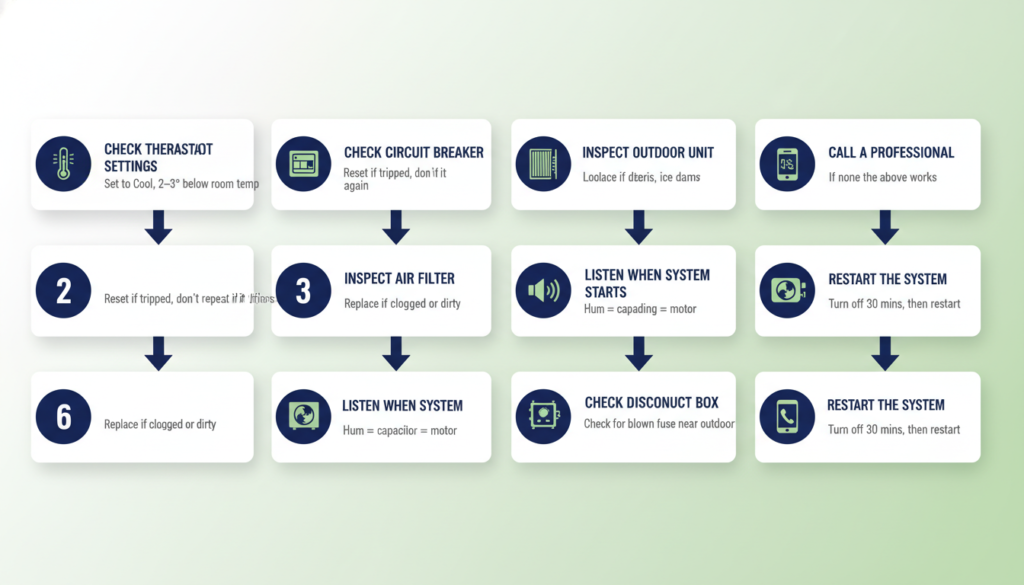
Before calling anyone, run through these steps in order. This simple process can save you a service call:
1. Check the thermostat. Make sure it is set to “Cool,” the temperature is set lower than the room temperature, and the fan is set to “Auto.”
2. Check the circuit breaker. Go to your electrical panel and make sure the AC breaker has not tripped
3. Check the air filter. A clogged filter restricts airflow and can cause multiple problems, including frozen coils
4. Turn off the system and inspect the outdoor unit. Look for visible debris, ice, or obstructions around and inside the unit
5. Listen carefully when the system starts. A hum with no fan movement points to a capacitor; grinding or screeching points to the motor
6. Check the outdoor unit disconnect. There is usually a disconnect box near the outdoor unit; make sure the fuse inside has not blown
7. Try restarting the system. Turn everything off for 30 minutes, then restart. Some systems have a built-in safety lockout that resets after a period of time
8. Call a professional. If none of the above solves the issue, it is time to call an HVAC technician in Lafayette
How Much Does It Cost to Fix an AC Fan Not Spinning in Lafayette?
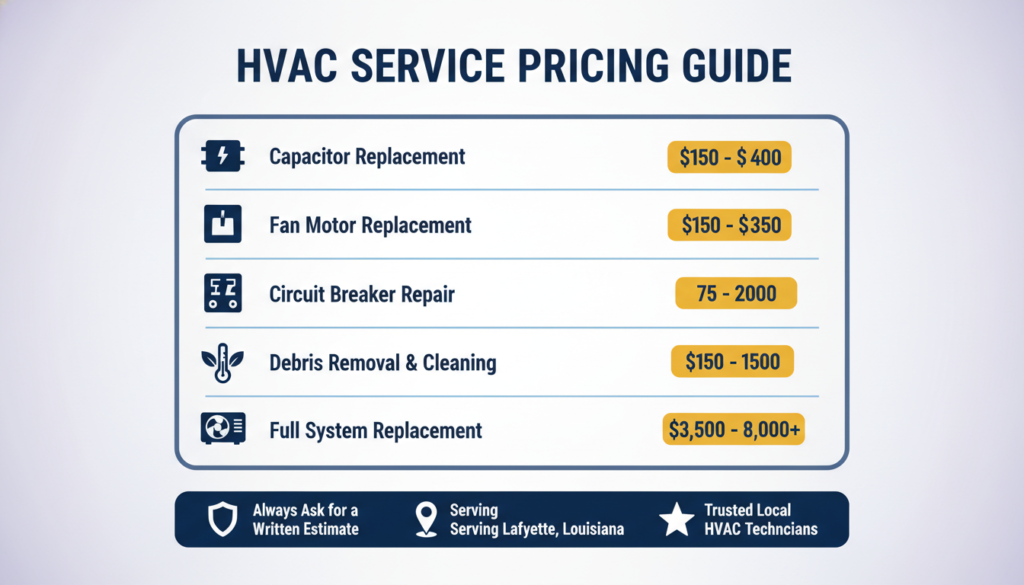
Here is a general breakdown of repair costs you can expect in the Lafayette area:
| Problem | Estimated Repair Cost |
| Capacitor replacement | $150 – $400 |
| Fan motor replacement | $300 – $700 |
| Contactor replacement | $150 – $350 |
| Circuit breaker reset/repair | $75 – $200 |
| Debris removal/cleaning | $75 – $150 |
| Thermostat replacement | $150 – $400 |
| Full system replacement (older units) | $3,500 – $8,000+ |
Costs vary based on the brand, model, and age of your system. Always ask for a written estimate before approving any repair.
When Should You Call a Professional in Lafayette?
You can handle a few things yourself,l ike checking the breaker, replacing the air filter, or clearing debris from the outdoor unit. But call a professional if:
• You hear humming, but the fan is not spinning (likely a capacitor)
• There is a burning smell from any part of the system
• The circuit breaker keeps tripping after you reset it
• The fan spins but stops again after a few minutes
• You see ice on the refrigerant lines or the indoor unit
• The system is more than 10 years old and has a major component failure
• You are not comfortable working around electrical components
At Fontenot Air Conditioning and Heating in Lafayette, our team diagnoses AC fan problems quickly and gets your system back up and running. We have been serving Lafayette homeowners for years, and we know how brutal a broken AC feels in the Louisiana heat.
How to Prevent AC Fan Problems
A little maintenance goes a long way. Here is what you can do to keep your AC fan spinning reliably all season:
• Replace your air filter every 1 to 3 months. A dirty filter is one of the biggest causes of AC problems, including frozen coils and overworked fans
• Schedule annual AC maintenance, A professional tune-up before summer catches small problems (like a weakening capacitor) before they become expensive repairs
• Keep the area around your outdoor unit clear, trim back plants, and remove debris regularly
• Do not close vents in unused rooms. This disrupts airflow and strains the system
• Listen to your AC. New noises like humming, rattling, or grinding are early warning signs
• Check your system before summer. Do not wait until the hottest day of the year to discover a problem
Frequently Asked Questions
Why is my AC fan not spinning, but the unit is humming?
A humming sound with no fan movement is almost always caused by a failed capacitor. The motor is trying to start,t but cannot get enough power to begin spinning. Turn the system off immediately to prevent motor damage and call an HVAC technician to test and replace the capacitor.
Can I run my AC if the fan is not spinning?
No. Running your AC with a non-spinning fan will cause the compressor to overheat, which can lead to very expensive damage. The compressor is the most costly component in your AC system. Turn the system off right away and troubleshoot before restarting.
Why is my outside AC fan not spinning, but the inside unit is working?
This is a common scenario. Your indoor blower is fine, but the outdoor condenser fan has failed. The most likely causes are a bad capacitor, a faulty contactor, or a burnt-out outdoor fan motor. Call a professional to inspect the outdoor unit.
How do I know if my AC capacitor is bad?
Common signs include: humming without fan movement, the fan spinning slowly before stopping, visible bulging or leaking on the capacitor body, and the AC shutting off unexpectedly. An HVAC technician can confirm with a capacitor test using a multimeter.
How long does an AC fan motor last?
With regular maintenance, an AC fan motor typically lasts 10 to 15 years. Poor maintenance, overheating, and excessive debris buildup can shorten that lifespan. Annual tune-ups help extend it.
What is the most common reason an AC fan stops spinning?
The faulty capacitor is the single most common cause. It is a relatively inexpensive repair compared to a motor replacement, and catching it early prevents damage to the motor and compressor.
Final Thoughts
An AC fan not spinning in Lafayette is a problem you do not want to ignore, especially during the summer months. The cause can range from something as simple as a tripped breaker or wrong thermostat setting, to something more serious like a failed capacitor or burnt-out motor.
Start with the basic check: thermostat, breaker, air filter, and visible debris. If those do not solve the issue, it is time to call in an expert before small AC problems turn into big ones.
Fontenot Air Conditioning and Heating is here to help Lafayette homeowners stay comfortable. If your AC fan has stopped spinning and you are not sure why, give us a call. We will diagnose the problem fast and give you a fair, upfront estimate.
For more on common air conditioning issues, read our complete AC Problems guide, your go-to resource for everything that can go wrong with your AC and how to fix it.