
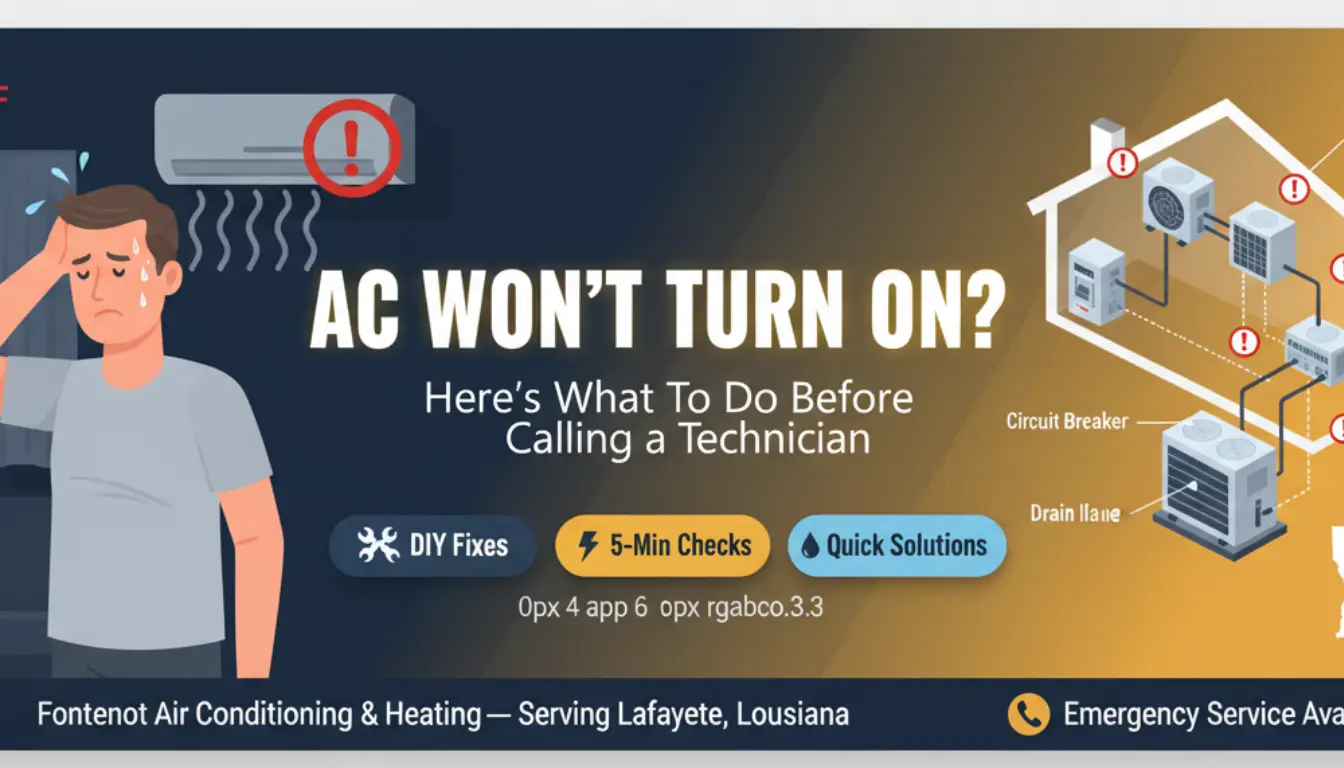
Is your air conditioner refusing to turn on during a hot Louisiana day? You’re not alone. At Fontenot Air Conditioning and Heating, we receive dozens of calls from frustrated Lafayette homeowners dealing with this exact problem, especially during our brutal summer months.
The good news? Not every AC that won’t turn on needs expensive repairs. Many issues have simple fixes you can try yourself before calling a professional. In this guide, we’ll walk you through everything you need to know to get your cooling system running again.
Quick Checklist: Start Here Before Anything Else
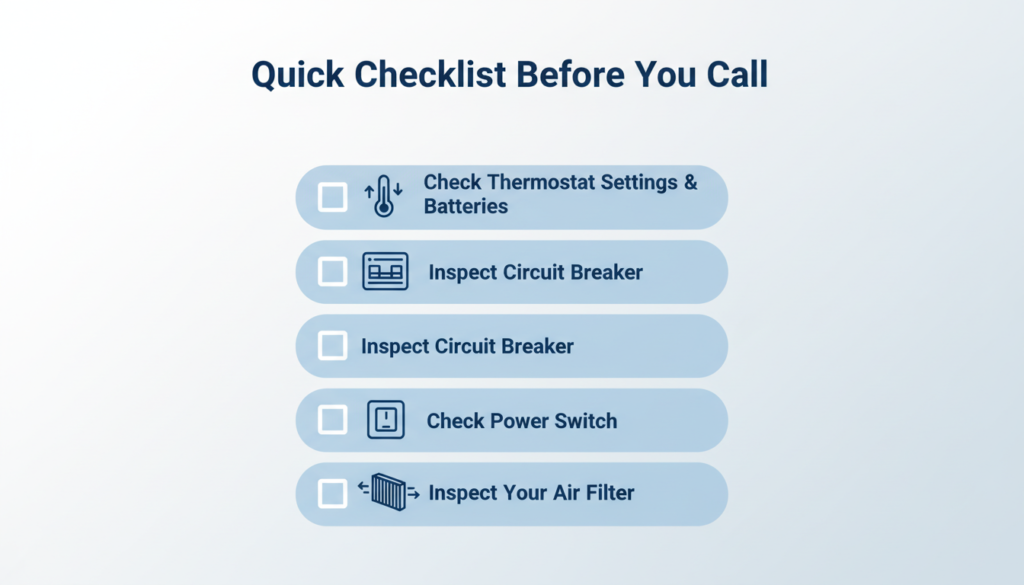
Before you panic or reach for your phone, take five minutes to check these basics:
1. Check Your Thermostat
- Is it set to “COOL” mode?
- Is the temperature set lower than your current room temperature?
- Are the batteries dead? (Most thermostats need replacing every 1-2 years)
2. Look at Your Circuit Breaker
- Did the breaker trip?
- Is the switch in the “ON” position?
3. Check the Power Switch
- Is the switch near your indoor unit turned on?
- Is there a switch near your outdoor unit that’s been accidentally turned off?
4. Inspect Your Air Filter
- When did you last change it?
- Is it clogged with dust and debris?
If everything checks out but your AC still won’t power on, keep reading. We’ll dig deeper into what might be wrong.
12 Common Reasons Why Your AC Won’t Turn On
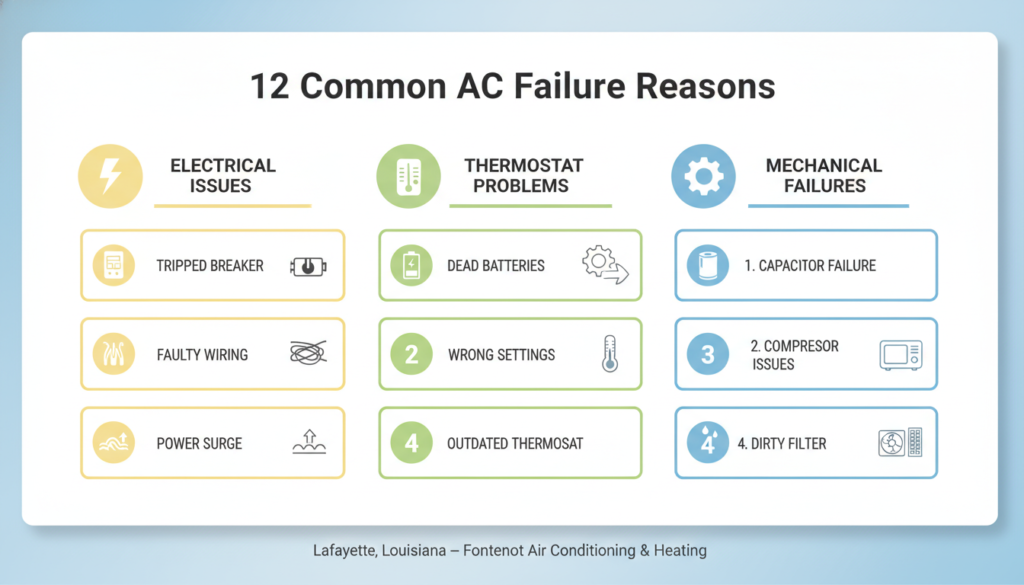
Understanding what causes an air conditioner not to turn on helps you fix the problem faster. Here are the most common culprits we see in Lafayette homes:
Electrical Issues
1. Tripped Circuit Breaker: Your AC unit draws significant power, especially when starting up. If your electrical panel can’t handle the load, the breaker trips as a safety measure. This is particularly common after power outages or during Louisiana thunderstorms.
2. Blown Fuse Older homes in Lafayette might have fuse boxes instead of circuit breakers. A blown fuse stops electricity from reaching your AC system completely.
3. Faulty Wiring Damaged or loose wiring connections prevent your air conditioner from receiving power. This often happens in older homes or after pest damage (we see a lot of rodent issues in Louisiana).
4. Power Surge Damage Summer storms can cause power surges that damage your AC’s electrical components. Even a brief surge can fry sensitive parts.
Thermostat Problems
5. Dead Batteries If your thermostat screen is blank or dim, dead batteries are likely the problem. This is one of the easiest fixes and takes less than two minutes.
6. Incorrect Settings Sometimes the simplest answer is the right one. Your thermostat might be set to “HEAT,” “OFF,” or “FAN ONLY” instead of “COOL.”
7. Faulty Thermostat Wiring: Loose or corroded wires inside your thermostat prevent communication between the thermostat and your AC unit.
8. Outdated Thermostat Old mechanical thermostats can fail over time. If your thermostat is more than 10 years old, it might be time for an upgrade.
Safety Switch Activation
9. Condensate Drain Pan Overflow: Your AC produces condensation while cooling. If the drain line clogs, water backs up into the drain pan. A float switch then shuts down your system to prevent water damage. This is extremely common in humid Lafayette weather.
10. Dirty Air Filter A severely clogged filter restricts airflow, causing pressure switches to trip and shut down your system for protection.
Mechanical Failures
11. Capacitor Failure The capacitor gives your AC motor the electrical boost it needs to start. When it fails, your unit won’t turn on or might hum without starting. This is the most common mechanical failure we see at Fontenot Air Conditioning and Heating.
12. Compressor Issues: Your compressor is the heart of your cooling system. If it’s failed, your AC won’t start. Unfortunately, compressor replacement is expensive and sometimes means you need a new system.
Step-by-Step AC Troubleshooting Guide
Let’s walk through each fix, starting with the easiest solutions.
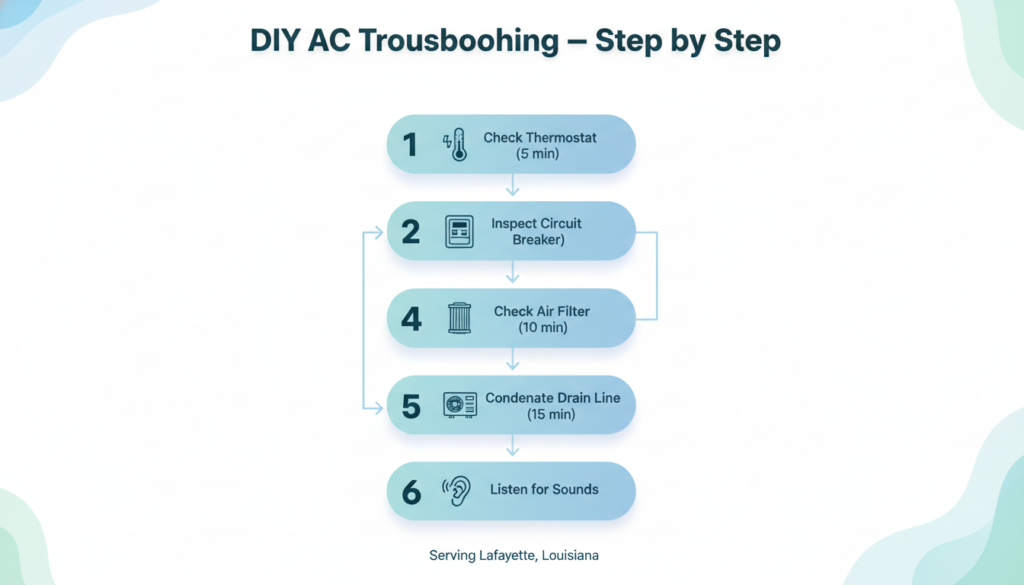
Step 1: Check Your Thermostat (5 Minutes – DIY)
Your thermostat controls everything, so start here.
What to do:
- Make sure it’s set to “COOL.”
- Set the temperature at least 5 degrees below the current room temperature
- Check if the display is working (if not, replace batteries)
- Look for any error codes or warning messages
Replace the batteries: Most thermostats use AA or AAA batteries. Open the front panel, swap in fresh batteries, and wait 30 seconds for the system to reboot.
Still not working? Try switching the thermostat to “OFF,” wait 5 minutes, then switch back to “COOL.” This simple reset fixes many issues.
Step 2: Inspect the Circuit Breaker (2 Minutes – DIY)
Lafayette homes typically have the electrical panel in the garage, utility room, or outside the house.
What to do:
- Open your electrical panel
- Look for a switch labeled “AC,” “Air Conditioner,” or “HVA.C”
- Check if it’s in the middle position (tripped) or fully “OF.F”
- If tripped, switch it fully to “OFF,” then back to “O.N”
Important warning: If the breaker trips again immediately, don’t keep resetting it. This signals a serious electrical problem that needs professional attention.
Step 3: Examine Your Air Filters (10 Minutes – DIY)
Dirty filters are responsible for countless AC problems in Louisiana homes. Our humid climate means filters get dirty faster than in drier states.
Where to find your filter:
- Return air vent (usually on a wall or ceiling)
- Inside the air handler (the indoor unit)
- Special filter grille in hallway or utility room
What to look for: Hold the filter up to the light. If you can’t see light through it, it’s too dirty.
What to do: Replace disposable filters with new ones. If you have washable filters, rinse them with water, let them dry completely, then reinstall.
Pro tip from Fontenot Air Conditioning and Heating: Lafayette homeowners should change filters every 30-60 days during the cooling season, not the 90 days shown on the package. Our humidity and pollen levels clog filters faster.
Step 4: Check the Condensate Drain Line (15 Minutes – DIY)
Your AC removes moisture from the air. That water needs somewhere to go. In Lafayette’s humid climate, condensate lines work overtime and clog frequently.
Locate your drain line: It’s a PVC pipe coming from your indoor unit, usually leading outside or to a drain.
Signs of a clog:
- Water pooling around your indoor unit
- Water in the drain pan under your air handler
- Musty smell near the unit
How to fix it:
- Turn off your AC at the thermostat
- Find the access point on the drain line (usually a T-shaped vent)
- Pour 1 cup of white vinegar or bleach down the line
- Wait 30 minutes
- Flush with water
- Clear the outdoor drain opening with a wet/dry vacuum
Prevention: Pour 1/4 cup of vinegar down your drain line monthly to prevent algae buildup.
Step 5: Inspect Your Outdoor Unit (10 Minutes – DIY)
Your outdoor condenser unit needs room to breathe. Lafayette’s vegetation grows fast, and debris accumulation is common.
What to check:
- Clear leaves, grass clippings, and debris from around the unit
- Ensure at least 2 feet of clearance on all sides
- Look for visible damage (dents, bent fins, disconnected wires)
- Make sure nothing is blocking the top of the unit
Clean the unit: Turn off the power at the disconnect box near the outdoor unit. Gently spray the fins from inside out with a garden hose. Don’t use a pressure washer—it’ll bend the delicate fins.
Check the disconnect box: Near your outdoor unit, there’s a small box with a pull-out handle. Make sure it’s pushed in fully. Sometimes this gets pulled accidentally during yard work.
Step 6: Listen for Sounds When You Try to Start the AC
Different sounds tell you different things about what’s wrong.
Clicking sound but no start: Likely a bad capacitor or relay. This needs professional repair.
Humming but not starting: Your compressor is trying to start but can’t. It could be a bad capacitor, a seized compressor, or an electrical issue.
Complete silence: No power is reaching the unit. Check electrical connections, breakers, and the thermostat.
Buzzing sound: Often indicates electrical issues like a failing contactor or loose wiring.
When to Call Fontenot Air Conditioning and Heating
Some AC problems need professional expertise. Here’s when to pick up the phone:
Call us immediately if:
- Your circuit breaker keeps tripping repeatedly
- You smell burning or see smoke
- You hear loud banging, grinding, or screeching sounds
- Water is leaking heavily inside your home
- Your outdoor unit has visible damage
- You’ve tried the basic fixes, and nothing works
Call us for these repairs:
- Capacitor replacement
- Compressor issues
- Refrigerant leaks
- Electrical wiring problems
- Sensor or control board failures
- Motor replacement
What to expect: Our Lafayette technicians typically arrive within 24 hours for non-emergency calls. For emergency service during heat waves, we prioritize elderly residents and families with small children.
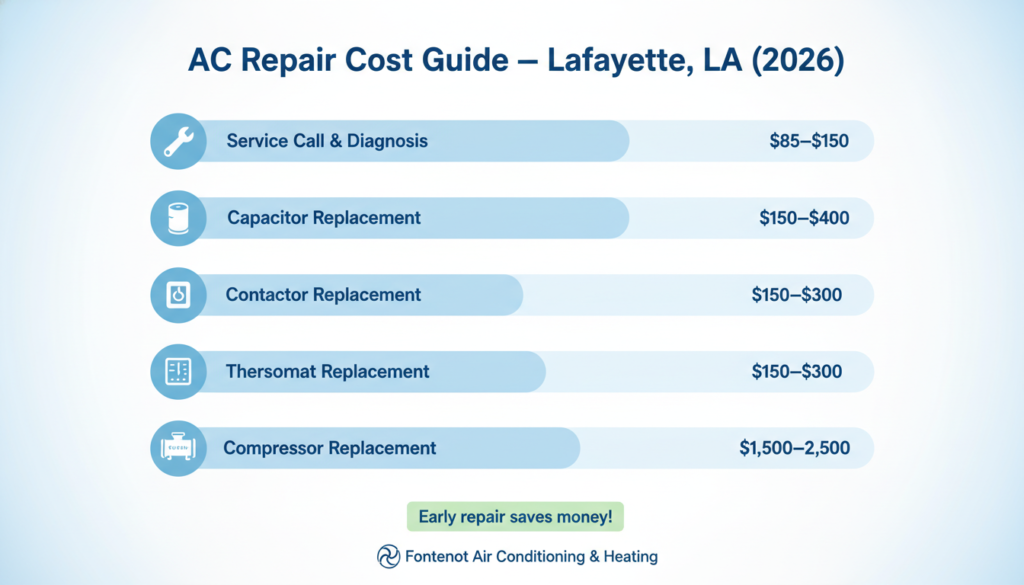
Cost expectations for 2026:
- Service call and diagnosis: $85-$150
- Capacitor replacement: $150-$400
- Contactor replacement: $150-$300
- Thermostat replacement: $150-$500
- Compressor replacement: $1,500-$2,500
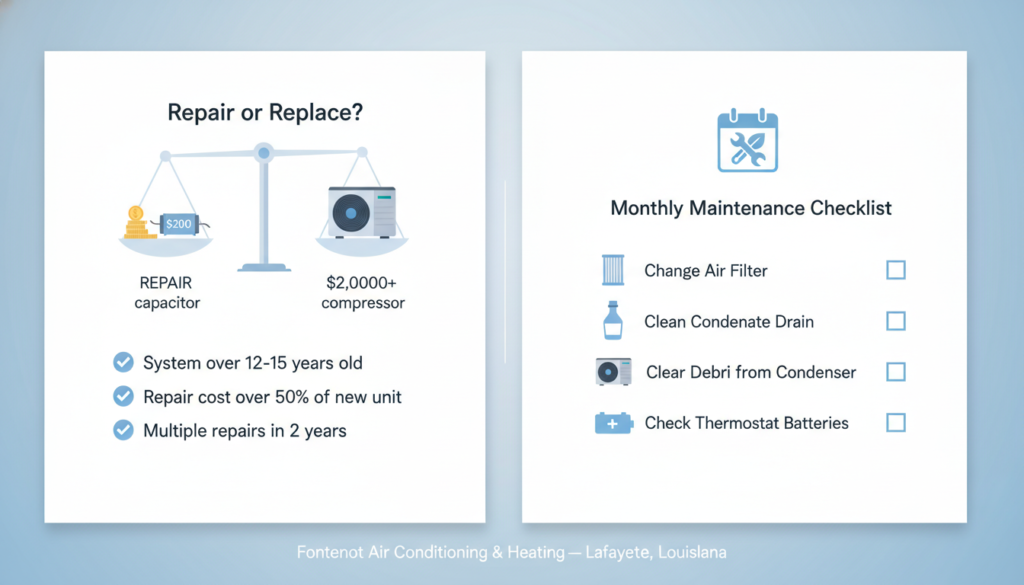
Remember, catching problems early saves money. A $200 capacitor replacement today prevents a $2,000 compressor failure tomorrow.
Preventing Your AC From Not Starting in the Future
Regular maintenance prevents most AC startup problems. Here’s what Lafayette homeowners should do:
Monthly Tasks (DIY)
- Change or clean air filters
- Pour vinegar downthe condensate drain
- Clear debris from the outdoor unit
- Check thermostat batteries
Seasonal Tasks (DIY)
- Clean outdoor unit coils
- Trim vegetation around the condenser
- Check insulation on refrigerant lines
- Test thermostat accuracy
Annual Professional Maintenance
Schedule service with Fontenot Air Conditioning and Heating every spring before cooling season. Well:
- Test all electrical connections
- Check refrigerant levels
- Clean coils thoroughly
- Lubricate moving parts
- Test capacitors and contactors
- Calibrate thermostat
- Inspect ductwork
Maintenance saves money: Our customers with annual maintenance agreements experience 75% fewer emergency breakdowns, and their systems last 3-5 years longer on average.
Emergency Cooling While Waiting for Repair
If your AC won’t power on and you’re waiting for service, here’s how to stay cool in Lafayette’s heat:
Immediate solutions:
- Close blinds and curtains on sun-facing windows
- Use ceiling fans (remember: counterclockwise in summer)
- Create cross-ventilation by opening windows on opposite sides of your home (only at night when it’s cooler outside)
- Stay in the lowest level of your home (cool air sinks)
Portable cooling:
- Box fans in windows (facing out) create airflow
- Portable AC units cool single rooms effectively
- Wet towels on the neck and wrists lower body temperature
- Take cool showers
Heat safety:
- Drink plenty of water
- Avoid using ovens and stoves
- Watch for signs of heat exhaustion (dizziness, nausea, headache)
- Check on elderly neighbors
Lafayette temperatures regularly exceed 95°F in summer. Don’t take chances with your health if you have medical conditions or small children; consider staying with family or at a cooling center while waiting for repairs.
Should You Repair or Replace Your AC?
When your air conditioner is not turning on, it becomes a regular problem; replacement might make more sense than another repair.
Consider replacement if:
- Your system is over 12-15 years old
- Repair costs exceed 50% of the replacement cost
- Your energy bills keep increasing
- You’ve had multiple repairs in the past 2 years
- Your home never feels comfortable
Benefits of new systems:
- 30-50% better energy efficiency
- Quieter operation
- Better humidity control (important in Louisiana!)
- Smart thermostat compatibility
- Fewer breakdowns
Fontenot Air Conditioning and Heating offers: Free replacement estimates, financing options, and help with manufacturer rebates and energy efficiency incentives.
Frequently Asked Questions
Why won’t my AC turn on, but the fan works?
If your indoor fan runs but you’re getting no cold air and the outdoor unit won’t start, you likely have a problem with the outdoor unit itself, most commonly a bad capacitor, failed compressor, or tripped outdoor disconnect. The thermostat successfully signals the indoor unit but can’t start the outdoor condenser.
How do I reset my AC unit?
Turn your thermostat to “OFF.” Go to your circuit breaker and flip the AC breaker to “OFF.” Wait 5 minutes. Turn the breaker back “ON,” then set your thermostat to “COOL.” This full reset clears many electronic glitches. If this doesn’t work after one try, don’t keep resetting, call a professional.
Can a dirty filter prevent my AC from turning on?
Yes. A severely clogged filter restricts airflow so much that safety switches shut down the system to prevent damage. This is especially common in Lafayette because our high humidity clogs filters faster. If your system won’t start, check the filter first; it’s the easiest fix.
How much does it cost to fix an AC that won’t turn on?
It depends on the cause. Simple fixes like replacing a filter or resetting a breaker are free. Professional repairs range from $150 for a capacitor to $2,500 for a compressor. At Fontenot Air Conditioning and Heating, we provide a detailed diagnosis before any work begins so you know exactly what you’re paying for.
Is it the thermostat or the AC unit?
Here’s a quick test: Set your thermostat to “FAN ONLY.” If the fan runs, your thermostat works, and the problem is with the AC unit itself. If nothing happens, the issue is likely the thermostat, wiring, or power supply.
What does it mean when my AC clicks but won’t start?
Clicking without starting usually means the capacitor or contactor is failing. The click is the contactor trying to engage, but the capacitor can’t provide enough power to start the compressor motor. This is a common problem, especially in systems over 5 years old, and requires professional replacement.
Why won’t my AC turn on after a power outage?
Power surges during outages can trip breakers or damage components. First, check your circuit breaker and reset if needed. Wait 5 minutes before trying to start your AC—the system needs time to equalize pressure. If it still won’t start, the surge may have damaged the capacitor, control board, or compressor.
Can I fix an AC that won’t turn on myself?
You can safely check and fix: thermostat settings/batteries, circuit breakers, air filters, condensate drain clogs, and outdoor debris. Don’t attempt: electrical repairs, refrigerant work, component replacement, or anything requiring specialized tools. Lafayette building codes also require licensed technicians for most HVAC repairs.
Get Your Lafayette AC Running Again
An AC that won’t turn on doesn’t always mean disaster. Many issues have simple solutions you can try right now. Start with the basics thermostat, breaker, and filter. These solve the problem about 40% of the time.
For everything else, Fontenot Air Conditioning and Heating has served Lafayette families for years. We understand Louisiana’s unique climate challenges and how they affect your cooling system. Our technicians arrive equipped to diagnose and fix most problems on the first visit.
Don’t suffer through Lafayette’s heat. If your AC won’t power on and you’ve tried the troubleshooting steps above, call us today. We offer same-day emergency service when your family needs relief fast.
Remember: Regular maintenance prevents most AC startup problems. Schedule your annual tune-up before summer arrives, and you’ll avoid the rush when temperatures soar.
Need help now? Contact Fontenot Air Conditioning and Heating: Lafayette’s trusted HVAC experts since [year]. We’ll get your home cool and comfortable again.