

It’s another scorching summer day in Lafayette, and you notice something frustrating your air conditioner is running constantly, the electric bill is climbing, but your house feels like an oven. You’re not alone. Why is My AC Running But Not Cooling the House? is one of the most common questions and AC problems homeowners face, and the good news is that some causes are surprisingly easy to fix yourself.
At Fontenot Air Conditioning and Heating, we get calls about this issue almost daily during Louisiana’s brutal summer months. While some problems require professional help, others can be solved in just a few minutes. Let’s walk through exactly why your AC might be running but not cooling, and what you can do about it.
Quick Diagnostic Checklist
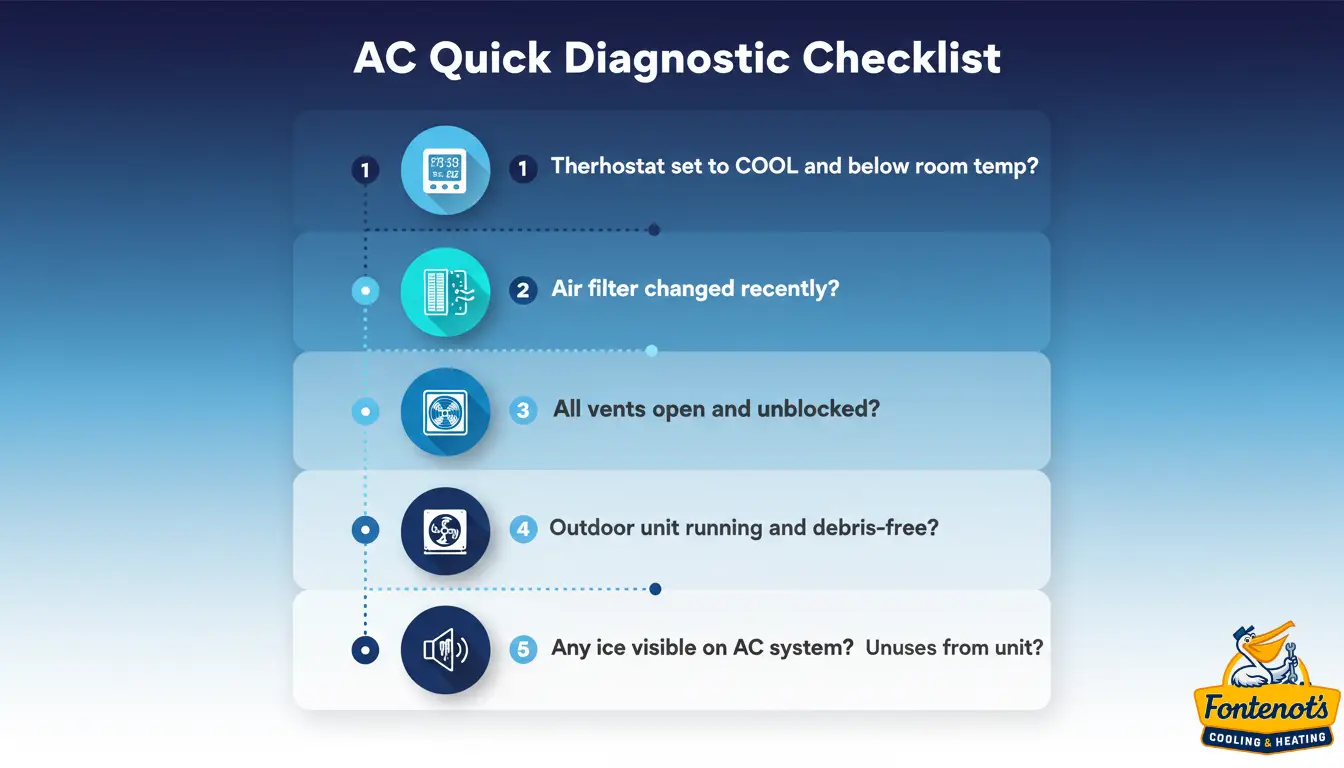
Before we dive deep, here’s a quick checklist to help you identify the problem:
- Is your thermostat set to “cool” and below the current room temperature?
- When did you last change your air filter?
- Are all your vents open and unblocked?
- Is your outdoor unit running and free of debris?
- Do you see ice anywhere on your AC system?
- Can you hear unusual noises coming from the unit?
If you answered “no” or “I’m not sure” to any of these questions, you’re on the right track to finding your problem.
12 Common Reasons Your AC Runs But Doesn’t Cool
Easy DIY Fixes
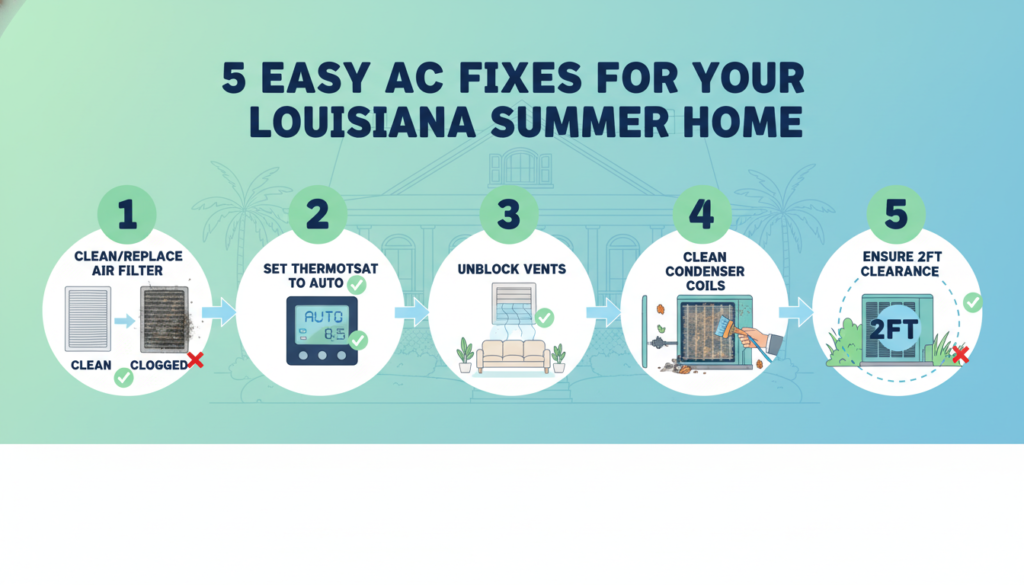
1. Dirty or Clogged Air Filter (The #1 Culprit)
This is hands-down the most common reason why an air conditioner blows air but doesn’t cool properly. Your AC filter traps dust, pollen, pet hair, and other particles to keep your system clean and your air quality high. But when that filter gets clogged, airflow drops dramatically.
Why it matters: Restricted airflow means your AC can’t pull enough warm air from your home to cool it down. The system keeps running, but it’s essentially working with one hand tied behind its back.
How to check: Turn off your AC, locate your filter (usually near the return air vent or in the air handler), and pull it out. Hold it up to a light. If you can’t see light through it, it’s too dirty.
The fix: Replace disposable filters or clean reusable ones. During Lafayette’s hot, humid summers, you should check your filter monthly and replace it every 1-3 months depending on usage.
Cost: $5-30 for replacement filters
2. Thermostat Settings and Issues
Sometimes the problem isn’t your AC at all it’s how you’re telling it to work.
Common thermostat mistakes:
- Fan set to “ON” instead of “AUTO” (this makes the fan blow constantly, even when not cooling)
- Temperature set too high
- Thermostat in direct sunlight or near heat sources, giving false temperature readings
- Dead batteries are causing incorrect operation.
The fix: Switch your fan setting to “AUTO,” lower the temperature setting 5 degrees below the current room temperature, and replace the batteries if you have a battery-powered model. If your thermostat is near a window, lamp, or kitchen, it might be reading the wrong temperature and needs repositioning.
Cost: Free to $5 for batteries
3. Blocked or Closed Vents
We often see homeowners who’ve closed vents in unused rooms, thinking they’ll save energy. Unfortunately, this backfires with most AC systems.
Why it matters: Your central air system is designed to distribute cool air throughout your entire house. When you close vents, you create pressure imbalances that make the whole system work harder and less efficiently.
The fix: Walk through your home and make sure all supply vents are open. Also, check that furniture, curtains, or rugs aren’t blocking airflow. You should feel strong airflow from each vent when the AC is running.
Cost: Free
4. Dirty Condenser Coils
Your outdoor unit (the condenser) releases the heat it pulls from your house. But if the coils are covered in dirt, grass clippings, or cottonwood fluff (common in Louisiana), they can’t release heat efficiently.
Signs of dirty coils: The outdoor unit runs but feels hotter than usual around it, or you notice reduced airflow.
The fix: Turn off the power to the unit at the breaker box. Gently spray the coils with a garden hose from the inside out (never use a pressure washer it’ll damage the fins). Remove any visible debris.
Cost: Free (DIY) or $75-150 (professional cleaning)
5. Blocked Outdoor Condenser Unit
Beyond just dirty coils, your outdoor unit needs breathing room.
Common obstructions:
- Grass clippings and leaves
- Overgrown shrubs or weeds
- Storage items are placed too close together
- Dirt and mud buildup
The fix: Clear at least 2-3 feet of space around all sides of your condenser unit. Trim back vegetation, remove debris, and consider installing a protective cover (but only when the unit isn’t running).
Cost: Free
Issues Requiring Professional Help
6. Low Refrigerant or Refrigerant Leak
Refrigerant is the lifeblood of your AC system. It absorbs heat from inside your home and releases it outside. If you’re low on refrigerant, your AC simply can’t cool effectively.
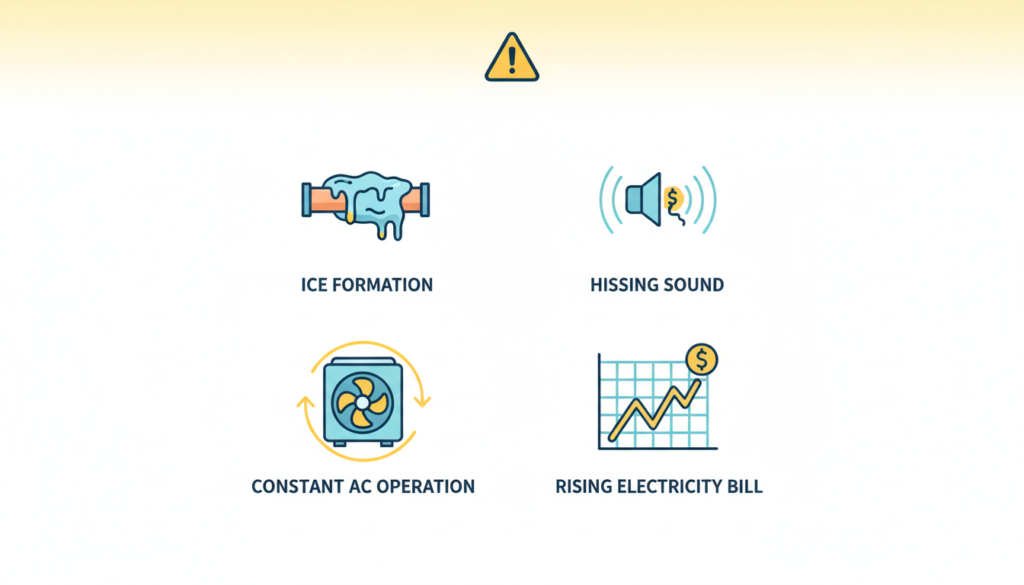
Signs of low refrigerant:
- Ice forming on the refrigerant lines or the indoor coil
- Hissing or bubbling sounds
- AC runs constantly but barely cools
- Higher electric bills without increased comfort
Important: Refrigerants don’t just “run out” like gas in a car. If you’re low, you have a leak. Simply recharging the system without fixing the leak is a temporary and wasteful solution.
Why DIY is dangerous: Refrigerant requires EPA certification to handle. It’s harmful to the environment and can cause frostbite or worse if mishandled.
Professional solution: An HVAC technician will locate the leak, repair it, and recharge your system to the correct level.
Cost: $200-1,500 depending on leak location and severity
7. Frozen Evaporator Coils
If you see ice on your indoor unit or refrigerant lines, your evaporator coil is frozen. This is often connected to airflow problems (like a dirty filter) but can also indicate refrigerant issues.
What causes it:
- Severely restricted airflow (dirty filter, closed vents)
- Low refrigerant levels
- Blower fan problems
- Running the AC when outdoor temperatures are below 60°F
What to do: Turn off your AC immediately and switch the fan to “ON” to help melt the ice. Don’t run the system until the ice is completely gone. If it happens repeatedly, call a professional there’s an underlying issue.
Professional solution: A technician will diagnose why the coils froze and fix the root cause.
Cost: $100-400 for diagnosis and repair
8. Faulty Compressor
The compressor is like the heart of your AC system. It pressurizes and circulates refrigerant. When it fails, your outdoor unit might run, but it won’t actually cool your home.
Signs of compressor failure:
- The outdoor unit makes loud or unusual noises
- Circuit breaker trips repeatedly
- Unit vibrates excessively
- Warm air is coming from vents despite proper thermostat settings
Professional solution: Compressor replacement is expensive, so technicians will first verify it’s truly the issue and not something simpler.
Cost: $1,200-2,800 for compressor replacement (often worth considering full system replacement at this point)
9. Ductwork Problems
You might have a perfectly functioning AC, but if your ducts are leaking, disconnected, or poorly insulated, cool air never makes it to your rooms.
Common duct issues:
- Gaps or holes in duct seams
- Disconnected sections (especially in attics or crawl spaces)
- Poor insulation in unconditioned spaces
- Crushed or kinked flexible ducts
Studies show that typical duct systems lose 20-30% of cooled air through leaks and poor connections. In Louisiana’s hot attics, this loss can be even higher.
Signs of duct problems:
- Some rooms are significantly warmer than others
- Weak airflow from certain vents
- Dusty home despite regular cleaning
- Higher energy bills
Professional solution: A duct inspection, sealing, and possibly insulation upgrade.
Cost: $300-1,000 depending on the extent of repairs needed
10. Undersized AC Unit
Your AC might be running perfectly it’s just too small for your home.
When this happens:
- Home additions without AC upgrades
- Poor initial sizing during installation
- Increased heat load (more windows, removed shade trees, etc.)
How to know: An AC that runs constantly even on moderately hot days and never quite reaches the desired temperature is often undersized. In Lafayette, you generally need about 1 ton of cooling for every 400-600 square feet, but factors like insulation, windows, and sun exposure also matter.
Professional solution: Load calculation to determine proper size, followed by system replacement if necessary.
Cost: $3,500-7,500+ for new system
11. Aging AC System
Air conditioners don’t last forever. The average lifespan is 10-15 years in Louisiana’s climate (shorter than the national average due to our intense heat and humidity).
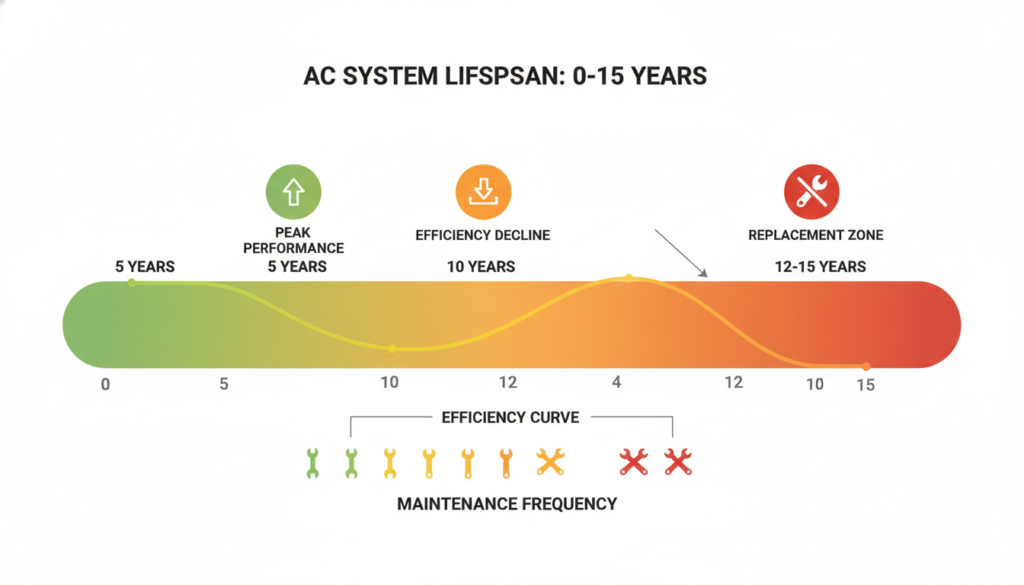
Signs of an aging system:
- Frequent repairs needed
- Declining efficiency despite maintenance
- Uses outdated R-22 refrigerant (being phased out)
- Runs constantly but can’t keep up as it used to
What to consider: If your system is over 10 years old and needs a major repair (like a compressor), replacement often makes more financial sense than repair.
Professional solution: Energy audit and replacement consultation.
Cost: $3,500-8,000+ for replacement
12. Electrical Issues
Various electrical problems can prevent your AC from cooling properly.
Common electrical culprits:
- Failed capacitor (prevents compressor or fan from starting)
- Faulty contactor or relay
- Wiring issues
- Tripped breakers or blown fuses
Signs:
- The outdoor unit hums but doesn’t start
- Fan runs, but the compressor doesn’t
- The system won’t turn on at all
- Burning smell from the unit
Professional solution: Electrical diagnosis and component replacement.
Cost: $150-500 for most electrical repairs
How to Troubleshoot Step-by-Step
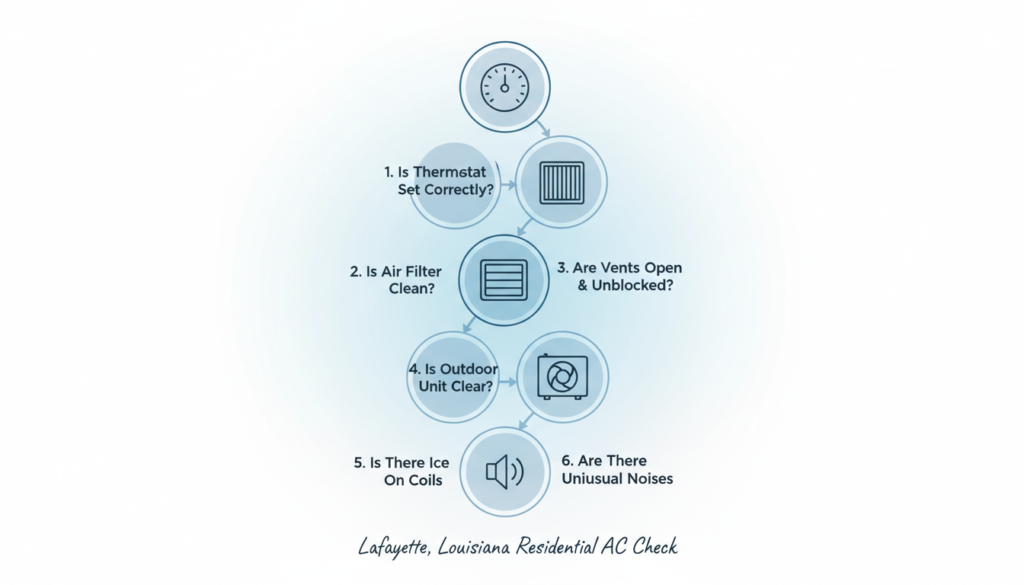
Here’s exactly what to do when your AC is running but not cooling:
Step 1: Check and adjust your thermostat
- Verify it’s set to “cool.”
- Set the temperature 5 degrees below the current room temp
- Make sure the fan is on “AUTO,” not “ON.”
- Replace batteries if applicable
Step 2: Inspect your air filter
- Locate and remove the filter
- Hold it up to the light if you can’t see through it; replace it
- Install a fresh filter and wait 30 minutes to see if cooling improves
Step 3: Examine your outdoor unit
- Make sure it’s running when the thermostat calls for cooling
- Clear any debris or vegetation within 2-3 feet
- Gently clean the coils if visibly dirty
- Listen for unusual sounds
Step 4: Check for ice buildup
- Look at exposed refrigerant lines and the indoor unit
- If you see ice, turn off the AC and switch the fan to “ON.”
- Wait for ice to melt completely (2-4 hours)
- If ice returns, you need professional help
Step 5: Verify all vents are open and unblocked
- Walk through each room
- Open all supply vents fully
- Move furniture or curtains blocking airflow
- Feel for strong airflow from each vent
Step 6: Know when to call a professional
- If none of the above fixes work
- If you see ice repeatedly
- If you hear unusual noises
- If your electric bill has spiked without explanation
- If the problem returns quickly after a temporary fix
When to Call Fontenot Air Conditioning and Heating
Some AC problems are perfect for DIY fixes, but others require professional expertise, specialized tools, and EPA certifications. Call us if you experience:
- Ice on your system that returns after melting
- Refrigerant issues (hissing sounds, ice on lines)
- Electrical problems (burning smells, tripped breakers)
- No improvement after changing filters and cleaning
- Unusual noises from indoor or outdoor units
- Complete system failure
Our experienced technicians serve Lafayette and the surrounding areas with same-day service for cooling emergencies. We’ll diagnose the exact problem, explain your options clearly, and get your home comfortable again.
Prevention Tips to Avoid Future Cooling Problems
An ounce of prevention is worth a pound of cure, especially with Louisiana’s demanding climate:
Monthly tasks:
- Check and replace air filters (every 30-60 days during peak summer)
- Clear debris from around the outdoor unit
- Listen for unusual sounds when the system runs
Seasonal tasks:
- Schedule professional maintenance before the cooling season (spring)
- Trim vegetation around the condenser
- Check thermostat batteries
- Clean supply and return vents
Annual professional maintenance includes:
- Refrigerant level check and adjustment
- Electrical connection inspection and tightening
- Condensate drain cleaning
- Coil cleaning (indoor and outdoor)
- Blower component inspection
- Thermostat calibration
- Safety control testing
Regular maintenance catches small problems before they become expensive emergencies and keeps your system running at peak efficiency.
Frequently Asked Questions
Q: Why is my AC running, but the house is still hot?
The most common reasons are a dirty air filter, low refrigerant, thermostat issues, or an undersized system. Start by checking your filter and thermostat settings. If those look good, you likely need a professional diagnosis.
Q: How long should my AC run to cool my house?
On extremely hot days (95°F+), it’s normal for your AC to run for 15-20 minutes per cycle, multiple times per hour. If it runs continuously for hours and never reaches the set temperature, there’s a problem.
Q: Why is my AC blowing air but not cold?
This usually indicates either very restricted airflow (dirty filter, closed vents), low refrigerant, or a problem with the outdoor unit not running. Check your filter first, then inspect the outdoor condenser to make sure it’s operating.
Q: Can a dirty filter cause my AC not to cool?
Absolutely. A severely clogged filter is the #1 most common cause of cooling problems we see. It restricts airflow so much that the system can’t cool effectively, and it can even cause the evaporator coil to freeze.
Q: How much does it cost to fix an AC that’s not cooling?
It depends on the cause. A new filter costs $5-30, while a refrigerant leak repair might run $200-1,500. Compressor replacement can cost $1,200-2,800. That’s why proper diagnosis is so important you want to fix the right problem.
Q: Should I turn off my AC if it’s not cooling?
If you see ice anywhere on the system, yes turn it off immediately and let it thaw. Otherwise, you can leave it running while troubleshooting simple fixes. However, if nothing improves within a day, turn it off and call a professional to avoid wasting energy and potentially causing more damage.
Q: Why is my AC running constantly but not cooling?
Constant running with poor cooling usually indicates low refrigerant, an undersized system, severe airflow restriction, or ductwork problems. After checking your filter and vents, this typically requires professional diagnosis.
Don’t Let AC Problems Ruin Your Summer Comfort
When your air conditioner runs but won’t cool your Lafayette home, it’s more than an inconvenience—it’s uncomfortable, stressful, and expensive. The good news is that many causes have simple solutions you can handle yourself, and even the complex issues can be resolved quickly by experienced professionals.
Start with the easy checks: replace that filter, adjust your thermostat, and clear debris from your outdoor unit. These three simple steps solve the problem about 40% of the time. If your AC still won’t cool properly after trying these fixes, it’s time to call in the experts.
At Fontenot Air Conditioning and Heating, we’ve helped thousands of Lafayette homeowners solve their AC problems and get back to enjoying cool, comfortable homes. We offer transparent pricing, same-day emergency service, and technicians who take the time to explain exactly what’s wrong and what your options are.
Don’t spend another day sweating in your own home. Call Fontenot Air Conditioning and Heating at [your phone number] or schedule service online today. Your comfort is our priority.