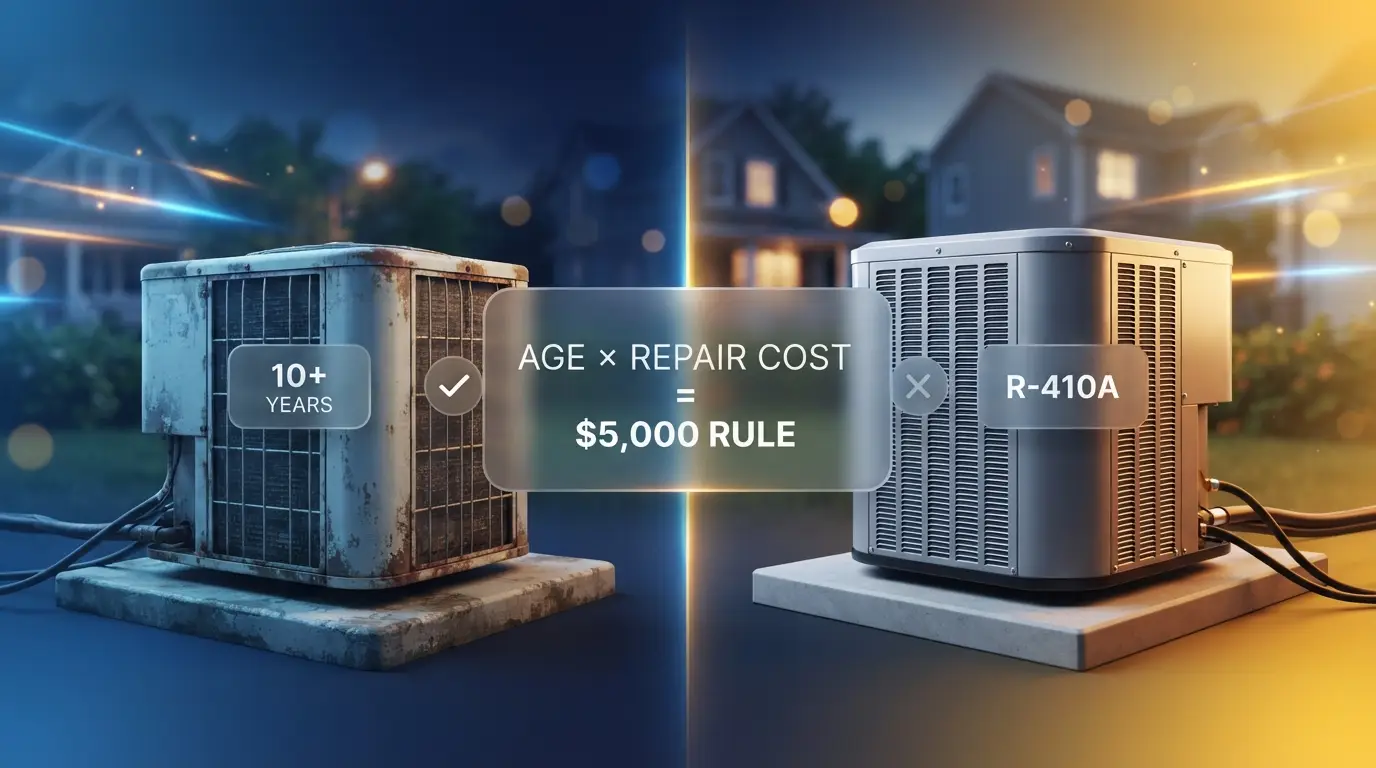
“Is it worth repairing an AC over 10 years old? In most cases, yes, if the repair costs less than $500, the system still runs efficiently, and it has no major component failures. Replacement usually makes more sense once repair costs exceed the $5,000 rule, energy bills climb, or the unit uses outdated R-22 refrigerant.”
KEY TAKEAWAYS
If your repair bill is under $500 and the AC still runs well, fixing it is usually the smarter choice.
The $5,000 rule (unit age multiplied by repair cost) gives you a fast way to decide: cross $5,000, and replacement wins.
Systems using R-22 refrigerant almost always cost more to repair than to replace, since the refrigerant is scarce and expensive.
A 10 to 15-year-old AC in Lafayette’s humidity works harder than the same unit up north, which shortens its useful life.
Rising energy bills, even after a normal repair, often signal declining efficiency that only a new system fixes.
Your air conditioner just broke again, and it’s already over 10 years old. You want a straight answer. Should you pay for one more repair, or is it time to replace the whole system?
This is one of the most common calls Fontenot’s AC & Heating gets in Lafayette. Louisiana’s heat and humidity push older systems harder than most manufacturers ever planned for. As a result, the right answer depends on a few specific factors, not just the age printed on the nameplate.
In this guide, you’ll learn how long AC units really last in Southern Louisiana. You’ll also get a simple decision framework, real cost ranges, and the warning signs that mean replacement beats another repair.
Is It Worth Repairing an AC Over 10 Years Old? The Short Answer
In most cases, yes, if the repair is minor. Repairing an AC over 10 years old makes sense when the fix costs under $500 and the unit still cools evenly. Replacement becomes the better investment once repairs pile up, energy bills rise, or the compressor fails. Louisiana’s humidity adds extra strain, so age alone should never be your only test.
A simple check works well here: multiply the unit’s age by the repair cost. If that number passes $5,000, most Lafayette technicians recommend replacement instead of another repair. We’ll break this down fully later in this guide.
How Long Should an AC Unit Last in Lafayette, LA?
Average AC Lifespan in Southern Louisiana
Most residential air conditioners last between 12 and 17 years nationally, according to the U.S. Department of Energy. In Southern Louisiana, that range often shrinks. Homeowners in Lafayette, Broussard, and Youngsville frequently see units start struggling around year 10 to 12.
This shorter lifespan comes down to how hard the system works. Your AC runs more hours per year here than in drier, cooler states. More run time means more wear on the compressor and coils.
How Louisiana’s Heat and Humidity Affect AC Longevity
Humidity forces your air conditioner to do two jobs at once. It has to cool the air and pull moisture out of it. This second job, called latent cooling, adds extra strain that units in Arizona or Colorado rarely deal with.
Coastal air in Lafayette also carries more moisture than inland regions. Over time, this speeds up corrosion on outdoor coils and electrical components. Have you noticed your outdoor unit rusting faster than expected? That’s a common sign of this exact issue.
Factors That Shorten an Air Conditioner’s Lifespan
A few factors consistently cut an AC’s useful life short in this region:
Skipped or delayed maintenance, especially annual coil cleaning
Oversized or undersized units that cycle too often or run too long
Poor airflow caused by dirty filters or blocked vents
Heavy daily use during Louisiana’s long cooling season, often 7 to 8 months a year
Each of these speeds up wear on the compressor, the most expensive part to replace. Understanding these factors helps you judge whether your specific unit is aging faster or slower than average.
With that lifespan context in mind, here’s when a repair still makes financial sense.
When Repairing a 10+ Year-Old AC Makes Sense
Minor Repairs With Low Costs
Small, inexpensive repairs almost always justify keeping your current system. A capacitor replacement, a refrigerant leak fix, or a new contactor typically costs between $150 and $450. These repairs restore full function without touching the compressor or coils, the two most expensive components.
A Well-Maintained System With Few Previous Repairs
If your AC has had annual tune-ups and a few breakdowns, it has likely aged more slowly than average. A well-maintained 10 or 11-year-old unit can often run efficiently for several more years. Consistent maintenance matters more than the number on the birth certificate.
Reliable Cooling Performance and Stable Energy Bills
Your energy bills tell an honest story. If your cooling costs have stayed roughly stable year over year, your system is still working efficiently. In this case, a single repair usually costs far less than a full replacement, making it the smarter short-term choice.
Not every situation fits this pattern, though. Here’s when repair stops making sense.
When Replacing Your Air Conditioner Is the Better Investment
Major Component Failure (Compressor, Coil, etc.)
A failed compressor is the single biggest turning point in any repair-or-replace decision. Compressor replacement alone often costs $1,800 to $2,800 in Lafayette. On a unit already over 10 years old, that expense rarely makes sense compared to a full system replacement.
Frequent Breakdowns
One repair is a fix. Three repairs in two years is a pattern. If your technician has visited more than twice in the past 24 months, your system is likely entering its failure phase. At this point, continued repairs become a losing bet.
Rising Energy Bills and Poor Humidity Control
An aging AC loses efficiency gradually before it fails completely. If your home feels sticky even when the thermostat reads correctly, your system may no longer manage humidity well. Combined with climbing energy bills, this usually signals it’s time to replace rather than repair.
Your System Uses R-22 Refrigerant
If your AC still runs on R-22 refrigerant, repairs cost significantly more than they used to. We cover this in full detail later in this guide, since it deserves its own explanation.
Your AC Is Near the End of its lifespan
A unit at 14, 15, or 16 years old in Lafayette’s climate is living on borrowed time. Even if it’s currently running, a major repair on a system this old rarely pays for itself. Replacement becomes the financially sound choice at this stage.
So how do you weigh all of this without guessing? Use this simple framework.
Repair vs. Replace: How to Make the Right Decision
Apply the $5,000 Rule
The $5,000 rule is the fastest gut-check in the HVAC industry. Multiply your AC’s age by the estimated repair cost. If the result exceeds $5,000, replacement typically saves you more money over time.
For example, a 12-year-old AC with a $500 repair estimate equals 6,000 (12 x 500). That crosses the threshold, pointing toward replacement. A 10-year-old unit with a $300 repair equals 3,000, which usually still favors repair.
Estimate Future Repair Expenses
One repair rarely happens in isolation on an aging system. Ask your technician what else is likely to fail within the next year or two. Factoring in future repairs, not just today’s bill, gives you a more accurate picture.
Calculate Long-Term Energy Savings
Newer AC units typically run 20 to 40 percent more efficiently than models installed over a decade ago, according to ENERGY STAR. Over 10 years, that efficiency gap can offset a large portion of the replacement cost through lower monthly bills.
Consider How Long You Plan to Stay in Your Home
Your timeline matters as much as the numbers. If you plan to sell within a year or two, a smaller repair may make more sense. If you’re staying long-term, a new system pays for itself through savings and reliability.
Here’s a quick summary you can use as a reference:
Situation
Repair
Replace
Repair cost
Under $500
Over $1,500
Age x Repair Cost ($5,000 Rule)
Under $5,000
Over $5,000
Repairs in the past 2 years
0 to 1
2 or more
Refrigerant type
R-410A
R-22
Energy bills
Stable
Rising
Once you know which side of that table you’re on, the next question is cost. Here’s what repairs and replacements actually run in Lafayette.
Typical AC Repair Costs vs. Replacement Costs in Lafayette, LA
Common AC Repair Costs
Repair costs vary based on the failed part. Typical ranges in the Lafayette area include:
Capacitor or contactor replacement: $150 to $350
Refrigerant leak repair (non-R-22): $300 to $700
Blower motor replacement: $400 to $900
Compressor replacement: $1,800 to $2,800
These are realistic ranges, not fixed quotes. Your exact cost depends on your specific system and the technician’s diagnosis.
Average AC Replacement Costs
A full AC replacement in Lafayette typically ranges from $4,500 to $9,500, depending on system size and efficiency rating. Higher SEER ratings cost more upfront, but lower your monthly energy bills over time.
Factors That Affect Replacement Pricing
Several factors move this price up or down:
Home square footage and cooling load
The SEER efficiency rating you choose
Ductwork condition, since damaged ducts add cost
Whether you replace just the outdoor unit or the full system
Compressor failure comes up so often that it deserves its own closer look.
Is Replacing the Compressor Worth It?
When Compressor Replacement Makes Sense
If your AC is under 8 years old and otherwise healthy, replacing just the compressor can be worth it. On a newer system, this repair often extends the unit’s life by several more years at a fraction of full replacement cost.
When Replacing the Entire System Is the Better Investment
On a unit already past 10 years, a failed compressor is usually the final sign. Since the rest of the system is aging alongside the compressor, most homeowners get better long-term value from full replacement instead.
Compressor age isn’t the only factor working against older systems. Refrigerant type matters just as much.
Is It Worth Repairing an AC That Uses R-22 Refrigerant?
Why R-22 Repairs Cost More
The United States phased out R-22 production in 2020, according to the U.S. Environmental Protection Agency. Since supply is limited, remaining R-22 now costs far more than modern refrigerants. A leak repair that once cost $300 can now run well over $1,000 on an R-22 system.
When Replacing an R-22 System Is the Smarter Choice
If your outdoor unit still uses R-22, replacement usually beats repair, even for smaller issues. Modern systems use R-410A, which is both more available and more efficient. This switch alone often improves cooling performance in Lafayette’s humidity.
Refrigerant type also affects a bigger question: should you replace the whole system, or just part of it?
Should You Replace the Entire HVAC System or Just the Outdoor Unit?
When Replacing Both Indoor and Outdoor Units Makes Sense
Manufacturers design indoor and outdoor units to work together as matched pairs. If your air handler is also over 10 years old, replacing both at once usually improves efficiency and reliability more than swapping just one part.
When Keeping Your Existing Air Handler Is an Option
If your indoor air handler is newer, in good condition, and compatible with a new outdoor unit, keeping it can save money. Your technician can confirm compatibility before recommending a partial or full replacement.
There’s one more option worth considering before you decide, especially if you’re already planning a replacement.
Should You Consider a Heat Pump Instead?
Heat Pump vs. Central Air Conditioner
A heat pump cools your home in summer and heats it in winter, unlike a standard AC that only cools. For homeowners replacing an aging system, this dual function can replace an aging furnace at the same time.
Is a Heat Pump a Good Choice for Lafayette, LA?
Lafayette’s mild winters make heat pumps a practical option for many homes. Since temperatures rarely drop far below freezing, a heat pump can handle heating needs efficiently without a backup furnace in most cases.
Whichever direction you choose, a few financial incentives can lower your final cost.
Warranties, Rebates, and Tax Credits That Can Reduce Replacement Costs
Manufacturer Warranty Coverage
New AC systems typically include a 10-year manufacturer’s warranty on parts when registered within 60 to 90 days of installation. This warranty can save thousands if a major component fails early.
Available Energy-Efficiency Rebates
Many utility providers offer rebates for high-efficiency AC installations. These programs change often, so ask your installer which current rebates apply in the Lafayette area before you finalize your decision.
Federal Tax Credits for High-Efficiency HVAC Systems
The federal government currently offers tax credits for qualifying high-efficiency HVAC systems under the Energy Efficient Home Improvement Credit, according to the Internal Revenue Service. These credits can offset a meaningful portion of your replacement cost.
Before you make your final call, run through these questions with your technician and with yourself.
Questions to Ask Before Making Your Final Decision
Questions to Ask Your HVAC Technician
What specifically failed, and is it likely to fail again?
How does my repair cost compare using the $5,000 rule?
What SEER rating would fit my home if I replace?
Are there current rebates or tax credits available?
Questions to Ask Yourself
How long do I plan to stay in this home?
Can I comfortably afford a full replacement right now?
Have my energy bills been rising steadily?
How many repairs has this system needed in the past two years?
Conclusion
Deciding whether to repair or replace an AC over 10 years old comes down to a few clear signals. Minor repairs on a well-maintained system usually make sense. Major component failures, R-22 refrigerant, and rising energy bills usually point toward replacement.
The $5,000 rule gives you a fast, reliable gut-check when you need one. However, your specific home, budget, and timeline also matter. Lafayette’s heat and humidity add extra pressure that homeowners in other regions rarely face.
Fontenot’s AC & Heating has walked local homeowners through this exact decision for years. We know Southern Louisiana’s climate, and we’ll give you a straight answer, not a sales pitch.
Most repairs on a 10-year-old AC cost between $150 and $700, depending on the failed part. Simple fixes like capacitors run on the lower end. Compressor repairs cost significantly more, often $1,800 or higher, which usually points toward replacement instead.
What is the $5,000 rule for AC replacement?
The $5,000 rule multiplies your AC’s age by the repair cost estimate. If that number exceeds $5,000, replacement typically saves more money long-term. It’s a fast way to compare repair versus replacement without a full cost analysis.
Is it worth replacing just the AC compressor?
Compressor replacement makes sense on units under 8 years old that are otherwise healthy. On systems already past 10 years, full replacement usually offers better long-term value, since other components are aging at the same rate.
How long do AC units last in Lafayette, Louisiana?
Most units last 12 to 17 years nationally, but Lafayette’s heat and humidity often shorten that range. Many homeowners see performance decline starting around year 10 to 12 due to the extra strain of constant humidity control.
Should I repair or replace an AC that uses R-22 refrigerant?
Replacement is usually smarter for R-22 systems. Since production stopped in 2020, R-22 costs far more than modern refrigerants. Even small repairs can cost significantly more than they would on a newer, R-410A-based system.