
Heat Pump Guide: How Heat Pumps Work, Cost, Efficiency & Maintenance in Louisiana
Search
Recent Posts
Tags
Follow Us on
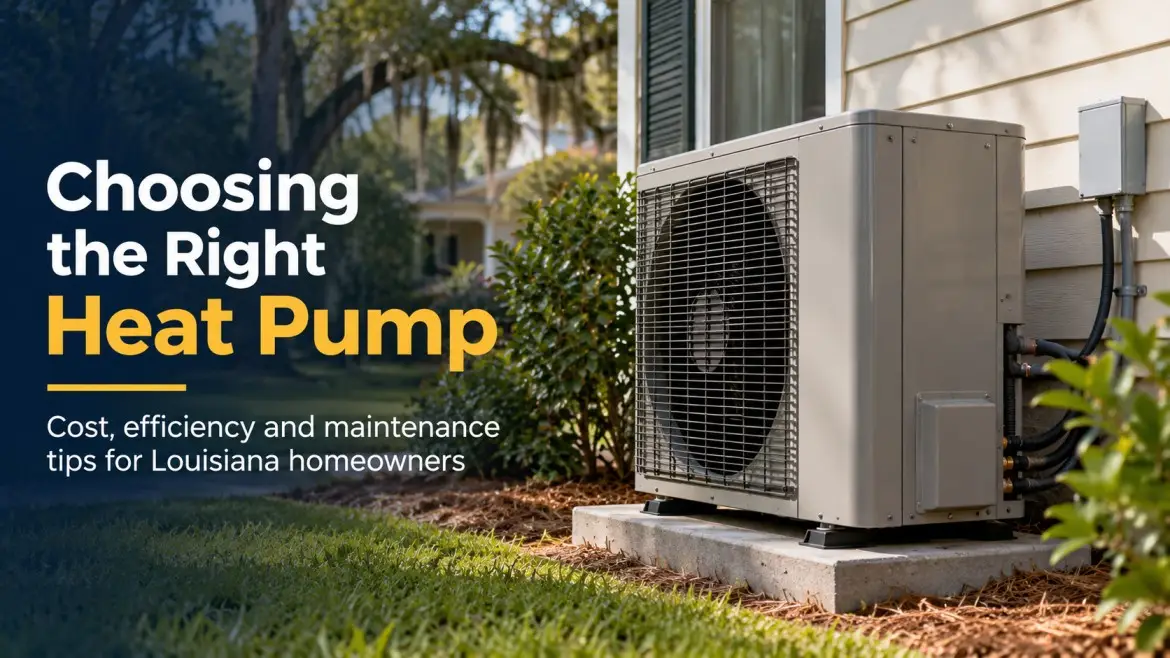
A heat pump is a single electric system that cools your home in summer and heats it in winter by moving heat instead of burning fuel to make it. In Louisiana’s long, humid cooling season and short, mild winters, a correctly sized heat pump can be an efficient year-round choice. Cost, efficiency, and comfort depend heavily on system type, sizing, ductwork, and installation quality, so a proper in-home evaluation matters more than any online estimate. This Heat Pump Guide covers what Louisiana homeowners need to know about choosing, installing, and maintaining a heat pump.
Key Takeaways
- In Acadiana, cooling efficiency matters more than heating efficiency. Pay close attention to SEER2 and EER2 ratings, and to how well a system removes humidity, since that is where most of your operating hours go.
- Heat pumps still work in Louisiana cold snaps, but they lean on backup heat. Expect electric heat strips to run more during hard freezes, and expect a higher bill during those stretches.
- The federal heat pump tax credit is gone for 2026 installations. The 25C credit ended for systems placed in service after December 31, 2025, so be cautious with quotes that still advertise it.
- Sizing should come from a load calculation, not square footage. An oversized heat pump in a humid climate can cool the air quickly but leave your home feeling damp.
- Installation quality affects results as much as the equipment brand. Duct condition, refrigerant charge, airflow, and matched components all shape efficiency, comfort, and warranty coverage.
If you are replacing an aging system, building an addition, or wondering whether a heat pump makes sense instead of an AC and furnace, you are probably weighing several unknowns at once: how the technology works, whether it can handle a Louisiana winter, what it realistically costs, and what keeps it running well. This guide walks through each of those questions with the local climate in mind, so you can compare options, ask contractors better questions, and decide what fits your home.
What Is a Heat Pump?
A heat pump is an electric heating and cooling system that transfers heat from one place to another. In summer, it pulls heat out of your home and releases it outdoors, working just like a central air conditioner. In winter, it reverses the process, pulling heat from the outdoor air (or the ground) and moving it inside.
The key difference from a furnace or electric heater is that a heat pump does not create heat by burning gas or running electricity through a heating element. It moves heat that already exists. According to the U.S. Department of Energy, heat pumps use electricity to move heat from a cool space to a warm space, much like a refrigerator, and because they transfer heat rather than generate it, they can efficiently maintain comfortable temperatures.
That is why heat pumps can deliver more heat energy than the electricity they consume. ENERGY STAR notes that an air-source heat pump can deliver up to three times more heat energy to a home than the electrical energy it uses. (ENERGY STAR)
For most Acadiana homeowners, a heat pump replaces two pieces of equipment: the central air conditioner and the heating system. You get one outdoor unit and one indoor air handler serving both seasons.
How Does a Heat Pump Work?
How a Heat Pump Heats and Cools Your Home
In cooling mode, the indoor coil gets cold as refrigerant absorbs heat from the air your blower pushes across it. That heat travels through copper refrigerant lines to the outdoor unit, where the outdoor coil and fan release it outside. Along the way, moisture in your indoor air condenses on the cold coil and drains away, which is how the system dehumidifies.
In heating mode, a component called the reversing valve switches the direction refrigerant flows. Now the outdoor coil becomes the cold side. Even when it feels chilly outside, outdoor air still contains heat energy, and the very cold refrigerant in the outdoor coil can absorb it. The compressor concentrates that heat, and the indoor coil releases it into the air moving through your ducts.
This is also why heat pump air can feel different from furnace air. A gas furnace often delivers very hot air in short bursts. A heat pump usually delivers warm, not hot, air over longer run times. That is normal operation, not a sign something is wrong.
Understanding the Refrigeration Cycle
Every heat pump runs on the same four-step cycle, whether it is heating or cooling:
- Evaporation: Low-pressure liquid refrigerant enters a coil and absorbs heat from the surrounding air, turning into a vapor.
- Compression: The compressor squeezes that vapor, raising its pressure and temperature well above the temperature of the space it is about to heat.
- Condensation: The hot vapor flows through the other coil, releases its heat to the surrounding air, and condenses back into a liquid.
- Expansion: An expansion device drops the refrigerant’s pressure, making it cold again so the cycle can repeat.
The reversing valve simply decides which coil does the absorbing and which does the releasing. Because this is a sealed, pressurized system, refrigerant work requires EPA-certified technicians and specialized tools. It is never a homeowner job.
What Are the Main Parts of a Heat Pump?
A typical split-system heat pump in a Louisiana home includes:
- Outdoor unit: Houses the compressor, outdoor coil, outdoor fan, and reversing valve. It also manages defrost cycles in winter.
- Indoor air handler: Contains the indoor coil and the blower that moves air through your ducts. It often also holds the electric backup heat strips.
- Refrigerant line set: The insulated copper tubing connecting the indoor and outdoor units.
- Expansion device: Controls refrigerant flow and pressure between the coils.
- Thermostat: A heat pump needs a compatible thermostat that can control the reversing valve and backup heat staging properly.
- Condensate drain system: The drain pan and line that carry away moisture removed from your air. In a humid climate, this line handles a lot of water, so clogs are a common service issue.
- Ductwork: The supply and return ducts that distribute air (not present in ductless systems).
How Cold Weather Affects Performance
As outdoor temperatures drop, there is less heat available to capture, so a heat pump’s heating output and efficiency decline. At the same time, your home loses heat faster. At some point, the heat pump alone may not keep up, and backup heat starts to help. In winter, frost can also build up on the outdoor coil, so the system periodically runs a short defrost cycle.
For most of the Louisiana heating season, these effects are modest. They become noticeable during freezes and hard cold snaps, which are covered in detail in the Louisiana winter section below.
Heat Pump Guide: What Are the Different Types of Heat Pumps?
Air-Source Heat Pumps
Air-source heat pumps exchange heat with outdoor air and are by far the most common type in residential homes. The Department of Energy describes the air-source heat pump as the most common type, transferring heat between your house and the outside air. Most are ducted split systems that connect to existing ductwork, which makes them a natural replacement for a central AC and furnace or an older heat pump.
For a typical Lafayette, Broussard, or Youngsville home with existing ducts, a ducted air-source heat pump is usually the first option worth evaluating.
Ductless Mini-Split Heat Pumps
Ductless mini-splits pair an outdoor unit with one or more indoor wall, ceiling, or floor units. Each indoor unit serves a room or zone and has its own control. They make sense for garage conversions, room additions, sunrooms, older homes without ductwork, or rooms that never stay comfortable on the central system.
Because they avoid duct losses and usually use variable-speed compressors, mini-splits can be very efficient. The trade-off is cost per zone and the look of indoor units, and whole-home mini-split systems need careful design so each zone is sized correctly.
Geothermal Heat Pumps
Geothermal (ground-source) heat pumps exchange heat with the earth through buried piping loops rather than with outdoor air. Because underground temperatures stay steadier than air temperatures, these systems can be extremely efficient. DOE reports that high-efficiency geothermal heat pumps, such as ENERGY STAR-certified models, use 61% less energy than a standard model and help control humidity.
The major obstacle is installation cost. The ground loop requires drilling or trenching, and site conditions such as lot size, soil, and water table affect feasibility. For many Acadiana homes, geothermal is a niche option rather than a default recommendation.
Dual-Fuel (Hybrid) Heat Pumps
A dual-fuel system pairs an electric heat pump with a gas furnace. The heat pump handles cooling and most heating, and the furnace takes over when outdoor temperatures drop below a set point or when gas heat becomes cheaper to run than the heat pump.
Dual fuel can make sense if you already have natural gas service and a furnace in good condition, or if you strongly prefer the feel of gas heat during cold snaps. Because it involves combustion equipment, it also means continuing gas-safety maintenance and carbon monoxide awareness.
Ducted vs. Ductless Heat Pumps
| Factor | Ducted Heat Pump | Ductless Mini-Split |
| Best fit | Homes with existing ducts in fair or good condition | Additions, conversions, homes without ducts, problem rooms |
| Temperature control | Usually one thermostat per system (zoning possible) | Individual control per indoor unit |
| Efficiency factors | Duct leakage and duct location can reduce real-world efficiency | No duct losses; typically variable-speed |
| Appearance | Hidden equipment, only registers visible | Indoor units visible on walls or ceilings |
| Installation | Often straightforward if ducts are usable | Requires line sets and drains to each indoor unit |
| Humidity control | Good, especially with variable-speed models | Good, but depends on sizing and run times in each zone |
If your ducts run through a hot attic and have leaks or poor insulation, you may lose a noticeable share of the efficiency you paid for. A ducted system is only as good as the duct system it connects to.
How to Choose the Right Type
Start with what your home already has. If you have existing ducts and a central system, a ducted air-source heat pump is usually the most practical path, provided the ducts can be sealed or corrected where needed. If you need to condition space the central system does not reach, a ductless unit is often cleaner than extending ducts. If you have gas service and want gas backup, consider dual fuel. Geothermal is worth a conversation mainly when long ownership, suitable land, and budget all line up.
A good contractor should explain why a particular type fits your home rather than defaulting to whatever is in stock.
Are Heat Pumps a Good Choice for Louisiana?
How Louisiana’s Hot-Humid Climate Affects Performance
Acadiana falls in the hot-humid climate category used in building energy codes. That means long cooling seasons, high summer dew points, and relatively few hours of true heating demand. For a heat pump, this is favorable: the system spends most of its life in cooling mode, where it performs exactly like a central air conditioner, and it handles the mild heating months efficiently.
The climate also shifts what you should prioritize. DOE guidance notes that in warmer climates, SEER (cooling efficiency) matters more than HSPF (heating efficiency). In practical terms, a Louisiana homeowner comparing models should weigh cooling efficiency and dehumidification ability first, with heating ratings second.
How Heat Pumps Handle Louisiana Summers and Humidity
In summer, a heat pump is an air conditioner. It does two jobs at once: lowering air temperature (sensible cooling) and pulling moisture out of the air (latent cooling). In a humid climate, the moisture job is just as important for comfort. A home at 75°F with high humidity can feel sticky and warmer than a home at 77°F with well-controlled humidity.
Heat pumps with variable-speed or two-stage compressors tend to handle this better because they can run longer at lower capacity, giving the indoor coil more time to stay cold and remove water. DOE states that high-efficiency heat pumps dehumidify better than standard central air conditioners, which can mean lower energy use and more cooling comfort during summer.
The most common summer comfort problem is not the heat pump technology itself. It is oversizing, which is covered in the sizing section below.
How Heat Pumps Perform During Louisiana Winters (Including Cold Snaps)
Most Acadiana winter days are mild enough for a heat pump to heat your home efficiently on its own. Performance becomes more noticeable during freezes and the occasional severe event, like the January 2025 winter storm that brought snow and hard freezes to South Louisiana.
During those periods, three things typically happen:
- The heat pump runs longer or continuously. This is normal when it is working to keep up with a larger heat loss.
- Backup heat strips engage. When the heat pump alone cannot hold the thermostat setting, electric resistance strips add heat. That keeps you warm but uses much more electricity.
- Defrost cycles become more frequent. You may see steam rising from the outdoor unit and hear a whoosh as the reversing valve shifts. That is usually normal.
A heat pump sized and installed for this climate should still keep a well-insulated home comfortable during a typical Louisiana freeze. What changes is the cost of those few days, not whether the system can heat.
How Heat Pumps Control Indoor Humidity
Humidity control depends on how the system is sized, how it is set up, and how it runs:
- Right-sizing lets the system run long enough to remove moisture instead of cooling quickly and shutting off.
- Variable-speed blowers and compressors can slow down to improve moisture removal.
- Dehumidification settings on some thermostats and air handlers reduce airflow when humidity is high.
- Proper airflow setup during installation matters. Airflow set too high can reduce moisture removal, and airflow set too low can cause other problems, including coil freezing.
The EPA recommends keeping indoor relative humidity below 60%, ideally in the 30% to 50% range, to limit mold growth. If your home regularly feels clammy even when the thermostat is satisfied, that is worth raising with a technician, because the cause can range from system sizing to duct leakage to airflow settings. In some homes, a dedicated whole-home dehumidifier is a better fix than a larger system.
How Efficient Are Heat Pumps?
Understanding COP, SEER2, EER2, and HSPF2
These ratings measure different things, and they are not interchangeable:
| Rating | What It Measures | Why It Matters in Acadiana |
| SEER2 | Seasonal cooling efficiency over a typical cooling season | The most important rating for a long Louisiana cooling season |
| EER2 | Cooling efficiency at a hot outdoor condition (95°F) | Shows how well a system performs on the hottest afternoons |
| HSPF2 | Seasonal heating efficiency | Relevant, but carries less weight in a mild heating climate |
| COP | Heat delivered divided by energy used, at a specific moment | Explains why a heat pump can deliver more heat than the electricity it consumes |
The “2” versions (SEER2, EER2, HSPF2) come from an updated federal test procedure that took effect in 2023. The new procedure better reflects real duct conditions, so SEER2 numbers read lower than older SEER numbers for the same equipment. When comparing quotes, make sure you are comparing SEER2 to SEER2, not a new rating to an old one.
Under current federal standards, new split-system heat pumps must meet at least 14.3 SEER2 and 7.5 HSPF2. Higher-efficiency models exceed that, often with two-stage or variable-speed compressors.
A COP of 3 means the heat pump delivers three units of heat for every unit of electricity it uses. Electric resistance heat, by comparison, has a COP of 1.
How Outdoor Temperature Affects Efficiency
A heat pump’s efficiency is not fixed. It moves with the weather:
- In heating mode, efficiency is highest in mild weather and drops as it gets colder, because there is less heat to capture outdoors and the compressor has to work harder.
- In cooling mode, efficiency drops as outdoor temperatures climb, because the system must reject heat into hotter air.
That is why EER2 is useful for Louisiana buyers. SEER2 reflects a seasonal average, while EER2 shows performance under peak heat conditions, when your system works hardest and electricity demand is highest. Keeping the outdoor coil clean and unobstructed also helps, since a dirty coil makes the system work harder in both seasons.
Single-Stage vs. Two-Stage vs. Variable-Speed
- Single-stage systems run at full capacity every time they turn on. They cost the least up front, but they tend to cycle on and off more and remove less humidity during mild, muggy weather.
- Two-stage systems have a low setting for most days and a high setting for peak heat or cold. Longer, gentler run times usually improve comfort and dehumidification.
- Variable-speed (inverter) systems adjust capacity across a wide range to match your home’s demand closely. They typically offer the best humidity control and the steadiest temperatures, at a higher purchase price.
For humid Acadiana homes, the jump from single-stage to two-stage or variable-speed often shows up more in comfort than on the utility bill. Whether the added cost is worth it depends on how long you plan to stay, how much humidity bothers you, and your budget.
How Much Electricity Does a Heat Pump Use?
There is no single answer, because use depends on system size, efficiency, thermostat settings, insulation, duct condition, and weather. You can still get a rough sense of scale.
Here is a simplified, hypothetical example for cooling. A 3-ton heat pump has 36,000 BTUs per hour of cooling capacity. At 16 SEER2, dividing 36,000 by 16 gives roughly 2,250 watts, or about 2.25 kWh for each hour of full-capacity operation under seasonal average conditions. Actual draw varies with outdoor temperature and stage, but that math shows why efficiency ratings matter over thousands of summer operating hours.
In heating mode, a heat pump’s biggest electricity driver in Louisiana is often backup heat. Heat strips draw a large amount of power, so a system that relies on them more than necessary, because of a thermostat setup issue, a refrigerant problem, or undersizing, can raise winter bills sharply. For a heat pump in good condition, DOE says today’s models can cut the electricity used for heating by up to 75% compared with electric resistance heating such as baseboard heaters. (U.S. Department of Energy)
Heat Pump Costs and Potential Savings in Louisiana
Average Installation Cost by System Type
National pricing gives you a starting point, but it is not a quote. Prices in Acadiana depend on local labor, equipment availability, and the condition of your home.
| System Type | National Installed Cost Range (2026) |
| Ducted air-source heat pump | $4,000–$14,000 |
| Ductless mini-split | $2,000–$12,000 per zone |
| Geothermal heat pump | $12,000–$40,000+ |
These ranges come from ConsumerAffairs’ July 2026 cost guide, which lists ducted air-source systems at $4,000 to $14,000 installed, mini-splits at $2,000 to $12,000 per zone, and geothermal at $12,000 to $40,000 or more. (ConsumerAffairs) Other data sources report higher averages. EnergySage, drawing on real quotes from its marketplace, puts the national average for a whole-home heat pump setup at about $15,393 before incentives, with wide variation from state to state. (EnergySage)
The gap between sources is a reminder that “average” depends on what is included: equipment only versus a complete system, basic versus high-efficiency, and simple swap versus a project with duct or electrical work.
Factors That Affect Installation Costs
- Capacity: Larger systems cost more, but the right size should come from a load calculation.
- Efficiency and compressor type: Two-stage and variable-speed systems typically cost more than single-stage models.
- Scope of replacement: Replacing only the outdoor unit is rarely recommended, because mismatched indoor and outdoor components can affect efficiency, reliability, and warranty coverage.
- Refrigerant line set: New equipment uses newer refrigerants. Depending on the existing line set’s size, condition, and compatibility, it may need to be replaced.
- Ductwork: Sealing leaks, repairing damaged runs, adding returns, or resizing sections adds cost but can matter a great deal for comfort.
- Electrical work: Converting from gas heat, adding heat strips, or upgrading a panel or circuit changes the price.
- Air handler location and access: Attic installations with tight access can take more labor.
- Permits, thermostat upgrades, drain safety devices, and equipment pads also affect the final number.
Replacement vs. New Installation Costs
A like-for-like replacement of an existing heat pump tends to be the most predictable project, since the ducts, electrical service, and drain routing are already in place. Costs rise mainly if the ductwork or line set needs attention.
A conversion from a central AC and gas furnace to a heat pump can involve removing or capping the gas furnace, installing an air handler with backup heat, adding electrical capacity, and updating controls. A dual-fuel setup may avoid some of that by keeping the furnace.
A new installation in a home or space without ducts, such as an addition, typically favors ductless equipment unless new ductwork makes sense for the layout.
If you are comparing quotes, ask each contractor to list what is included: equipment model numbers, line set, duct work, electrical, permits, removal of old equipment, and warranty terms. Two quotes that look far apart may simply cover different scopes.
Operating Costs and Potential Energy Savings
Savings depend on what you are replacing. The largest potential gains usually come from moving away from electric resistance heat or from a much older, low-efficiency system. Replacing a relatively recent AC and gas furnace may produce smaller savings, and the result depends on local electricity and gas rates.
Real-world operating costs also depend on things the equipment label cannot control: duct leakage, attic insulation, window performance, thermostat habits, and how often backup heat runs. A higher-SEER2 heat pump connected to leaky attic ducts will not deliver its rated performance. Any contractor who promises a specific bill reduction without reviewing your home and usage history is guessing.
Louisiana Heat Pump Rebates and Incentives
Incentives have changed sharply over the past year, so older articles and quotes may be out of date.
The federal 25C tax credit has ended for new installations. The 25C and 25D credits were terminated for systems placed in service after December 31, 2025, under the One Big Beautiful Bill Act signed on July 4, 2025. If your heat pump was installed and in service in 2025, you may still be able to claim that year’s credit on your 2025 return; a tax professional can confirm your situation.
Louisiana’s federally funded home energy rebate programs are not yet open to consumers. Louisiana’s energy office announced it will administer the Home Efficiency Rebate (HER) and Home Electrification and Appliance Rebate (HEAR) programs, which together represent more than $200 million in rebates for single-family and multifamily properties. (Louisiana Department of Energy and Natural Resources) HEAR is designed as a point-of-sale rebate for low- to moderate-income households earning less than 150% of area median income, and heat pumps are among the eligible upgrades.
However, rebate trackers reported that as of July 2026, Louisiana’s HOMES and HEAR programs had not launched. Check the state energy office directly for current status before counting on these funds, since rebates are generally not paid for work done before a program opens.
Utility and manufacturer programs change frequently. Ask your electric provider, such as LUS or SLEMCO, whether any efficiency programs currently apply, and ask your contractor about manufacturer promotions. Confirm eligibility and equipment requirements in writing before signing a contract.
How to Choose the Right Heat Pump for Your Home
How to Determine the Right Size (Manual J Load Calculation)
Heat pump size should never be picked by square footage alone. Two 1,800-square-foot homes in Youngsville can need very different capacities depending on attic insulation, window area and orientation, shading, air leakage, ceiling height, and duct location.
The industry-standard approach is an ACCA Manual J load calculation, which estimates how much heating and cooling your home actually needs under local design conditions. Equipment is then selected to match that load (ACCA Manual S), and ducts are evaluated or designed to deliver the right airflow (ACCA Manual D).
Sizing matters more in a humid climate than many homeowners expect:
- Oversized systems cool the air quickly, satisfy the thermostat, and shut off before removing enough moisture. The result is short cycling, a clammy feel, more wear, and sometimes higher bills.
- Undersized systems may struggle on the hottest afternoons and lean more heavily on heat strips during freezes.
If a contractor offers to “just match what you have,” ask whether the old system was ever sized correctly. Homes often change over time with new windows, added insulation, or enclosed porches.
Choosing Based on Your Home and Climate
For Acadiana homes, a few priorities tend to rise to the top:
- Cooling efficiency and dehumidification first. Weigh SEER2, EER2, and compressor type heavily.
- Duct condition. If ducts run through a hot attic, have them inspected for leaks, disconnections, and insulation problems before or during replacement.
- Backup heat sized appropriately. Heat strips should be sized for your home’s needs during cold snaps, not simply the largest kit available.
- Outdoor unit placement. Good airflow around the unit, a stable level pad, and reasonable protection from debris help performance. In homes near the coast or in flood-prone areas, ask about equipment elevation and corrosion-resistant coil options.
- Controls. A thermostat designed for heat pumps, set up to limit unnecessary strip heat, can make a real difference in winter bills.
What to Look for in a Warranty
Warranties vary widely, and the details matter:
- Parts vs. labor: Manufacturer warranties usually cover parts. Labor coverage often comes from the installer, and terms differ.
- Registration requirements: Many manufacturers offer longer parts coverage only if the equipment is registered within a set window after installation. Ask who handles registration.
- Compressor coverage: Check whether the compressor has a longer term than other parts.
- Matched system requirements: Some coverage depends on installing matched indoor and outdoor components.
- Transferability: If you may sell your home, find out whether coverage transfers to a new owner.
- Maintenance conditions: Some warranties expect proof of regular professional maintenance.
Get every warranty term in writing, including what the installer covers separately from the manufacturer.
How to Compare Brands and Manufacturers
Brand reputation matters less than most homeowners assume. Many brands share components, and installation quality often has a bigger effect on how a system performs and how long it lasts.
A better comparison looks at:
- The specific matched system, not just the outdoor unit. Ask for the AHRI certificate, which confirms the rated efficiency for that exact indoor-outdoor combination.
- Compressor type and efficiency ratings for each option.
- Local parts availability and support, which affects how quickly repairs can happen.
- Warranty terms as described above.
- The installer’s experience with that equipment line.
Also expect new equipment to use newer, lower-global-warming-potential refrigerants such as R-454B or R-32. This is a result of federal rules on new equipment manufacturing, not a reason to fear the equipment. These refrigerants are classified as mildly flammable (A2L), and installers follow updated safety standards and equipment designs when working with them.
What to Expect During Heat Pump Installation
How Long Does Installation Take?
A straightforward replacement of an existing ducted heat pump is often completed in one to two days. Projects take longer when they include ductwork repairs or replacement, electrical upgrades, a conversion from gas heat, a new air handler location, or a multi-zone ductless system. Your contractor should give you a timeline based on your specific scope.
What Is Involved in the Installation Process?
A typical ducted replacement includes:
- Recovering refrigerant from the old system using EPA-required procedures.
- Removing old equipment, including the outdoor unit and, when replaced, the indoor air handler or coil.
- Setting the new outdoor unit on a level pad with proper clearance.
- Installing the indoor air handler or coil and connecting it to the ductwork.
- Installing or preparing the refrigerant line set, then pressure-testing for leaks and evacuating the system to remove moisture and air.
- Completing electrical connections, including the disconnect and any backup heat circuits.
- Connecting the condensate drain and any safety switch that shuts the system down if the drain backs up.
- Installing and configuring the thermostat for heat pump operation and backup heat.
- Commissioning the system: checking refrigerant charge, airflow, temperatures, and operation in both heating and cooling modes.
The commissioning step is where installation quality often shows. Incorrect refrigerant charge or airflow can reduce efficiency and comfort even on brand-new, high-efficiency equipment. Ask your installer what measurements they take and whether they will share the startup readings.
Preparing Your Home for Installation
- Clear a path to the indoor equipment location, whether that is a closet, garage, or attic access.
- Move vehicles, furniture, plants, or stored items away from the outdoor unit area.
- Secure pets away from work areas and open doors.
- Ask whether a permit is required and who will schedule any inspection.
- Plan for the system to be off for part of the day. In summer heat, plan for a cooler room, fans, or time away if needed, especially for young children, older adults, or anyone sensitive to heat.
How to Choose a Heat Pump Contractor in Louisiana
What to Look for in an Installer
- Proper licensing and insurance. Verify licensing through the Louisiana State Licensing Board for Contractors and ask for proof of liability insurance.
- EPA Section 608 certification for technicians who handle refrigerant, which federal law requires.
- A load calculation rather than a size guess based on the old equipment or square footage.
- Duct evaluation as part of the estimate.
- Written, itemized quotes showing model numbers, scope, and warranty terms.
- Clear commissioning practices, including refrigerant charge verification and airflow checks.
Questions to Ask Before Hiring
- How did you determine the size you are recommending?
- Is the quote for a complete matched system, and can I see the AHRI certificate?
- Will you inspect my ductwork, and what changes, if any, do you recommend?
- Does my existing line set need to be replaced for this equipment?
- How will you size and control the backup heat strips?
- What refrigerant does this system use, and how does that affect future service?
- Who registers the warranty, and what labor warranty do you provide?
- Is a permit required, and will you handle it?
- What maintenance schedule do you recommend for this system?
A contractor who welcomes these questions and answers them specifically is usually a good sign.
Why Local Climate Experience Matters
Heat pump advice written for cold northern climates often focuses on heating performance at extreme lows. In Acadiana, the more common challenges are different: long cooling seasons, sticky humidity, overflowing condensate lines, attic ductwork exposed to extreme heat, salt air near the coast, and short winter cold snaps that expose poorly configured backup heat.
An installer who understands these conditions is more likely to prioritize dehumidification, set airflow for humidity control, specify drain safety devices, and configure the thermostat so strip heat runs only when it should.
Heat Pump vs. Traditional HVAC Systems
Heat Pump vs. Central AC and Furnace
In cooling mode, a heat pump and a central air conditioner work the same way. The difference is winter. A central AC paired with a gas furnace burns gas for heat, while a heat pump moves heat with electricity. You maintain one system instead of two, and you remove combustion equipment from the home unless you choose dual fuel.
| Factor | Heat Pump | Central AC + Gas Furnace |
| Heating source | Electricity (moves heat) | Natural gas (burns fuel) |
| Cooling | Same as a central AC | Central AC |
| Winter air feel | Warm, steady air over longer cycles | Hotter air in shorter bursts |
| Cold-snap operation | Relies more on backup heat strips | Furnace output is not affected by outdoor temperature |
| Combustion safety | No combustion (unless dual fuel) | Requires venting and CO awareness |
| Utility service | Electric only | Electric and gas |
Heat Pump vs. Gas Furnace
A gas furnace delivers strong heat regardless of outdoor temperature, which some homeowners prefer during freezes. A heat pump is typically more efficient across most mild Louisiana winter days and adds no combustion byproducts to the home. Operating cost comparisons depend on your local gas and electric rates and on how often backup heat would run. If you already have gas service and a furnace in good condition, dual fuel lets you use both strengths.
Heat Pump vs. Electric Resistance Heating
This is where a heat pump’s advantage is clearest. Electric furnaces, heat strips used as the main heat source, and baseboard heaters convert electricity directly into heat, one unit of heat for one unit of electricity. A heat pump moves heat instead, delivering more heat per unit of electricity for most of the heating season. If your home currently relies on an older electric furnace or strip heat for most of its heating, a heat pump is usually worth serious consideration.
When a Heat Pump Makes Sense for a Louisiana Home
A heat pump tends to be a strong fit when:
- Your current heat is all-electric or the home has no gas service.
- You are replacing an aging AC and want one system for both seasons.
- Your ductwork is in reasonable shape, or you are willing to fix it.
- You want better humidity control through a two-stage or variable-speed system.
- You are adding conditioned space that a ductless unit can serve.
The decision gets more nuanced if you have a newer gas furnace, inexpensive gas service, or a strong preference for hot air during cold snaps. In those cases, dual fuel or keeping the furnace may be reasonable.
Do Heat Pumps Need Backup or Auxiliary Heat?
What Is Auxiliary Heat?
Auxiliary heat is a supplemental heat source that helps the heat pump when it cannot meet demand on its own. In most Louisiana homes, it is a set of electric resistance heat strips in the indoor air handler. In dual-fuel systems, the gas furnace serves this role.
Many thermostats show “AUX” when this backup is running. That is different from “EM HEAT” or emergency heat, which turns off the heat pump entirely and uses only the backup source. Emergency heat is meant for situations where the heat pump is not working, not for everyday use, because running only strip heat is much more expensive.
When Does a Heat Pump Need Backup Heat?
Backup heat commonly runs:
- When outdoor temperatures drop low enough that the heat pump cannot keep up alone.
- During defrost cycles, to temper cool air while the outdoor coil defrosts.
- When the thermostat is raised several degrees at once, which some thermostats treat as a signal to add backup heat.
- When the heat pump has a problem that limits its heating ability.
If you see AUX running often on mild days, have the system checked. Possible causes include thermostat setup, refrigerant charge, a defrost control issue, or airflow restrictions, and a technician would need to test the system to know which applies.
How This Applies During Louisiana Cold Snaps
During freezes, it is normal for backup heat to run more, and your bill may be noticeably higher for that billing period. A few practical steps can help:
- Avoid large thermostat setbacks right before a freeze. Recovering from a deep setback can trigger heavy strip heat use. Small, steady settings usually work better.
- Do not switch to emergency heat unless the heat pump has stopped heating. The system is designed to bring in backup heat automatically.
- Keep the outdoor unit clear of debris, and do not cover it while it can run. Covers block airflow.
- Do not chip ice off the outdoor coil or fins. That can damage the coil. Some frost is normal. If the unit stays encased in ice and does not clear through defrost cycles, turn it off at the thermostat and call for service.
Heat Pump Maintenance and Lifespan
How Often Should a Heat Pump Be Serviced?
Because a heat pump works in both seasons, twice-a-year professional maintenance is a common recommendation: once before cooling season and once before heating season. In Acadiana, the spring visit is especially valuable because the system is about to face its heaviest workload. Some manufacturers also tie warranty terms to documented maintenance, so check your paperwork.
What Does Routine Maintenance Include?
A thorough professional visit may include:
- Inspecting and cleaning the outdoor coil and checking fins for damage.
- Checking the indoor coil and blower where accessible.
- Clearing the condensate drain line and checking the pan and any float safety switch.
- Measuring refrigerant system performance and checking for signs of leaks.
- Testing electrical components, connections, capacitors, and contactors.
- Verifying the reversing valve and defrost operation.
- Testing backup heat strips before winter.
- Checking airflow, filter condition, and thermostat operation.
Maintenance cannot guarantee that nothing will fail, but it helps catch developing problems, keeps efficiency closer to rated levels, and reduces surprises during peak heat.
Maintenance Homeowners Can Do
Safe, useful tasks for homeowners include:
- Check the air filter monthly and replace it when dirty. Humid, dusty summers and pets can shorten filter life.
- Keep the outdoor unit clear of leaves, grass clippings, vines, and stored items. Follow the manufacturer’s recommended clearance around the unit.
- Keep supply and return vents open and unblocked by furniture or rugs.
- Look for water around the indoor unit or an overflowing drain pan, and call for service if you see it.
- Watch your thermostat for frequent AUX operation on mild days.
Leave electrical components, refrigerant, and internal cleaning to a qualified technician. Do not open electrical panels on the equipment or attempt to replace capacitors, which can hold a dangerous charge even when power is off.
How Long Does a Heat Pump Last?
There is no fixed lifespan. How long a heat pump lasts depends on installation quality, sizing, maintenance, how hard the system works each year, and environmental factors such as salt air near the coast. Because a Louisiana heat pump runs in both seasons and faces a long cooling season, its compressor and fan motors accumulate more operating hours than a system in a milder climate might.
Age alone should not decide replacement. A well-maintained older system may still run reliably, while a younger system with repeated repairs may be a candidate for replacement. When repair decisions come up, weigh repair cost, repair history, efficiency, comfort, refrigerant considerations, and how long you plan to stay in the home.
On refrigerant specifically, older R-410A systems can still be serviced and repaired. The federal rules restrict manufacturing new R-410A split systems, not repairing existing ones. In May 2026, EPA finalized a rule removing the January 1, 2026, installation deadline for residential and light commercial AC and heat pump systems using higher-GWP refrigerants, as long as the equipment was manufactured or imported before January 1, 2025. (ACHR News) ACCA has cautioned that refrigerant prices could still rise, so repair costs on older systems are worth factoring into long-term decisions. (ACCA)
Signs Your Heat Pump Needs Professional Repair
Contact a technician if you notice:
- Warm or humid air in cooling mode, or cool air in heating mode that does not improve.
- Ice that stays on the outdoor unit and does not clear through defrost cycles.
- AUX heat running constantly on mild days.
- Short cycling, where the system turns on and off frequently.
- New grinding, squealing, rattling, or loud buzzing sounds.
- Water leaking from the indoor unit or a drain pan that keeps filling.
- A sudden jump in electric bills without a change in weather or habits.
- A breaker that trips. You can reset a normally tripped breaker once. If it trips again, leave it off and call for service rather than resetting it repeatedly.
If you smell burning, see smoke, or notice signs of electrical arcing, turn the system off at the thermostat and, if safe, at the breaker, then call for service. If there is active smoke or fire, leave the home and call 911. For dual-fuel systems, if you smell gas or your carbon monoxide alarm sounds, leave the home and call your gas utility or 911 from outside.
These symptoms can have several possible causes, and a technician will need to inspect and test the system to diagnose the actual problem.
Advantages and Disadvantages of Heat Pumps
Benefits of Installing a Heat Pump
- One system for heating and cooling, with shared components and a single maintenance routine.
- Efficient heating on most Louisiana winter days, especially compared with electric resistance heat.
- Strong dehumidification potential with two-stage or variable-speed models, which matters in Acadiana’s humidity.
- No combustion in the home unless you choose a dual-fuel system.
- Flexible options, including ductless systems for additions and rooms the central system does not serve well.
Potential Drawbacks
- Higher reliance on backup heat during freezes, which can raise bills during cold snaps.
- Winter air feels warm rather than hot, which some homeowners need time to get used to.
- Year-round operation means more total run hours, which is one reason twice-yearly maintenance is often recommended.
- Upfront cost can be higher than a basic AC-only replacement, especially for variable-speed systems or projects needing duct or electrical work.
- Performance depends heavily on installation, so a poor install can erase much of the efficiency advantage.
When Is a Heat Pump Not the Best Choice?
A heat pump may not be the best fit, or may need a different configuration, when:
- Your ductwork has serious problems you cannot address right now. A new heat pump connected to badly leaking or undersized ducts may disappoint.
- Your electrical service cannot support the system and backup heat without an upgrade you are not ready to make.
- You have a newer, well-functioning gas furnace and inexpensive gas, in which case keeping it or choosing dual fuel may make more sense.
- You strongly prefer the feel of hot furnace air during winter.
- Your home has significant air leakage or insulation problems that should be addressed before sizing any new system.
In those situations, the right answer might still include a heat pump, just paired with duct repairs, insulation work, or a dual-fuel setup.
Conclusion
For many Acadiana homes, a heat pump is a practical, efficient way to handle both a long, humid cooling season and short, mild winters. The best results come from choosing the right type for your home, prioritizing cooling efficiency and humidity control, sizing the system with a load calculation, and paying close attention to ductwork, backup heat setup, and installation quality. Keep your expectations realistic on cost: the federal tax credit has ended for 2026 installations, Louisiana’s home energy rebate programs had not opened as of mid-2026, and national price ranges are only a starting point.
If you are weighing a new heat pump, the most useful next step is an in-home evaluation that looks at your current system, ductwork, electrical service, and comfort concerns before recommending equipment. Fontenot’s Air Conditioning & Heating serves homeowners in Lafayette, Broussard, Youngsville, and surrounding Acadiana communities. You can review options on the heat pump replacement page to request a replacement consultation, explore other heating services, or visit the Fontenot’s Air Conditioning & Heating homepage to get in touch with the team.