
Window AC vs. Central Air for Small Homes: Which Actually Cools Better?
Search
Recent Posts
Heat Pump vs Furnace: Which Fits Louisiana Homes?
October 15, 2026
Tags
Follow Us on
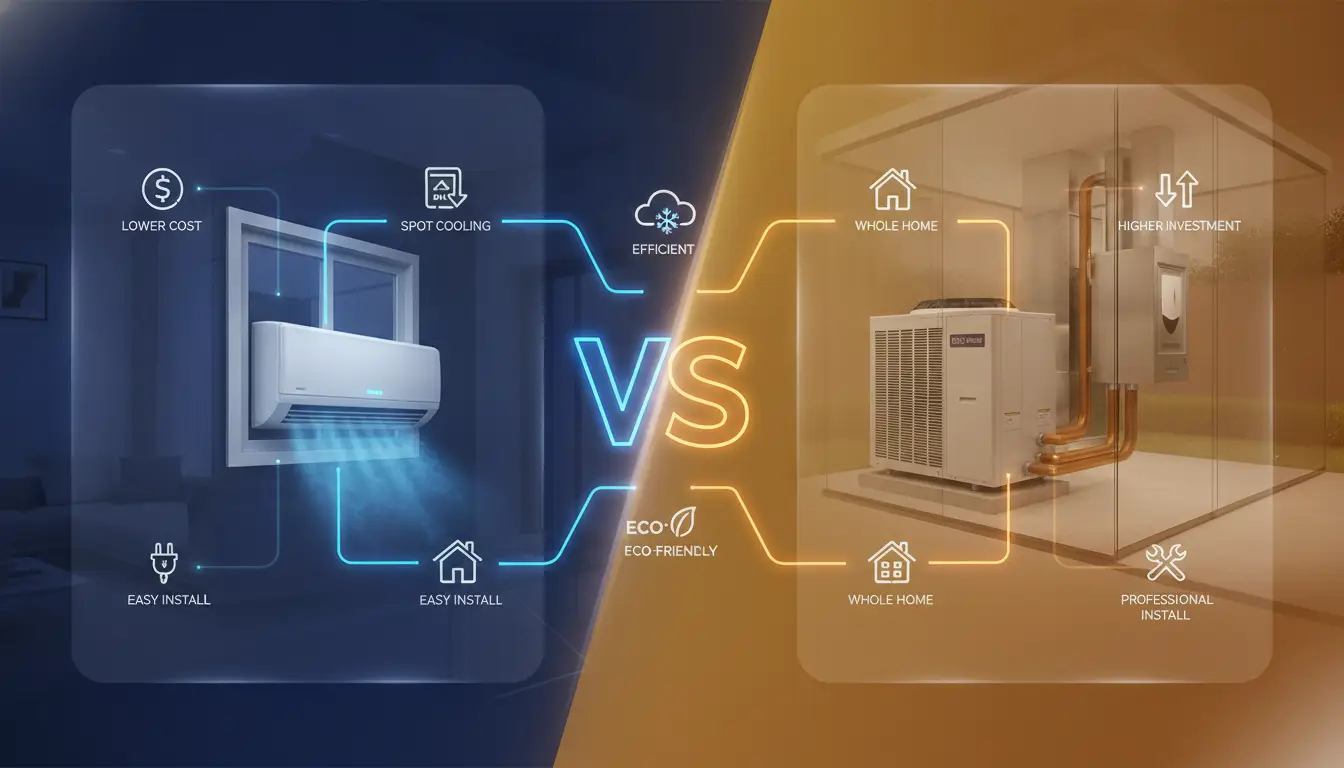
Central air conditioning cools better than window AC units in nearly every category, especially in Louisiana’s climate. Central systems control humidity, cover the whole home evenly, and run more efficiently over time. Window units cost less upfront and work for single rooms, but they struggle against South Louisiana summers.
KEY TAKEAWAYS
- Central air beats window AC for whole-home comfort in Louisiana’s humid climate.
- Window units cost less upfront but run 20-40% less efficiently than central systems, raising your monthly bill.
- Humidity removal is the deciding factor in Broussard and Lafayette summers, and central air wins here every time.
- If your home already has ductwork, upgrading to central air typically pays for itself in 7-10 years through energy savings.
- Ductless mini-splits are often the smartest middle-ground option for homes without existing duct systems.
If you’re sweating through another Broussard summer while your window unit blasts at full power, you already know the feeling. The room nearest the AC is freezing. Every other room feels like the inside of a truck cab. That temperature gap is not just uncomfortable. It costs you money every month.
Most homeowners in the Lafayette Parish area start asking about central air after one or two brutal summers with window units. The problem is real. Louisiana heat is not just hot. The humidity makes it physically harder to cool your home, and not every cooling system handles moisture the same way.
In this guide, you will get a plain-language comparison of window AC vs. central air covering performance, energy costs, humidity control, installation costs, and what makes sense for your specific home. By the end, you will know exactly which system fits your situation.
Window AC vs. Central Air at a Glance
Quick Comparison
Here is a side-by-side look at the key differences before we dig deeper.
| Factor | Window AC | Central Air |
| Upfront Cost | $150 – $900 | $3,000 – $7,500+ |
| Coverage | Single room | Whole home |
| Humidity Control | Limited | Strong |
| SEER2 Range | 10 – 12 EER | 14.3 – 22+ SEER2 |
| Installation | DIY possible | Licensed tech required |
| Noise Level | Moderate to loud | Quiet (indoor unit) |
| Home Value Impact | None | Positive |
| Best For | Small rentals, supplements | Owned homes, full comfort |
What Are the Key Differences Between Window AC and Central Air?
The biggest difference is coverage. A window unit cools one room. Central air cools every room through a duct system connected to one outdoor compressor and one indoor air handler.
A few other differences stand out right away:
- Control: Central air uses one thermostat for the whole house. Window units need to be set room by room.
- Humidity: Central systems pull moisture from the whole house. Window units only dehumidify the room they sit in.
- Air quality: Central air filters air through a single return vent. Window units only filter the air passing directly through them.
- Install: Window units slot into a window frame. Central air requires a licensed technician and, in many cases, existing ductwork.
How Does Each System Work?
How Does Central Air Conditioning Cool a Home?
Central air works through a split system. The outdoor unit holds the compressor and condenser. The indoor unit holds the evaporator coil and blower. Refrigerant cycles between them, absorbing heat from inside your home and releasing it outside.
Air from every room travels through return ducts to the air handler, gets cooled and dehumidified across the evaporator coil, then gets pushed through supply ducts back to each room. One thermostat triggers the whole cycle.
For homes in Broussard and Lafayette, this whole-home loop is what separates real comfort from partial cooling. Every room gets treated air, not just the one with the unit in the window.
How Do Window Air Conditioners Cool a Room?
A window AC unit is a self-contained system built into one box. The front half faces inside your room. The back half hangs outside the window.
The indoor side absorbs heat from room air across an evaporator coil. The outdoor side releases that heat through a condenser coil and fan. Moisture pulled from the air drains out the back or sides of the unit.
The result: one cooled room. The hallway outside that room can still feel like a sauna. That room-by-room limitation is why many homeowners in the Lafayette area eventually make the switch to central air.
Which System Actually Cools Better?
Whole-Home Coverage vs. Room-by-Room Cooling
Central air is not even a close competition here. One central system maintains the same temperature in your bedroom, living room, kitchen, and hallway. Window units can only condition the space they sit in.
Imagine trying to cool a 1,500 sq ft home with three window units. You would need one per main room, all running at the same time. Your electric bill would show it. And the bedroom down the hall would still be warmer than the rest.
For any home with more than one or two rooms that need cooling, central air covers the space more completely and more consistently.
How Do These Systems Handle Temperature Consistency and Hot Spots?
Hot spots are one of the top complaints homeowners in South Louisiana have about window AC setups. A window unit creates a cone of cold air in front of it. Corners, hallways, and rooms without a unit get left out.
Central air eliminates hot spots by delivering conditioned air through multiple supply vents. A properly sized and installed system keeps every room within one or two degrees of the thermostat setting. That level of consistency is simply not possible with window units alone.
What Are the BTU and Cooling Capacity Differences?
BTU (British Thermal Unit) measures how much heat a system removes per hour. A standard window unit runs between 5,000 and 24,000 BTU. Central air systems for residential homes typically start at 18,000 BTU (1.5 tons) and go up to 60,000 BTU (5 tons) or more.
For a 1,500 sq ft home in Louisiana, you would need roughly 30,000 BTU of cooling capacity (According to Energy Star guidelines). That takes two to three window units running simultaneously. One properly sized central system handles it in a single, quieter, more efficient unit.
How Do These Systems Perform During Extreme Summer Heat?
Louisiana summers push heat indexes above 100 degrees Fahrenheit regularly. Window units lose efficiency as outdoor temperatures climb. When it is 98 degrees outside, the unit has to work harder to push heat out.
Central air systems handle peak heat better because the outdoor condenser is designed to operate across a wider temperature range. Higher-end systems include two-stage or variable-speed compressors that adjust output to the actual heat load. Most window units run only at full speed or off.
Humidity Control: A Critical Factor in Louisiana
Why Does Humidity Matter More Than Temperature Here?
South Louisiana humidity regularly sits between 70 and 90 percent during summer months. That moisture in the air makes a 90-degree day feel like 105 degrees. Your body cannot cool itself through sweat when the air around you is already saturated.
Temperature alone does not determine comfort in Broussard. Relative humidity does. A home that is 76 degrees and 70% relative humidity feels miserable. The same home at 76 degrees and 50% humidity feels comfortable. Your cooling system needs to remove moisture, not just heat.
How Do Central Air and Window AC Handle Moisture Removal?
Central air systems dehumidify every cubic foot of air in your home as it passes over the evaporator coil. Over a full day of operation, a properly sized central system can remove 15 to 25 gallons of moisture from the air (According to the American Society of Heating, Refrigerating and Air-Conditioning Engineers, ASHRAE).
Window units do remove some moisture from the room they sit in. However, they cannot address humidity in rooms they do not cover. Run the unit in your living room, and your hallway, bedrooms, and bathroom still hold that heavy, sticky air.
What Is the Mold Risk With Window Units in Broussard’s Climate?
High indoor humidity creates the conditions mold needs to grow. Mold spores thrive at relative humidity above 60 percent. A window unit that only partially controls humidity in one room leaves the rest of your home exposed.
Mold growth in walls, ceilings, and under flooring is a real risk in South Louisiana when whole-home humidity is not managed. Central air, by treating the entire home, keeps indoor relative humidity in the 45 to 55 percent range where mold cannot establish itself. That is a health and structural protection, not just a comfort benefit.
This humidity difference is one of the main reasons HVAC professionals in the Lafayette area recommend central air over multiple window units for owned homes.
Energy Efficiency and Monthly Operating Costs
What Are SEER2 Ratings and Why Do They Matter for Your Bill?
SEER2 (Seasonal Energy Efficiency Ratio 2) measures how efficiently a central AC system cools over an entire season. The higher the SEER2, the less electricity it uses per unit of cooling. As of 2023, the U.S. Department of Energy requires all new central AC systems in the South to meet a minimum SEER2 of 14.3 (Source: U.S. Department of Energy, 2023).
Window units do not use the SEER2 scale. They use EER (Energy Efficiency Ratio), which measures a single operating point rather than seasonal performance. Most window units carry an EER between 9 and 12. Converting to a comparable scale, that is roughly equivalent to a SEER2 of 10 to 13.
A new 16 SEER2 central system uses noticeably less energy per hour of operation than a window unit at equivalent EER, especially during Louisiana’s long cooling season that runs from April through October.
How Do Window AC and Central Air Compare on Electricity Use?
A single 12,000 BTU window unit running at full capacity draws around 900 to 1,200 watts per hour. If you run three units to cover a small home, that is 2,700 to 3,600 watts per hour of total draw.
A 2-ton (24,000 BTU) central system at 16 SEER2 draws roughly 1,700 to 2,000 watts to deliver the same cooling. That is 30 to 50 percent less electricity for the same result, according to data from Energy Star’s residential HVAC comparison tools.
In Louisiana, where air conditioning can account for 50 to 60 percent of a summer electric bill, that difference adds up fast.
What Are the Long-Term Energy Savings With Central Air?
The savings compound over time. A family running three window units from May through September might spend $180 to $250 per month on electricity from those units alone. A comparable central system running at the same hours might cost $110 to $160 per month.
Over a 10-year period, the energy savings alone can total $5,000 to $10,000 depending on your home size, usage habits, and local utility rates. That math changes the upfront cost conversation significantly.
Installation and Lifetime Ownership Costs
What Are the Equipment and Installation Costs?
Window units range from $150 to $900 each, depending on BTU capacity and brand. Most homeowners can install them without professional help.
Central air installation costs in Louisiana typically range from $3,000 to $7,500 for a standard system in an existing home with ductwork. Homes without ducts add $4,000 to $10,000 or more for duct fabrication and installation. A ductless mini-split system falls in between at $2,500 to $5,000 per zone installed.
For professional AC installation services in the Lafayette area, the total cost depends on your home size, existing infrastructure, and the efficiency tier you choose.
What Do Maintenance and Repair Costs Look Like?
Window units need filter cleaning every 2 to 4 weeks during heavy use. Coils need annual cleaning. Units typically last 8 to 12 years before performance drops significantly.
Central air maintenance runs $100 to $200 per year for a professional tune-up covering refrigerant check, coil cleaning, electrical inspection, and filter replacement. Well-maintained central systems last 15 to 20 years. That is a longer useful life than any window unit.
What Is the Total Cost of Ownership Over 10 to 15 Years?
Let’s compare two scenarios for a 1,400 sq ft home in the Broussard area:
- Three window units: $1,500 initial cost + $120/year in maintenance + higher monthly electric bills + unit replacements at year 10 = estimated $12,000 to $16,000 over 15 years.
- Central air system: $5,000 installed + $150/year maintenance + lower monthly electric bills = estimated $11,000 to $14,000 over 15 years, not counting the added home value.
The numbers are closer than most people expect. Add in home value and quality-of-life benefits, and central air wins the long-term calculation.
Indoor Air Quality and Comfort
How Does Air Filtration Compare Between These Systems?
Central air systems filter the entire home’s air supply through a single filter at the return air vent. You can upgrade to a MERV 11 or higher filter to capture dust, pollen, pet dander, and fine particles. Some systems accept whole-home UV purifiers or media filters.
Window units have a small foam or mesh filter that catches large particles from the air directly around them. That filter does not treat air in other rooms. For households with allergy sufferers or asthma, this difference in filtration reach matters a great deal.
How Loud Are Window AC Units Compared to Central Air?
Window units are notoriously noisy. The compressor and fan sit right there in the window. Decibel levels range from 50 to 65 dB, roughly as loud as a conversation or a running dishwasher.
Central air is quieter in the living space because the compressor sits outside and the indoor air handler moves air through ducts. Most indoor units produce 25 to 35 dB inside the home. That difference matters in bedrooms and home offices where background noise affects sleep and focus.
Do These Systems Work With Smart Thermostats and Home Automation?
Central air integrates easily with any smart thermostat, such as the Nest, Ecobee, or Honeywell T6. You can schedule temperature changes, monitor energy use by the hour, and control the system from your phone.
Some newer window units offer Wi-Fi control through manufacturer apps. However, you still control each unit separately, and the automation options are limited compared to a whole-home thermostat connected to a central system.
Which System Is Right for Your Home?
What Is the Best Cooling Option for a Small Home Under 1,000 Sq Ft?
A home under 1,000 sq ft is the one scenario where window AC makes more financial sense, at least in the short term. One or two units can cover the main living areas without a major upfront investment.
However, even in small homes, central air performs better in Louisiana’s climate. If you own the home and plan to stay more than five years, the humidity control and efficiency benefits of central air are worth the investment.
Does It Matter Whether Your Home Has Existing Ductwork?
Ductwork changes the math significantly. Homes with existing ducts in decent shape can add central air for $3,000 to $5,500 in most cases. That is a much easier financial decision.
Homes without ductwork face a larger investment. In those cases, a ductless mini-split system often makes more sense than running new ducts. Mini-splits deliver central-air-quality performance without requiring duct installation.
Are Window Units a Better Choice for Rental Properties and Apartments?
Rental properties present a different situation. Landlords often use window units because they require no structural changes to the property and the upfront cost is low. Renters can move them from unit to unit.
For long-term rental properties, central air increases rental income potential and reduces tenant turnover. In the Lafayette Parish rental market, central air is now an expected feature in most residential listings. Properties without it rent slower and for less.
When Does a Ductless Mini-Split Make More Sense Than Either Option?
A ductless mini-split system uses the same refrigerant technology as central air but delivers conditioned air through wall-mounted heads instead of ducts. Each head covers a zone, and most systems handle two to five zones from one outdoor unit.
Mini-splits are ideal when:
- Your home has no existing ductwork
- You are adding an addition, bonus room, or converted garage
- You want zone control so different rooms run at different temperatures
- You want central-air efficiency without the cost of duct installation
What Are the Signs It’s Time to Upgrade From Window Units to Central Air?
These are the clearest signals that window units are no longer the right answer:
- Your window unit runs constantly but cannot keep the room below 78 degrees during peak heat
- You notice high indoor humidity even when the unit is running
- Your monthly electric bill has increased despite no change in usage habits
- You are running more than two window units to try to cover the home
- You are waking up at night from the noise the unit makes
- Your unit is more than 10 years old and needs a repair that costs more than half its value
Does Central Air Add Home Value in Louisiana?
What Do Buyers Expect in the Broussard Market?
Central air conditioning is a standard expectation for home buyers in South Louisiana. In the current Broussard and Lafayette market, a home listed without central air faces immediate buyer resistance. Most buyers will not tour a home without it during summer months.
Real estate agents in the Lafayette area consistently report that window-unit-only homes sit on the market longer and sell for less per square foot than comparable homes with central air.
What Is the Resale ROI of Central Air vs. Window Units?
According to Remodeling Magazine’s Cost vs. Value Report, HVAC upgrades return 85 to 100 percent of their cost in home resale value in hot Southern markets. Central air specifically can add $5,000 to $12,000 in perceived value for a 1,500 sq ft home.
Window units add no resale value. Buyers factor the cost of upgrading to central air as a credit off the purchase price, not as existing value. Installing central air before selling removes that negotiation point entirely and often shortens time on market.
Conclusion
Window AC vs. central air comes down to one honest question: are you trying to survive the summer or actually enjoy your home? Window units work for single rooms and temporary situations. Central air controls the whole home, manages Louisiana humidity, filters the air you breathe, and runs more efficiently year after year.
At Fontenot Air Conditioning & Heating, we have helped homeowners across Broussard, Lafayette, Scott, Youngsville, Carencro, Maurice, and Milton make this exact decision for years. We understand the local climate, the ductwork challenges older homes present, and the systems that actually hold up in South Louisiana heat. We do not guess at sizing or try to sell you more than you need.
If you are ready to stop battling your window units and start cooling your home the right way, we are here to help. Contact us for a free consultation and system recommendation. We will walk through your home’s layout, existing infrastructure, and budget to find the right fit. Call us or reach out online today.
Frequently Asked Questions
How much does it cost to switch from window AC to central air in Louisiana?
The total cost depends on whether your home has existing ductwork. With ducts in good shape, most homeowners in the Lafayette area pay $3,500 to $6,500 installed. Without existing ducts, budget $7,000 to $15,000 or more. A ductless mini-split system is often a more affordable alternative at $2,500 to $5,000 per zone.
Can a window AC unit handle Louisiana humidity?
Not effectively for the whole home. A window unit removes moisture only from the room it sits in. In South Louisiana, where summer humidity regularly exceeds 75 percent, you need whole-home dehumidification. Central air treats every room’s air supply and keeps indoor humidity in the comfortable 45 to 55 percent range.
Is it cheaper to run window AC units or central air in the summer?
Central air costs less to run per BTU of cooling once you account for system efficiency. Three window units cooling a small home can draw 2,700 to 3,600 watts combined. A properly sized central system delivers the same cooling for 1,700 to 2,000 watts. Over a five-month Louisiana cooling season, that difference can save $400 to $700 per year.
What SEER2 rating should I look for in a new central AC system in Louisiana?
The federal minimum for new systems in the South is SEER2 14.3 as of 2023 (Source: U.S. Department of Energy). For Louisiana’s long cooling season, a 16 to 18 SEER2 system offers a strong balance of upfront cost and long-term savings. Higher efficiency systems (20 SEER2+) make sense if you plan to stay in the home 10 or more years.
Does a ductless mini-split cool as well as central air?
Yes, in the zones it covers. Mini-splits use the same refrigerant technology as central systems and carry similar SEER2 ratings. They also dehumidify effectively. The difference is coverage: a mini-split serves specific zones rather than an entire duct network. For homes without ducts, mini-splits are often the best balance of performance and installation cost.
Will adding central air increase my home’s value in Broussard or Lafayette?
Yes, significantly in this market. Central air is a baseline expectation for buyers in South Louisiana. Homes without it sell for less and sit longer. Most HVAC upgrades in hot Southern markets return 85 to 100 percent of their cost in resale value, and in some cases central air can add $5,000 to $12,000 in buyer-perceived value depending on the home.
Related Articles
Heat Pump vs Furnace: Which Fits Louisiana Homes?
October 15, 2026