
Central AC vs Mini Split: Installation Cost, Energy Bills & Long-Term Value Compared
Search
Recent Posts
Heat Pump vs Furnace: Which Fits Louisiana Homes?
October 15, 2026
Tags
Follow Us on
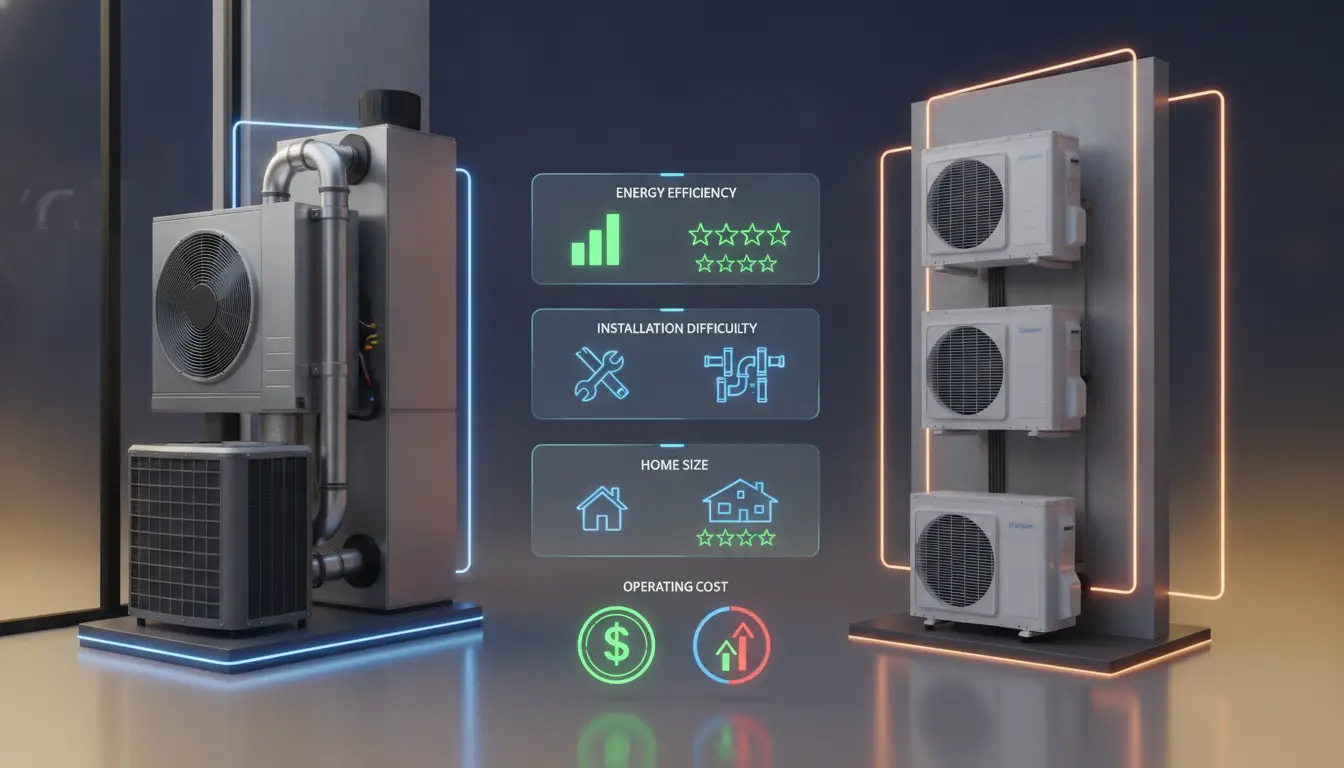
Central AC vs mini split: central air uses ductwork to cool your whole home from one unit, while a mini split delivers conditioned air directly to each room without ducts. Mini splits cost less to install in homes without existing ductwork and run 20–30% more efficiently. Central AC costs less upfront when ductwork already exists and remains the preferred choice for large homes or buyers who value familiarity.
| KEY TAKEAWAYS |
| • Mini splits save 20–30% on monthly energy bills compared to central AC in most South Louisiana homes, thanks to inverter technology that eliminates the energy waste of cycling on and off. |
| • Central AC is the smarter choice when your home already has ductwork in good condition — you avoid a $3,000–$8,000 duct installation cost and get whole-home comfort from one system. |
| • Homes without ductwork face a $10,000–$16,000+ total cost for central AC vs. $1,500–$5,000 for a comparable mini split — a gap that takes years of energy savings to close. |
| • Both systems last 15–20 years with proper maintenance, but mini splits have fewer moving parts and tend to require less frequent repairs. |
| • Lafayette Parish homeowners may qualify for federal tax credits of up to 30% on qualifying high-efficiency heat pump mini splits under the Inflation Reduction Act (IRA) through 2032. |
Your AC is dying in the middle of a Louisiana summer, and you need to decide fast. Do you replace the central system your home already has, or switch to mini splits you keep hearing about? One wrong call can cost you $5,000 to $10,000 more than necessary over the next decade.
South Louisiana heat is not forgiving. In Broussard, Lafayette, and the surrounding parishes, your cooling system runs hard for eight or nine months a year. That means the difference between a central AC and a mini split shows up on your Entergy bill every single month. We install and service both systems across Lafayette Parish every week, and the right answer depends entirely on your home.
In this guide, you will find a full side-by-side comparison of central AC vs. mini split systems: installation costs, monthly energy bills, performance in South Louisiana humidity, lifespan, and total cost of ownership over 15 years. By the end, you will know which system fits your home and your budget.
Central AC vs. Mini Split at a Glance
Key Differences at a Glance
The core difference is simple. Central AC uses a network of ducts to push conditioned air to every room from one outdoor compressor and one indoor air handler. A mini split has an outdoor compressor connected to one or more indoor wall-mounted units, and it conditions air in each room directly. No ducts required.
That single difference in design creates a ripple effect across installation cost, energy efficiency, and comfort. Here is a quick breakdown before we go deeper.
Full Comparison Chart (Cost, Efficiency, Comfort, Lifespan, ROI)
| Factor | Central AC | Mini Split | Winner | Notes |
| Installation Cost | $3,000–$7,500+ | $1,500–$5,000+ | Mini Split* | *Without ductwork |
| Monthly Energy Cost | Higher (duct loss) | Lower (inverter) | Mini Split | Up to 30% savings |
| SEER2 Rating | 13–18+ | 15–25+ | Mini Split | Higher = more efficient |
| Comfort (whole home) | Excellent | Good (zoned) | Tie | Depends on layout |
| Humidity Control | Good | Good–Excellent | Tie | Both handle LA humidity |
| System Lifespan | 15–20 years | 15–20 years | Tie | With proper maintenance |
| Resale Value | High (familiar) | Growing | Central AC | Buyers expect central |
| Noise Level | Moderate | Very quiet | Mini Split | Indoor unit is near-silent |
| Ductwork Required | Yes | No | Mini Split | For homes without ducts |
| Upfront Cost (w/ ducts) | $8,000–$14,000+ | $1,500–$5,000 | Mini Split | Major cost gap |
Note: Costs above reflect typical ranges for Lafayette Parish and surrounding areas in 2026. Your actual cost depends on home size, existing ductwork condition, and equipment brand. A load calculation from a licensed HVAC contractor gives you the most accurate number.
How Does Each System Work?
How Central AC Works (with Ductwork)
A central air conditioning system has three main components: an outdoor condenser unit, an indoor air handler or furnace, and a duct network that runs through your walls, attic, or crawlspace. The outdoor unit removes heat from refrigerant and expels it outside. The indoor air handler blows cooled air through the ducts and into each room through supply vents. Return vents pull warm air back to the air handler to repeat the cycle.
Most central AC systems in Louisiana also include a gas or electric furnace for winter heating, though heat pump models handle both heating and cooling from the same outdoor unit.
How a Mini Split Works (Ductless)
A mini split system: one outdoor compressor connected by refrigerant lines to one or more indoor wall-mounted air handlers, also called heads or cassettes. Each indoor unit conditions the room it is mounted in directly. There are no ducts. The outdoor unit still removes heat from the refrigerant, but the conditioned air never travels through ductwork to reach you.
Most mini splits today are heat pumps, meaning they reverse the refrigerant cycle in winter to pull heat from the outside air and deliver it inside. This makes them efficient for both heating and cooling, which matters in South Louisiana winters.
Single-Zone vs. Multi-Zone Mini Split Options
A single-zone mini split connects one outdoor unit to one indoor head. This works well for a garage, a converted attic room, a home addition, or a small house with one primary living space.
A multi-zone mini split connects one outdoor unit to two to five indoor heads, each in a different room or zone. You control each zone’s temperature independently. For a whole-home setup, multi-zone systems are the standard approach. Each zone gets its own thermostat, so bedrooms, the kitchen, and the living room can all run at different temperatures simultaneously.
How Do Installation Costs Compare?
Central AC Installation Costs
Installing central AC in a home that already has ductwork in good condition typically costs $3,000 to $7,500 for the equipment and labor, depending on the system size and efficiency rating. A higher-SEER2 unit costs more upfront but saves money over time.
In Lafayette Parish, standard central AC installations (system swap, existing ducts, no major modifications) average around $4,500 to $6,500 for a 3-ton system as of 2026. Larger homes needing 4- or 5-ton units push costs to $6,000 to $9,000.
Mini Split Installation Costs
A single-zone mini split installation for a room or small home runs $1,500 to $3,500 installed, including labor. A two- or three-zone system covering most of a medium-sized home runs $3,500 to $7,000. Full whole-home multi-zone setups for larger homes can reach $8,000 to $12,000 or more, depending on how many zones you need.
Keep in mind: mini splits require a dedicated electrical circuit for each outdoor unit, and some older homes may need an electrical panel upgrade. Factor in $500 to $1,500 if your panel is at or near capacity.
Cost of Adding or Replacing Ductwork
Ductwork installation or replacement is the hidden cost most homeowners overlook. Adding new ductwork to a home that has none typically costs $3,000 to $8,000, and in older homes with tight attic spaces or historic construction, costs can exceed $10,000. Replacing deteriorated existing ductwork runs $2,000 to $5,000 depending on the scope.
This is where the math flips. If your home needs new ductwork, installing central AC becomes a $10,000 to $16,000 project. A comparable multi-zone mini split installation covering the same home costs $4,000 to $8,000. That gap is significant.
Estimated Total Installation Cost by Home Size
| Home Size | Central AC (with ductwork) | Mini Split (multi-zone) |
| Under 1,000 sq ft | $5,000–$9,000 | $1,500–$3,500 |
| 1,000–1,500 sq ft | $6,500–$11,000 | $2,500–$5,000 |
| 1,500–2,500 sq ft | $8,000–$13,500 | $4,000–$8,000 |
| 2,500+ sq ft | $10,000–$16,000+ | $6,000–$12,000+ |
*Central AC totals include new ductwork where needed. Mini split totals assume no duct installation.
Available Rebates, Tax Credits, and Incentives
Federal tax credits under the Inflation Reduction Act (IRA) allow homeowners to claim up to 30% of the cost of a qualifying high-efficiency heat pump mini split, capped at $2,000 per year. This credit applies through 2032 and can meaningfully reduce your out-of-pocket cost. (Source: IRS.gov, 2025 guidance)
Entergy Louisiana offers rebates for qualifying HVAC equipment through their residential energy efficiency program. Rebate amounts vary by equipment type and efficiency tier. Check directly with Entergy or ask your contractor to confirm what is currently available in your zip code.
Central AC systems with a SEER2 rating of 15.2 or higher may also qualify for a federal energy efficiency tax credit of up to $600 per year under the same IRA provisions.
What Factors Affect Your Final Installation Price?
Four factors move the price on any HVAC installation:
- Home size and layout: Larger homes and multi-story floor plans require more equipment capacity and more complex refrigerant line routing.
- Existing ductwork condition: Leaky, undersized, or damaged ducts need repair or replacement before a new central system performs correctly.
- Equipment brand and efficiency: Premium brands and higher SEER2 ratings increase upfront costs but typically lower monthly bills enough to recover the difference.
- Electrical panel capacity: Mini splits require dedicated circuits. Older panels may need upgrades to handle the additional load.
How Do Energy Efficiency and Monthly Bills Compare?
SEER2 Ratings: What the Numbers Actually Mean
SEER2 (Seasonal Energy Efficiency Ratio 2): a standardized measurement of how much cooling output a system delivers per unit of electricity consumed over a full season. The higher the SEER2 rating, the less electricity the system uses to produce the same cooling effect. As of January 2023, new central AC systems in the South must meet a minimum SEER2 of 14.3. (Source: U.S. Department of Energy)
Standard central AC systems sold today range from 14.3 to 18+ SEER2. High-efficiency mini splits from major brands like Mitsubishi, Daikin, and LG reach 20 to 25+ SEER2. That gap in efficiency directly translates to lower monthly Entergy bills.
Duct Leakage and Hidden Energy Loss in Central AC
Even a well-designed central AC system loses energy in the ducts before conditioned air reaches your rooms. The U.S. Department of Energy estimates that 20% to 30% of the energy used by central AC systems is lost through duct leaks, poor insulation, and air that escapes into unconditioned attic or crawlspace spaces. (Source: Energy.gov)
In a South Louisiana attic that can reach 150°F in July, duct losses are not a small problem. That leakage is money leaving your home every time the system runs.
Why Do Mini Splits Run More Efficiently? (Inverter Technology)
Inverter technology: a variable-speed compressor motor that adjusts its output continuously to match the actual cooling demand, rather than cycling fully on and off the way a conventional central AC compressor does.
A traditional central AC compressor runs at 100% capacity until the thermostat is satisfied, then shuts off completely. It cycles like this dozens of times per day. Each start-up uses a surge of electricity. An inverter-driven mini split ramps up quickly to cool a room, then slows to a low hum to maintain the temperature precisely. Think of it like driving on a highway at a steady speed versus stop-and-go city traffic. The highway car uses far less fuel.
This is the single biggest reason mini splits outperform most central AC systems on monthly energy bills.
Side-by-Side Monthly Energy Bill Comparison
Actual energy costs depend on your home’s insulation, square footage, usage patterns, and current Entergy rates. These estimates are based on a 2,000-square-foot home in the Lafayette area running 9 months of heavy cooling per year:
- Standard 14.3 SEER2 central AC: $130 to $180 per month during peak cooling season
- High-efficiency 18 SEER2 central AC: $100 to $145 per month
- 20+ SEER2 multi-zone mini split: $80 to $120 per month
Over a full year, the difference between a standard central AC and a high-efficiency mini split can reach $500 to $700 annually. Over 15 years, that adds up to $7,500 to $10,500 in energy savings, not counting rate increases.
How Do Heating and Cooling Performance Compare?
Cooling Performance: Whole-Home vs. Zone-by-Zone
Central AC cools your entire home from one system. Every room gets conditioned air as long as the ducts reach it. This is the familiar approach most Louisiana homeowners grew up with, and it works well for open floor plans and single-story homes where air distribution is straightforward.
Mini splits cool zone by zone. You control each room independently, which means rooms you are not using do not get cooled unnecessarily. For a household where people sleep in different parts of the house or use some rooms only part of the day, this zoning benefit reduces waste. However, a poorly designed multi-zone system with too few indoor heads for a large floor plan will leave some areas uncomfortable.
Humidity Control Comparison
Humidity control matters enormously in South Louisiana. Both systems dehumidify the air as part of their cooling process. However, mini splits with inverter technology tend to run longer at lower speeds, which gives them more contact time with the evaporator coil and results in better moisture removal per cycle. A central AC system that short-cycles (turns on and off too quickly) cools the air without fully dehumidifying it, leaving your home feeling clammy even at the set temperature.
If your home currently feels humid even when the AC is running, an oversized central AC unit cycling on and off is often the culprit. A correctly sized mini split or a properly sized central system with a variable-speed air handler solves this.
Heating Performance: Heat Pump vs. Cooling-Only Systems
Most mini splits sold today are heat pumps. They extract heat from outside air and move it inside in winter. Modern cold-climate heat pumps maintain efficient heating output down to around 5 to 10 degrees Fahrenheit. In South Louisiana, where winter lows rarely drop below 30 to 35 degrees, a mini split heat pump handles 100% of your heating needs comfortably with no supplemental heat required.
Central AC units without a heat pump function only for cooling. If your home has a separate gas furnace, it handles heating. If you want a central heat pump setup, expect to pay a premium over a standard AC-only system. Mini splits bundle heat pump capability into the standard product at no extra cost.
Noise Levels and Day-to-Day Comfort
Mini split indoor units operate at 19 to 30 decibels, which is quieter than a whisper. You will hear the fan at low speed, but it blends into background noise easily. The outdoor compressor runs at 50 to 60 decibels, similar to a normal conversation.
Central AC systems deliver conditioned air through ducts, which creates air movement noise at each register. The air handler itself adds mechanical noise. Many homeowners find central systems noisier day to day, especially in bedrooms near return air vents.
Zoning and Personalized Temperature Control
Mini splits offer true room-by-room zoning as a standard feature. Each indoor head has its own remote or smart thermostat. Two people in different rooms can run different temperatures simultaneously. This is something central AC systems cannot do without expensive add-on zone control damper systems, which cost $2,000 to $4,000 more and add mechanical complexity.
What Are the Maintenance and Repair Differences?
Routine Maintenance Requirements for Each System
Both systems need regular attention. Annual professional maintenance is recommended for either type.
For central AC, annual maintenance includes:
- Cleaning or replacing air filters every 1 to 3 months
- Cleaning the outdoor condenser coil annually
- Inspecting and sealing duct leaks every 2 to 3 years
- Checking refrigerant levels and electrical connections
- Clearing the condensate drain line
For mini splits, annual maintenance includes:
- Washing the indoor unit filters monthly (they are washable and reusable)
- Cleaning the outdoor unit coil annually
- Clearing the condensate drain
- Checking refrigerant lines and electrical connections
Mini splits have washable filters that cost nothing to maintain. Central AC filters are disposable and cost $10 to $30 each, with replacement needed every 1 to 3 months depending on the filter type and household conditions.
Common Repair Costs
Both systems share common repair categories: refrigerant leaks, compressor issues, electrical component failures, and drainage problems. Here are typical repair cost ranges for Lafayette Parish homeowners in 2026:
- Refrigerant recharge: $200 to $500 (both systems)
- Capacitor replacement: $150 to $300 (both systems)
- Compressor replacement (central AC): $1,200 to $2,500
- Compressor replacement (mini split): $800 to $1,800
- Duct repair/sealing (central only): $300 to $1,500
- Circuit board replacement: $400 to $900 (both systems)
System Lifespan and Longevity Factors
Both central AC and mini split systems last 15 to 20 years with proper annual maintenance. A neglected system, regardless of type, may fail in 10 years or less. Mini splits have fewer moving parts in the indoor unit (no duct blower motor, no drain pan in most models) which reduces some failure points.
In high-humidity coastal environments, outdoor compressor corrosion can shorten both system types’ lifespan. Using a unit with a weatherproof coating or protective cover helps extend outdoor unit life in South Louisiana’s climate.
What Is the Long-Term Value and ROI of Each System?
Total Cost of Ownership Over 10 to 15 Years
| Cost Category | Central AC (15 years) | Mini Split (15 years) |
| Installation | $5,000–$8,000 | $3,000–$6,000 |
| Ductwork (if needed) | $3,000–$8,000 | $0 |
| Annual Energy Cost | $1,200–$1,800/yr | $800–$1,300/yr |
| Maintenance (annual) | $150–$300/yr | $100–$200/yr |
| Repairs (est. total) | $1,000–$3,000 | $800–$2,500 |
| Total (15 years, no ducts) | $26,500–$47,500 | $17,300–$33,500 |
| Total (15 years, w/ new ducts) | $35,000–$60,000+ | $17,300–$33,500 |
*Estimates based on Lafayette Parish average energy costs and typical installation pricing in 2026. Assumes moderate usage and annual maintenance. Actual costs vary.
Energy Savings Over Time
A mini split running at 20 SEER2 versus a central AC at 14.3 SEER2 saves approximately $400 to $700 per year in energy costs for a typical South Louisiana home. At $500 per year average savings, the mini split recoups its higher efficiency premium in 4 to 6 years. After that, the savings are pure reduction in monthly bills.
This assumes no ductwork cost difference. If central AC requires new ductwork at $5,000 to $8,000, the mini split’s payback period shrinks to 2 to 4 years even accounting for any upfront price difference.
Impact on Home Resale Value
Central AC remains the buyer expectation in most South Louisiana real estate markets. A home without central air may face pushback or a lower offer from buyers who are unfamiliar with mini splits. Real estate agents in Lafayette consistently report that central AC is an expected feature at most price points.
Mini splits are gaining acceptance, particularly in the luxury and energy-efficiency-conscious buyer segment. However, they are most likely to be neutral or positive for resale when the home is otherwise modernized. In a mid-range resale scenario, a properly installed central AC system may support a slightly higher listing price simply because more buyers are comfortable with it.
Which System Delivers Better Long-Term ROI?
For homes without ductwork, mini splits deliver better ROI in almost every scenario. The ductwork cost alone tips the calculation decisively. For homes with ductwork in good condition, the answer depends on how long you plan to stay and what your current energy bills look like. If you plan to sell within 5 years, central AC may give you less friction at resale. If you plan to stay 10 or more years, a high-efficiency mini split’s energy savings accumulate meaningfully.
Which System Is Right for Your Home?
Homes With Existing Ductwork
If your home has ductwork that was installed in the last 10 to 15 years and is in good shape, central AC is the more economical choice. You are not paying for duct installation, and you get whole-home comfort with one system. Upgrade to a 16 SEER2 or higher system to capture meaningful energy savings over the life of the unit.
Homes Without Ductwork (Older or Historic Homes)
Older homes in Lafayette, Broussard, and Scott were often built without central HVAC. Adding ductwork to a pier-and-beam cottage, a historic Acadian-style home, or a structure with a finished attic requires significant construction work. A multi-zone mini split gives you whole-home comfort at a fraction of the total cost and preserves the character of the home without invasive duct installation.
New Construction and Home Additions
For new construction, central AC with properly designed ductwork remains the most common choice in the Lafayette market. If you are adding a room, a garage apartment, or a sunroom to an existing home, a single-zone mini split is typically the simplest and most cost-effective solution since extending ductwork is expensive and often impractical.
Small Homes Under 1,500 Sq Ft
Single-zone or two-zone mini splits excel in smaller homes. You cover the primary living areas and bedrooms with two well-placed indoor units, spend $3,000 to $5,000 total on installation, and pay lower monthly energy bills for the life of the system. At this home size, central AC rarely offers a compelling cost advantage.
Large Homes Over 2,500 Sq Ft
Larger homes require either a high-capacity central AC system or a 4- to 5-zone mini split setup. At this size, costs converge more closely. A well-installed central system with properly sized ductwork and a variable-speed air handler handles large open floor plans efficiently. However, if any zones of your large home are used infrequently, mini split zoning reduces waste that central AC cannot easily address.
How Should You Choose? Budget, Needs, and Load Calculation
No online article can tell you exactly which system your home needs. The correct answer requires a Manual J load calculation, which accounts for your home’s square footage, ceiling height, insulation quality, window orientation, and local climate data. This calculation determines the exact tonnage and BTU output required to keep your home comfortable without overpaying for oversized equipment.
At Fontenot Air Conditioning and Heating, every recommendation we make starts with a proper load calculation. Oversized equipment short-cycles, wastes energy, and fails to dehumidify your home properly. Undersized equipment runs constantly and never reaches the set temperature on the hottest days. Size matters as much as the system type.
Get a free in-home assessment from Fontenot’s AC and Heating: fontenotsac.com/hvac-services/ac-installation/
Frequently Asked Questions
Is a Mini Split Cheaper to Run Than Central AC?
In most cases, yes. A 20+ SEER2 mini split with inverter technology typically costs 20 to 30 percent less to operate than a standard 14.3 SEER2 central AC in a similar-sized home. For a South Louisiana home running 9 months of heavy cooling, that difference can add up to $400 to $700 per year in energy savings.
Can a Mini Split Replace Central AC for a Whole House?
Yes. A multi-zone mini split with 3 to 5 indoor heads covers most homes completely. Each zone gets independent temperature control. The system must be properly sized with a Manual J load calculation to ensure every room gets adequate coverage. An undersized or poorly placed system will leave some areas of the home uncomfortable.
Does a Mini Split Increase Home Value?
It depends on the market and the buyer. In South Louisiana, central AC remains the standard buyer expectation, so a mini split system adds less perceived value than a comparable central system at most price points. However, a mini split paired with documented lower energy bills can be a selling point for efficiency-conscious buyers, especially for homes over $400,000.
Is It Worth Replacing Central AC With a Mini Split?
It can be. If your central system is 12 to 15 years old, your ducts are in poor condition, and your energy bills have been climbing, switching to a multi-zone mini split may deliver lower monthly costs and a fresh 15-year equipment lifespan. Run the numbers on duct repair cost versus mini split installation cost before deciding.
Are DIY Mini Split Installations Worth It?
DIY pre-charged mini split kits exist, but a professional installation is almost always the better choice. Improper refrigerant line sizing, poor mounting angle on indoor units, and electrical wiring errors cause premature failures, void manufacturer warranties, and can create safety hazards. In Louisiana, HVAC work also requires a licensed contractor for permitted installations. The savings on labor rarely outweigh the risks.
Conclusion
Central AC vs. mini split is not a question with one universal answer. Central AC makes sense when your home already has functioning ductwork and you want whole-home comfort from a single system. Mini splits make sense when you need to avoid $3,000 to $8,000 in duct installation, want lower monthly energy bills, or need to condition a space that ductwork cannot reach. The system that wins on paper is not always the system that wins in your home.
The real comparison is not just equipment specs and SEER2 numbers. It is the total cost to install, the monthly cost to run, and the real-world comfort your family experiences during a Louisiana August. A properly sized and professionally installed mini split will outperform a poorly sized or leaky central AC system in every category. Likewise, a well-maintained central system with tight ducts will outperform an undersized mini split setup that cannot keep up on the hottest days.
At Fontenot Air Conditioning and Heating, we have installed and serviced both system types across Lafayette, Broussard, Scott, Youngsville, Carencro, Maurice, and Milton for years. We start every recommendation with a proper load calculation, not a sales pitch. If you are weighing central AC vs. a mini split for your home, we are happy to walk through the numbers with you and give you a straight answer based on your actual home. Contact us to schedule a free in-home assessment and get a system recommendation you can trust.
Related Articles
Heat Pump vs Furnace: Which Fits Louisiana Homes?
October 15, 2026