

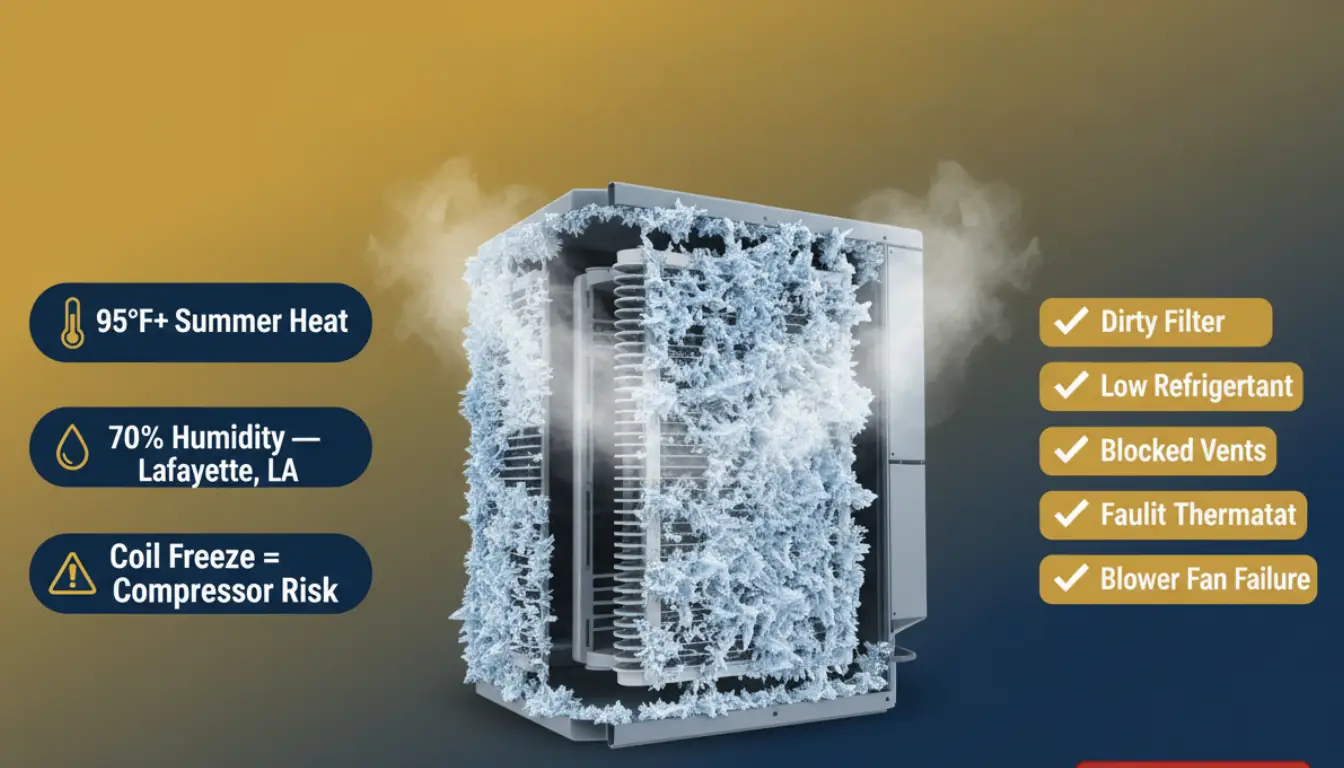
A frozen AC coil stops your system from cooling your home, and if left running, can permanently damage the compressor. The most common causes are restricted airflow, low refrigerant, and a dirty evaporator coil. Catching it early and responding correctly makes the difference between a simple fix and a costly system replacement.
KEY TAKEAWAYS:
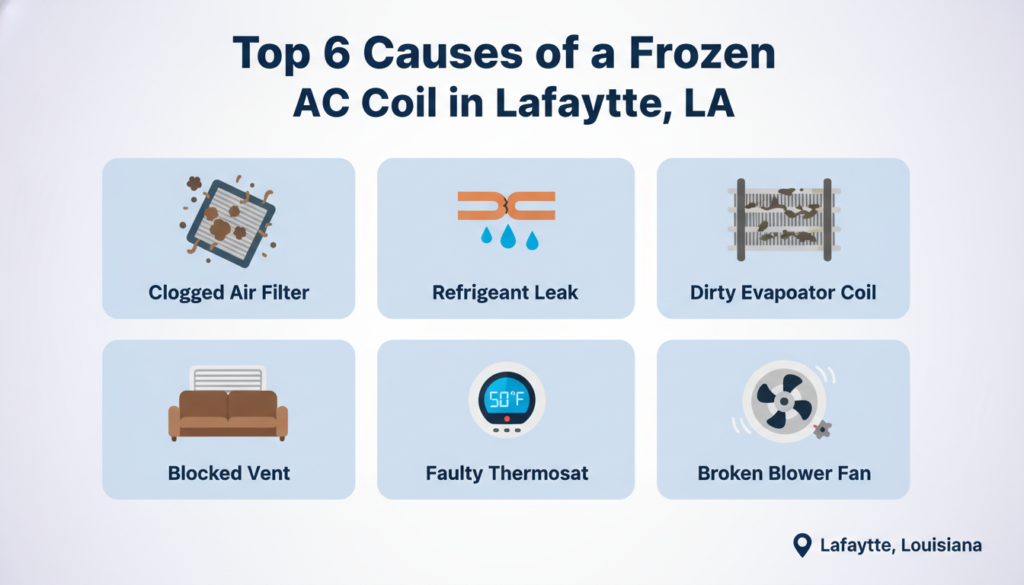
- A frozen AC coil almost always signals one of six root causes: dirty filters, low refrigerant, blocked vents, a dirty coil, a faulty thermostat, or a failing blower fan. Running the system while frozen can destroy your compressor.
- Before calling a technician, turn the AC off at the thermostat and switch the fan to “On” to begin thawing safely. Never chip ice off the coil manually.
- Lafayette’s combination of high heat and humidity pushes AC systems harder than in most U.S. cities, making routine maintenance every 1–3 months a practical necessity, not optional.
- A frozen coil that melts uncontrolled can overflow the condensate drain pan and cause water damage to ceilings, walls, and flooring making speed of response critical.
- Repair costs vary widely based on cause: a filter swap costs almost nothing, while a refrigerant leak repair or coil replacement can run several hundred to over a thousand dollars, depending on system age and refrigerant type.
Fast, Reliable Solutions for Frozen Evaporator Coils
When your AC starts blowing warm air on a 95-degree Lafayette afternoon, the last thing you want is to wait two days for a technician. A frozen evaporator coil is one of the most common reasons an air conditioner stops cooling, and it can happen to any system, regardless of age or brand.
The good news: most frozen coil situations are repairable, often the same day. The key is knowing what caused the freeze, thawing the system correctly, and fixing the underlying problem before it comes back.
Fontenot’s AC offers professional AC repair in Lafayette, LA, with fast diagnostics, same-day availability, and technicians who understand how South Louisiana’s climate stresses HVAC equipment differently than anywhere else in the country.
Serving Lafayette and Surrounding Areas
Fontenot’s AC serves Lafayette and surrounding communities, including Broussard, Youngsville, Breaux Bridge, Scott, and Carencro. Whether you’re dealing with a frozen coil in a residential home or a commercial space, the team is equipped to diagnose, repair, and restore your system quickly.
What Is an AC Coil and Why Does It Freeze?
What Does the Evaporator Coil Do?
The evaporator coil sits inside your indoor air handler. Its job is to absorb heat from the air inside your home. Warm air from your living space passes over the coil, which contains cold refrigerant. The refrigerant absorbs that heat, cools the air, and the cooled air gets pushed back through your vents.
Think of it as a cold soda can sitting on your kitchen counter; condensation forms because the cold surface pulls heat and moisture from the surrounding air. The evaporator coil works on the same principle, just on a much larger scale and with much tighter temperature tolerances.
When conditions inside the system shift, whether from restricted airflow, low refrigerant pressure, or a dirty coil surface, that temperature balance breaks down. The coil gets too cold, moisture in the air freezes on contact, and ice starts building up.
Evaporator Coil vs. Condenser Coil: What’s the Difference?
Your AC system has two coils, and it helps to know the difference:
| Component | Location | Function |
| Evaporator Coil | Indoor air handler | Absorbs heat from indoor air |
| Condenser Coil | Outdoor unit | Releases heat to the outside |
The evaporator coil is where freezing almost always occurs. It operates at lower temperatures and higher humidity exposure, making it far more vulnerable to ice buildup when something goes wrong.
Can the Outdoor Condenser Coil Freeze Too?
Yes, but it’s far less common. The condenser coil can freeze during unusual conditions running the AC when outdoor temperatures drop below 60°F, or if the condenser fan motor fails. In Lafayette, freezing outdoor temperatures are rare, so condenser coil freezing is not the primary concern. Most frozen coil calls in this area involve the indoor evaporator coil.
What Happens Inside Your AC When the Coil Freezes?
How Do Temperature and Pressure Cause Ice Formation?
Refrigerant inside the evaporator coil operates at a precise pressure and temperature. Under normal conditions, the refrigerant absorbs heat at around 40°F cold enough to cool the air but not cold enough to freeze the moisture on the coil surface.
When something disrupts that balance most often a drop in airflow or refrigerant pressure the refrigerant temperature drops below 32°F. At that point, the moisture in the warm air hitting the coil freezes on contact. Ice forms on the coil surface, which insulates it further, reducing its ability to absorb heat. The cycle accelerates until the coil is completely encased in ice.
What Role Does Airflow Play in Preventing Freezing?
Airflow is the single most important factor in keeping your evaporator coil from freezing. The coil needs a steady volume of warm air passing over it to maintain the temperature balance. If airflow drops from a clogged filter, blocked vent, or failing blower fan the coil loses its heat source.
Without enough warm air, the coil temperature plummets. Even a partially blocked filter can reduce airflow enough to start the freezing process on a hot, humid Lafayette day when the system is running constantly.
How Does Low Refrigerant Lead to Ice Buildup?
Refrigerants don’t get “used up” if your system is low, that means there’s a leak somewhere. When refrigerant levels drop, the pressure inside the evaporator coil drops with it. Lower pressure means lower temperature. The coil runs colder than designed, and ice forms.
Low refrigerant is particularly insidious because the symptoms reduced cooling, warm air from vents look identical to a frozen coil caused by airflow issues. A proper diagnosis requires a technician to check refrigerant pressure directly.
Top Causes of a Frozen AC Coil
1: A Dirty Air Filter Restricting Airflow
This is the most common cause, and also the most preventable. A clogged air filter restricts the volume of warm air reaching the evaporator coil. According to the U.S. Department of Energy, a dirty filter can reduce your AC system’s efficiency by 5–15% and is a leading cause of system malfunction. In Lafayette’s climate, where systems run near-constantly from May through October, filters clog faster than in cooler regions.
Fix: Check your filter monthly. Replace it every 1–3 months under normal conditions, or every 30 days if you have pets or anyone in the home with allergies.
2: Low Refrigerant Levels or Leaks
As explained above, low refrigerant drops coil temperature below the freezing point of water. The refrigerant itself doesn’t freeze the moisture in your air does, accumulating on the coil surface.
Refrigerant leaks can occur at fittings, valves, or through pinhole corrosion in the copper lines. Simply recharging the refrigerant without finding and repairing the leak is a short-term fix that will fail again.
3: A Dirty or Dust-Covered Evaporator Coil
Even with regular filter changes, dust and debris accumulate on the evaporator coil over time. That layer of grime acts as insulation, reducing heat transfer between the air and the coil. The coil runs colder as a result, and ice formation follows.
Coil cleaning is part of professional HVAC maintenance it’s not something most homeowners can do effectively without the right tools and coil-safe cleaning solutions.
4: Blocked or Closed Return Vents
Your AC system is designed for a specific volume of airflow. Closing vents in unused rooms a common energy-saving myth actually disrupts that balance and can cause the evaporator coil to freeze. The same applies to furniture, curtains, or boxes placed in front of return air vents.
Walk through your home and make sure every return vent is open, unblocked, and unobstructed.
5: A Faulty Thermostat or Incorrect Settings
A thermostat stuck in the wrong mode or set too low can force the AC to run continuously without cycling off. Extended run times at very low set points give moisture more opportunity to accumulate and freeze on the coil. In some cases, a malfunctioning thermostat can signal the system to run even when indoor temperatures have been reached.
6: Blower Fan or Motor Malfunction
The blower fan pushes air across the evaporator coil. If the fan motor is failing running slowly, cycling on and off, or stopping entirely airflow drops even if the filter is clean and vents are open. A failing blower is a mechanical problem that requires a technician to diagnose and repair.
How Does Lafayette’s Heat and Humidity Affect AC Systems?
Lafayette sits in one of the most demanding climate zones in the country for HVAC equipment. Average summer humidity regularly exceeds 70%, and temperatures stay above 90°F from June through September. According to NOAA climate data, south Louisiana averages more than 80 days per year above 90°F.
That humidity means more moisture is available to freeze on a struggling evaporator coil. It also means your system runs longer cycles and works harder than systems in drier climates accelerating wear on filters, coils, and fan motors. What might be a minor issue in a mild climate becomes a system-stopping problem here.
Signs Your AC Coil Is Frozen
Is Warm Air Coming from Your Vents a Sign of a Frozen Coil?
Yes and it’s usually the first thing homeowners notice. When the evaporator coil is encased in ice, it can no longer absorb heat from the air. The refrigerant continues to run cold, but the air passing over the coil doesn’t get cooled effectively. The result is warm or room-temperature air blowing from your vents despite the thermostat being set low.
Is There Ice Buildup on Indoor or Outdoor Components?
Ice visible on the refrigerant lines running from your indoor unit, or on the indoor unit itself, is a direct sign of a frozen coil. In advanced cases, ice can extend along the refrigerant lines to the outdoor unit. If you see ice anywhere on your AC system in summer, turn it off immediately.
Are You Experiencing Reduced Airflow and Weak Cooling?
Restricted airflow is both a cause and a symptom. As ice builds on the coil, it further blocks airflow through the system. You may notice that airflow from your vents has dropped noticeably air comes out, but with less force than usual, and the home isn’t reaching the set temperature.
Unusual Noises or Short Cycling
A frozen coil can cause the system to short-cycle turning on and off rapidly without completing a full cooling cycle. You may also hear hissing or bubbling sounds from the refrigerant lines, or a gurgling noise as ice interferes with refrigerant flow.
What Does a Frozen AC Coil Look Like?
Early-stage freezing looks like heavy frost on the coil surface similar to what you’d see in a neglected freezer. As it progresses, the frost turns to solid ice that encases the entire coil assembly. In severe cases, ice extends beyond the coil onto surrounding components. If you open your air handler and see anything beyond light condensation on the coil, call a technician.
What to Do Immediately if Your AC Coil Freezes
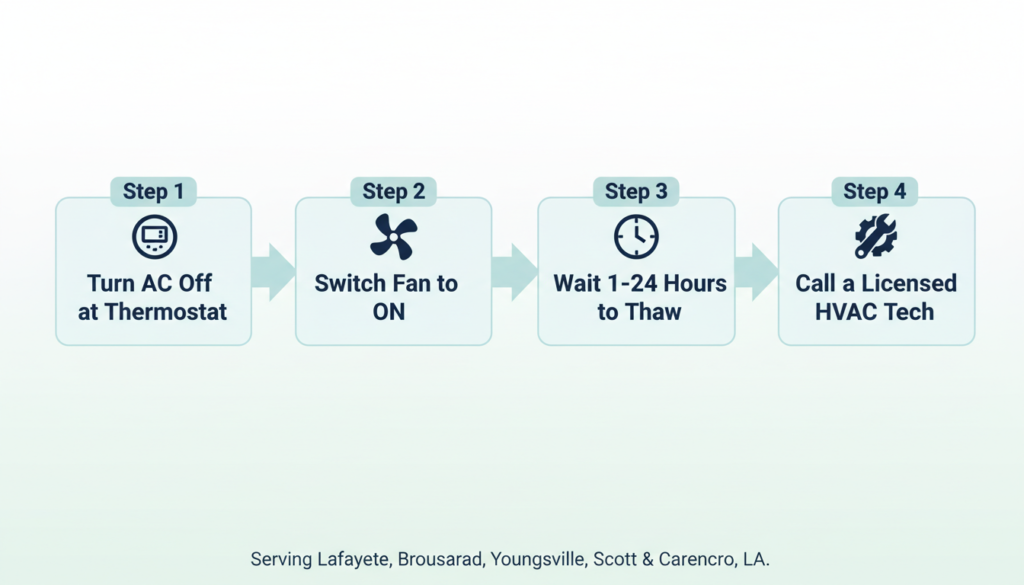
Step 1: Turn Off the AC at the Thermostat
Switch your thermostat from “Cool” to “Off.” Do not leave the system running operating an AC with a frozen coil forces the compressor to work without proper refrigerant flow, which can cause compressor burnout. Compressor replacement is one of the most expensive repairs in HVAC service, often costing more than the system itself.
Step 2: Switch the Fan to “On” to Start Thawing
After turning the cooling off, switch the fan setting from “Auto” to “On.” This keeps the blower running without the cooling cycle, circulating room-temperature air over the frozen coil to speed up thawing. It’s a simple step that can cut thaw time significantly.
How to Defrost AC Coils Safely
The safest approach is to let the coil thaw naturally with the fan running. You can also:
- Turn the system completely off and open the air handler cabinet to allow ambient air to reach the coil.
- Place towels around the base of the air handler to catch water as the ice melts.
- Check the condensate drain pan and make sure the drain line isn’t clogged overflow during thawing is a common secondary problem.
Do not use a heat gun, hair dryer, or any external heat source on the coil. The coil fins are delicate and can be permanently deformed by uneven heating.
How Long Does It Take for a Coil to Thaw?
A lightly frozen coil may thaw in 1–2 hours with the fan running. A heavily iced coil can take 24 hours or more. Patience matters here running the system before the coil is fully thawed will refreeze it immediately.
Why Should You Never Chip or Force Ice Removal?
The aluminum fins on an evaporator coil are extremely thin roughly the thickness of a sheet of paper. Chipping ice with a screwdriver, knife, or any rigid tool will bend or destroy those fins, reducing the coil’s ability to transfer heat even after the ice is gone. In some cases, forced ice removal can puncture the refrigerant lines, turning a simple repair into a refrigerant leak and coil replacement.
What to Check After Your AC Coil Thaws
Inspecting and Replacing Air Filters
Once the coil has fully thawed, check the air filter first. If it’s gray, clogged, or visibly dirty, replace it before restarting the system. A clogged filter is the leading cause of coil freezing if it caused the problem once, it will cause it again.
Checking Airflow and Return Vents
Walk through the home and verify that every return air vent is fully open and unobstructed. Check supply vents as well. If airflow still feels weak after the coil thaws and the filter is replaced, there may be a ductwork issue or blower problem that needs professional attention.
Looking for Water Leaks or Drain Line Issues
As the coil thaws, water drains into the condensate pan below the air handler. That pan has a drain line that carries water to a floor drain or outside. If the drain line is clogged, the pan will overflow which can cause water damage to the surrounding area. Check that the drain line is clear and water is flowing freely.
Signs the Problem Is Not Fully Resolved
Restart the system once the coil has fully thawed and a clean filter is in place. Watch for these warning signs that the underlying problem hasn’t been resolved:
- The system restarts, but still blows warm air after 15–20 minutes
- You hear the same unusual sounds as before
- Ice begins forming again within a few hours
- The system shuts off in short cycles or shuts off on its own
Any of these signs means the root cause likely low refrigerant or a mechanical issue needs professional diagnosis.
Our Frozen AC Coil Repair Process in Lafayette, LA
Complete System Inspection and Diagnosis
When a Fontenot’s AC technician arrives, the first step is a full system inspection not just the coil. Freezing is a symptom. The inspection identifies the cause. This includes checking the air handler, refrigerant lines, outdoor unit, thermostat, and electrical components.
Airflow Testing and Duct Evaluation
The technician measures airflow at key points in the system to identify restrictions. This can reveal problems inside the ductwork collapsed sections, disconnected joints, or undersized returns that wouldn’t be visible from outside the system.
Refrigerant Level Check and Leak Detection
Refrigerant pressure is checked with gauges connected directly to the system. If pressure is low, the technician uses electronic leak detection equipment to locate the source. Recharging refrigerant without repairing the leak is not a long-term solution any reputable technician will find and fix the leak first.
Professional Coil Cleaning and Restoration
If a dirty coil contributed to the freeze, the technician cleans it using coil-safe foam cleaner and, where needed, low-pressure rinse equipment. Clean coil surfaces transfer heat efficiently a dirty coil can reduce system efficiency by up to 30%, according to research published by the American Society of Heating, Refrigerating and Air-Conditioning Engineers (ASHRAE).
Thermostat and Blower Component Repair
If the thermostat or blower motor is contributing to the problem, the technician diagnoses and repairs or replaces the faulty component. Blower motor replacement is a straightforward repair for an experienced technician and significantly extends system life when done proactively.
Final System Testing for Peak Performance
After repairs, the system is restarted and monitored through a full cooling cycle. The technician verifies supply air temperature, checks refrigerant pressures under load, and confirms that airflow across all vents is within normal range before signing off.
Emergency Frozen AC Coil Repair Services
When Does a Frozen Coil Require Immediate Attention?
If the system has been running with a frozen coil for hours, if you notice water actively overflowing from the air handler, or if the system makes loud grinding or screeching sounds, treat it as an emergency. These are signs that secondary damage compressor stress or water intrusion may already be occurring.
How to Prevent Compressor Damage and System Failure
The compressor is the most expensive component in your AC system. It’s designed to compress refrigerant vapor, not liquid refrigerant. When a coil freezes and refrigerant circulation is disrupted, liquid refrigerant can flood back into the compressor a condition called liquid slugging which causes immediate mechanical damage.
Turning the system off the moment you suspect a frozen coil is the single most important thing you can do to protect the compressor.
Same-Day AC Repair Across Lafayette
Fontenot’s AC offers same-day service for frozen coil emergencies across Lafayette and surrounding communities. During peak season when the demand for AC repair in south Louisiana is highest same-day availability makes a real difference.
Can a Frozen AC Coil Cause Water Damage?
How Does Melting Ice Lead to Overflow Issues?
When a heavily frozen coil begins to thaw whether on its own or after you turn the system off it releases a significant volume of water in a short time. The condensate drain pan below the air handler is designed to handle normal condensation, not the sudden melt of a coil encased in ice. If the drain line is partially clogged, the pan overflows quickly.
What Are the Risks to Ceilings, Walls, and Flooring?
Air handlers installed in attics or closets are particularly vulnerable to water damage. An overflowing condensate pan in an attic can saturate insulation, damage drywall ceilings, and create conditions for mold growth within 24–48 hours. Ground-floor air handlers can damage flooring and baseboards. The water damage from a single overflow event can cost more to repair than the original AC problem.
How to Prevent Condensate Drain Problems
- Have the condensate drain line flushed annually as part of routine maintenance.
- Install a float switch in the condensate pan this shuts the system off automatically if the pan fills, preventing overflow.
- Keep the area around the air handler clear so that any early signs of overflow are visible.
How Much Does Frozen AC Coil Repair Cost in Lafayette, LA?
What Factors Affect Repair Costs?
Several variables determine what you’ll pay for frozen coil repair:
- Root cause: A filter replacement costs a few dollars. A refrigerant leak repair and recharge can run $300–$800 or more, depending on the type of refrigerant and the leak location.
- Refrigerant type: Older systems using R-22 refrigerant face significantly higher refrigerant costs since R-22 is no longer produced in the U.S. Systems using R-410A or newer R-454B refrigerant have better supply and lower per-pound costs.
- System age and condition: An older system with multiple issues may require additional repairs identified during diagnosis.
- Emergency or after-hours service: Same-day or weekend calls typically carry a service fee premium.
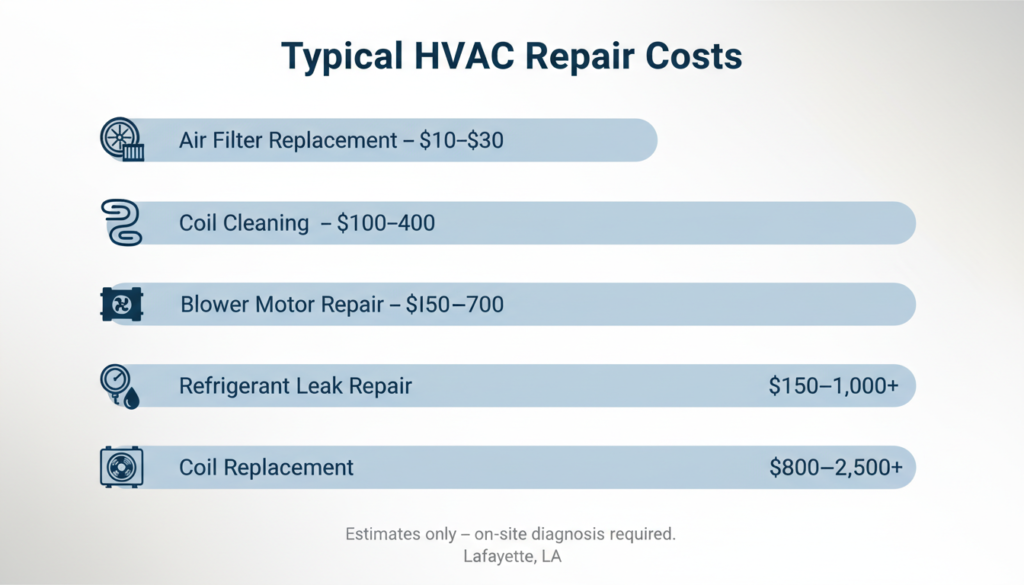
Typical Price Ranges for Common Fixes
| Repair Type | Estimated Cost Range |
| Air filter replacement | $10–$30 (DIY) |
| Evaporator coil cleaning | $100–$400 |
| Blower motor repair or replacement | $150–$700 |
| Refrigerant leak repair + recharge | $300–$1,000+ |
| Evaporator coil replacement | $800–$2,500+ |
Note: These are general estimates. Your actual cost depends on system size, brand, and specific conditions. A technician’s on-site assessment is always more accurate than any estimate.
What Are the Hidden Costs of Ignoring the Problem?
Ignoring a frozen coil doesn’t make it cheaper to fix it makes it exponentially more expensive. A system left running with a frozen coil risks:
- Compressor failure ($1,200–$2,500+ to replace)
- Water damage from condensate overflow
- Mold remediation if moisture goes undetected
- Complete system replacement if multiple components fail simultaneously
Addressing the problem at the first sign is always the more cost-effective path.
Should You Repair or Replace a Frozen AC Coil?
When Is a Simple Repair Enough?
If the system is less than 10 years old, the root cause is a minor issue (dirty filter, minor refrigerant leak, dirty coil), and the evaporator coil itself is not damaged, repair is almost always the right call. Most frozen coil situations fall into this category.
When Is Coil Replacement Necessary?
Coil replacement becomes necessary when:
- The coil has developed extensive corrosion or physical damage
- The leak is in the coil itself and cannot be repaired economically
- The coil is incompatible with a refrigerant upgrade on an aging system
How Do Age, Efficiency, and System Performance Factor In?
If your AC system is 12–15 years old and has experienced multiple repair events, a frozen coil may be the tipping point that makes replacement more sensible than repair. Modern systems are significantly more efficient many new units achieve SEER2 ratings of 18–22 compared to older units running at 10–12 SEER. A technician can help you run the numbers on repair cost versus the long-term savings of a new, efficient system.
Preventing Future AC Coil Freezing
How Often Should You Replace Air Filters?
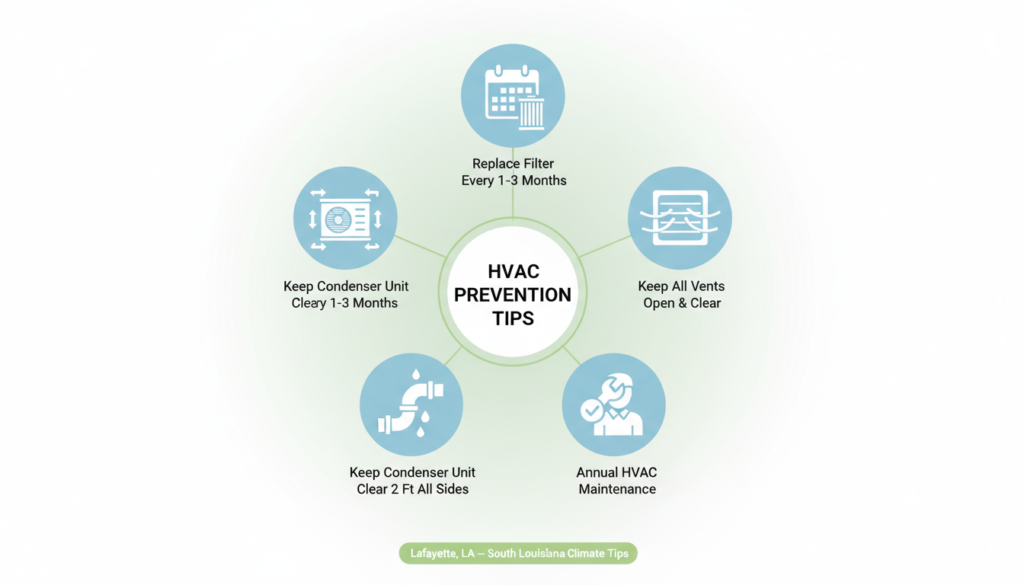
Replace your air filter every 1–3 months as a baseline. In Lafayette, where systems run for eight or more months a year and humidity drives heavier particulate loads, checking monthly is a practical habit. Households with pets or allergy sufferers should replace filters every 30 days.
How Do You Keep Coils Clean and Airflow Unrestricted?
- Keep all supply and return vents fully open
- Don’t block vents with furniture, rugs, or drapes
- Have the evaporator coil professionally cleaned annually
- Keep the outdoor condenser unit clear of leaves, grass clippings, and debris within at least 2 feet on all sides
Why Schedule Routine HVAC Maintenance?
Annual or semi-annual maintenance visits catch problems before they cause freezing. A technician checks refrigerant pressure, cleans the coil, tests the blower motor, inspects the drain line, and verifies overall system operation. According to the U.S. Department of Energy, properly maintained HVAC systems last significantly longer and operate up to 25% more efficiently than neglected ones.
How Do You Monitor Refrigerant and System Health?
Watch for early warning signs between maintenance visits: rising utility bills, longer cooling cycles, warm spots in certain rooms, or unusual sounds from the air handler. Any of these can indicate a developing problem catching it early is far less expensive than waiting for a full freeze-up.
Why Choose Our AC Repair Services in Lafayette, LA?
Licensed and Experienced HVAC Technicians
Every technician on the Fontenot’s AC team is licensed, EPA 608 certified, and trained on current HVAC equipment and refrigerant standards. There are no apprentices working unsupervised on your system.
Upfront Pricing with No Hidden Fees
Before any work begins, you receive a clear, itemized estimate. The price quoted is the price you pay no surprise charges added after the fact.
Fast Response and Emergency Availability
Fontenot’s AC offers fast response times across the Lafayette service area, including same-day availability during peak season. When your AC fails on the hottest day of the year, a two-day wait isn’t acceptable.
Commitment to Long-Term Customer Satisfaction
The goal isn’t just to fix the immediate problem it’s to make sure the same problem doesn’t come back next month. That means identifying root causes, not just treating symptoms, and giving you honest advice about your system’s long-term condition.
Frozen AC Coil Repair FAQs
Can I Run My AC with a Frozen Coil?
No. Running your AC with a frozen evaporator coil forces the compressor to operate without proper refrigerant flow. This can cause liquid refrigerant to flood the compressor a condition called liquid slugging which causes immediate and often irreparable mechanical damage. Turn the system off and let it thaw before attempting to restart.
How Long Does It Take to Thaw Completely?
With the cooling off and the fan set to “On,” a lightly frozen coil may thaw in 1–2 hours. A heavily iced coil can take 24 hours. Do not restart the cooling function until the coil is completely thawed even partial ice remaining will refreeze the coil within minutes of restarting.
Will a Frozen AC Coil Fix Itself?
The ice will melt once the system is off, but the underlying cause will not fix itself. Airflow restrictions, low refrigerant, and dirty coils don’t self-correct. If you restart the system without addressing the root cause, it will freeze again often within hours.
Can Low Refrigerants Cause Freezing?
Yes. Low refrigerant reduces pressure inside the evaporator coil, which lowers the coil temperature below 32°F. At that point, moisture in the air freezes on the coil surface. Low refrigerant always indicates a leak topping off refrigerant without finding and fixing the leak is a temporary measure that will fail again.
How Much Does It Cost to Repair or Replace a Coil?
Repair costs range from under $50 (filter replacement) to $1,000+ for refrigerant leak repair with recharge. Evaporator coil replacement typically runs $800–$2,500 depending on system size, coil type, and installation complexity. The best way to get an accurate number is an on-site diagnosis from a licensed HVAC technician.
Schedule Frozen AC Coil Repair in Lafayette Today
Book Your Service Appointment
If your AC is blowing warm air, showing ice buildup, or cycling on and off without cooling your home, a frozen evaporator coil is likely the cause. The longer the system runs in this condition, the greater the risk of compressor damage and water intrusion.
Booking a service appointment with Fontenot’s AC is straightforward same-day slots are available for urgent situations, and every appointment includes a full diagnostic, not just a surface-level check.
Speak with a Local HVAC Expert
Not sure whether your situation is a true emergency or something you can manage until a scheduled visit? Call Fontenot’s AC directly. A local technician not a call center will help you assess the situation and determine the right response.
Get Fast, Reliable AC Repair When You Need It
A frozen AC coil in Lafayette isn’t a problem that waits for a convenient time. It happens in the middle of summer, on weekends, and during the hottest stretches of the year exactly when you need your system working most.
Fontenot’s AC is ready to respond with experienced technicians, transparent pricing, and the kind of service that keeps customers coming back year after year. Schedule your repair today and get your home cool again.