

Is your AC turning on and off every few minutes, but your home still feels warm and stuffy? You’re not imagining it, and you’re definitely not alone. This is one of the most common complaints we hear from homeowners in Lafayette, and it has a name: AC short cycling.
AC short cycling is more than just an annoying habit your air conditioner picks up. It’s a warning sign that something is wrong, and if you ignore it long enough, it can lead to a costly breakdown right when you need your system the most.
In this guide, we’ll walk you through everything you need to know about AC short cycling, what it is, why it happens, how to spot it, and what you can do about it. Whether you’re a hands-on homeowner or just trying to understand what your HVAC technician is talking about, this guide is for you.
What Is AC Short Cycling?
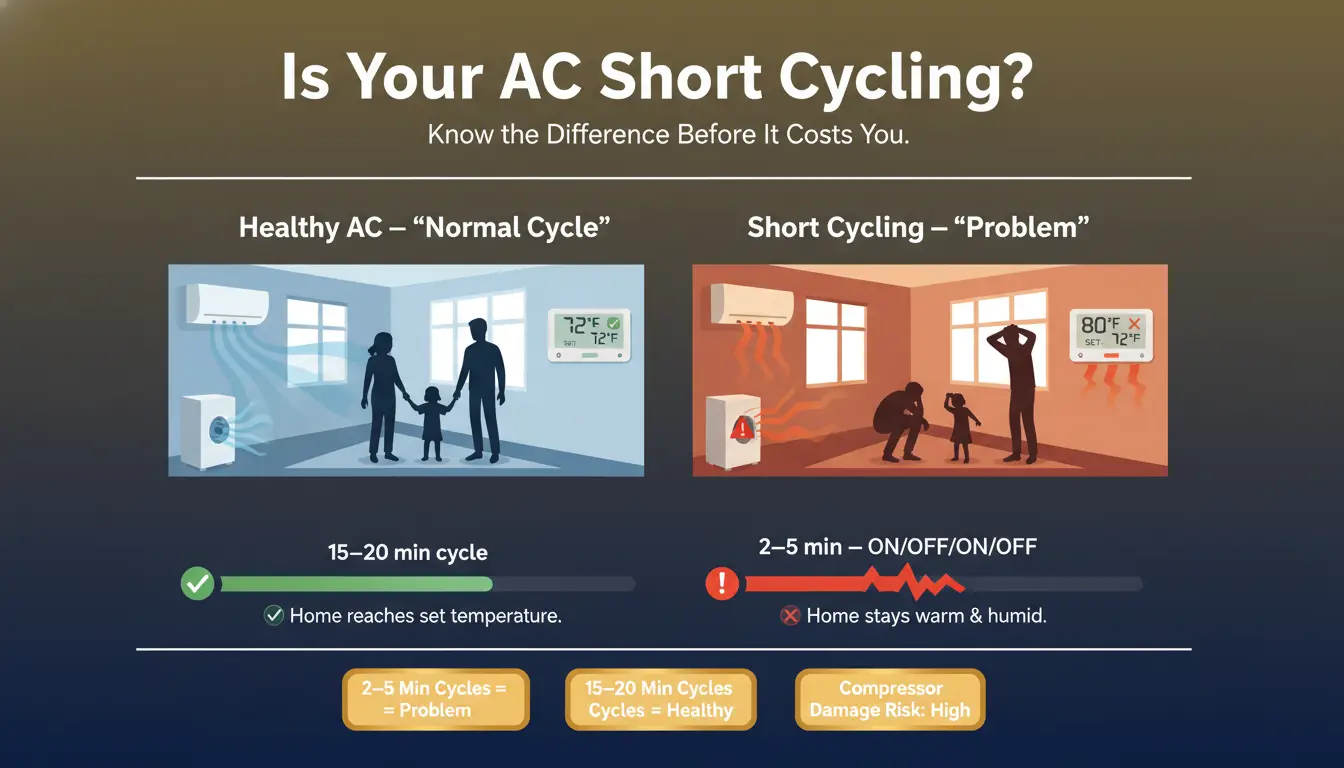
AC short cycling is when your air conditioner turns on, runs for only 2 to 5 minutes, shuts off, and then starts the whole process over again, without ever completing a full cooling cycle.
A healthy air conditioner runs in cycles that typically last 15 to 20 minutes. During that time, it pulls warm air from inside your home, cools it down, and circulates it back. When the system short-cycles, it cuts that process short, which means your home never reaches the temperature you set on the thermostat.
Here’s a quick comparison so you can see the difference:
| Normal AC Cycle | Short Cycling | |
| Cycle Duration | 15–20 minutes | 2–5 minutes |
| Cooling Result | Reaches set temperature | Rarely reaches the et temperature |
| Energy Use | Efficient | Very high |
| Compressor Wear | Normal | Excessive |
| Monthly Bills | Predictable | Noticeably higher |
The bottom line? Short cycling wastes energy, wears out your system faster, and leaves you uncomfortable, especially during a hot Lafayette summer.
Warning Signs Your AC Is Short-Cycling
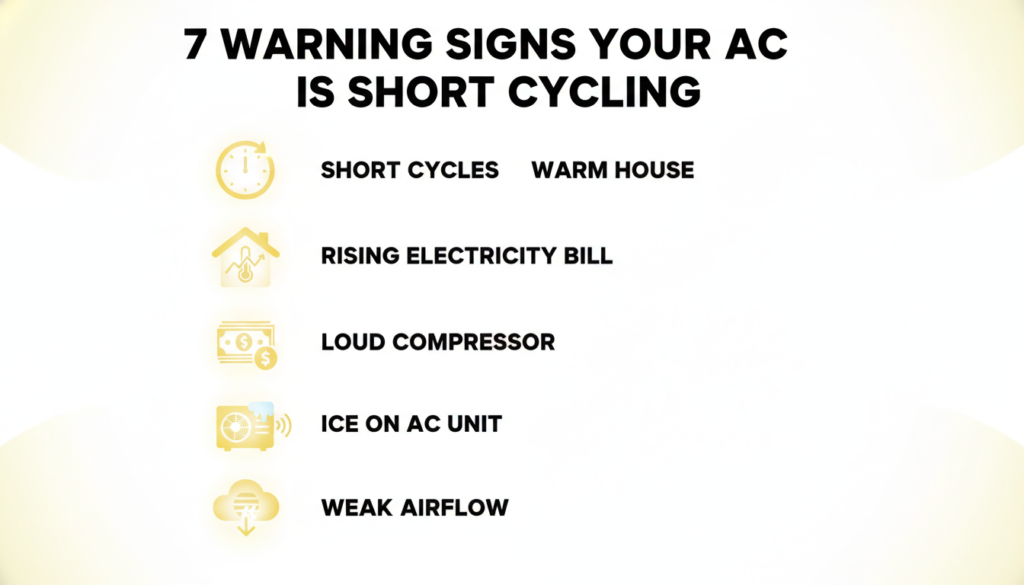
Before we get into the causes, let’s make sure you can actually identify the problem. Here are the most common signs of AC short cycling to watch for:
- Your AC turns on and off every few minutes. This is the most obvious sign. If your system can’t stay on for more than 5 minutes, something is off.
- Your home never feels cool enough. The system keeps restarting before it finishes the job, so your thermostat setting is never actually reached.
- Your electricity bill has gone up unexpectedly. Starting up uses the most energy. Constant restarts mean a much higher bill at the end of the month.
- You hear the compressor kicking on repeatedly. That clicking and humming sound every few minutes is your compressor working way harder than it should.
- Ice is forming on your outdoor unit or refrigerant lines. Frozen coils are both a cause and a symptom of short cycling.
- The air coming from your vents doesn’t feel as cold. Incomplete cycles mean incomplete cooling.
- Humidity feels higher than usual indoors. Your AC removes moisture when it runs. Short cycles don’t give it enough time to do that job.
If two or more of these sound familiar, there’s a good chance your air conditioner is short-cycling.
What Causes AC Short Cycling?
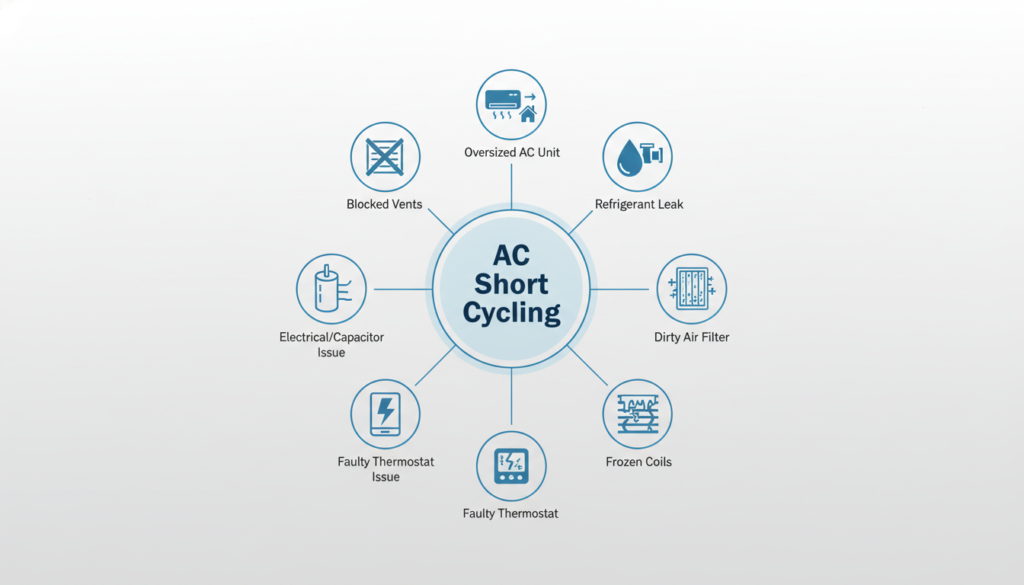
This is the big question, and the honest answer is that AC short cycling can have several different causes. Some are simple fixes you can handle yourself. Others need a trained HVAC technician to diagnose and repair. Let’s go through each one.
1. Oversized AC Unit
This is one of the most overlooked causes of AC short cycling and one of the most common mistakes made during installation.
When an AC unit is too large for the space it’s cooling, it cools the room down too quickly. That sounds like a good thing, but it’s not. The thermostat hits the target temperature in just a few minutes, so the system shuts off before it completes a proper cycle. Then the temperature creeps back up, and the whole thing starts again.
An oversized unit also does a poor job of removing humidity, which is a big deal in Lafayette, where the air tends to be thick and muggy. If your AC was recently replaced and short cycling started after the new install, oversizing could be the issue.
Fix: Unfortunately, there’s no quick patch here. If your unit is genuinely oversized, the right solution is AC installation with proper sizing a licensed technician will ensure the replacement unit is correctly matched to your home. A professional load calculation (Manual J) will tell you exactly what size your home needs and choose a unit that meets central air conditioning efficiency standards for best results.
2. Low Refrigerant or a Refrigerant Leak
Refrigerant is the substance your AC uses to absorb heat from your home and release it outside. When refrigerant levels drop, usually because of a leak, the system can’t manage pressure properly. This causes the compressor to overheat, which triggers the system to shut itself off as a protective measure. Then it restarts. Then shuts off again.
This is a serious issue. Running your system with low refrigerant doesn’t just cause short cycling; it can permanently damage your compressor, which is the most expensive part of your AC system to replace.
Signs of a refrigerant leak:
- Hissing or bubbling sounds near the outdoor unit
- Ice forming on refrigerant lines
- Warm air is blowing from the vents even when the AC is running
- The system is short-cycling with no other obvious cause
Fix: Only a licensed HVAC technician can handle refrigerant. They’ll find and repair the leak, then recharge the system to the correct level. This is not a DIY job.
3. Dirty or Clogged Air Filter
This one is simple, but it causes more AC problems than most people realize, including short cycling.
When your air filter gets clogged with dust and debris, airflow through the system is restricted. The AC can’t pull enough warm air across the evaporator coil to cool it properly. This causes the coil to freeze, which causes pressure problems, which can trigger the system to short-cycle.
In Lafayette, where AC runs almost year-round, filters can clog up faster than you’d expect, especially if you have pets or live near a dusty road.
Fix: Check your filter right now. If it looks grey and dirty, replace it. Most standard filters should be replaced every 1 to 3 months. A clean filter is the cheapest maintenance step you can take.
4. Frozen Evaporator Coils
Your evaporator coil is located inside your air handler. It’s responsible for absorbing the heat from your indoor air. When airflow is restricted (from a dirty filter, blocked vents, or low refrigerant), the coil gets too cold, and ice starts to form on it.
Once the coil is frozen, your AC can’t function properly. The system will either short-cycle or shut down entirely until the coil thaws. Then it starts again, and if the underlying problem isn’t fixed, the coil freezes again.
Signs of frozen coils:
- Visible ice on the refrigerant line running from the outdoor unit
- Water pooling around your indoor air handler
- AC cycling on and off without cooling the home
- Weak or warm airflow from vents
Fix: Turn your system off and let it thaw completely (this can take a few hours). Then check and replace your air filter. If freezing keeps happening after that, call a technician; there may be a refrigerant issue or an airflow problem deeper in the system.
5. Faulty or Misplaced Thermostat
Your thermostat is the brain of your AC system. If it’s reading the room temperature incorrectly, it will send the wrong signals, including telling the system to shut off before the cooling cycle is done.
A thermostat can malfunction due to old age, dead batteries, or electrical faults. But the problem can also be simpler than that: placement. If your thermostat is located near a heat source, a sunny window, a lamp, an oven, or a hot exterior wall, it will read the temperature as warmer than it actually is. The AC kicks on, cools the air near the thermostat quickly, and shuts off. The rest of the house is still warm.
Fix:
- Replace thermostat batteries first; it’s free and takes 2 minutes
- Make sure the thermostat is away from heat sources and direct sunlight
- If it’s an older model, consider upgrading to a programmable or smart thermostat
- If it’s malfunctioning even after all that, have a technician test and replace it
6. Electrical or Capacitor Problems
Your AC compressor uses a component called a capacitor to get started and stay running. When the capacitor starts to fail, the compressor can’t maintain a steady operation, so it starts, struggles, and shuts off. This can look exactly like short cycling.
Electrical issues like faulty wiring, tripped breakers, or failing contactors can also cause your system to short-cycle or cut out unexpectedly.
Fix: Electrical components need a trained HVAC technician. Don’t try to open your electrical panel or handle capacitors on your own; capacitors store a charge even when the system is off and can cause a serious shock.
7. Blocked or Closed Vents
If supply or return vents are closed or blocked by furniture, rugs, or curtains, airflow inside your system gets restricted, similar to a dirty filter. This can cause the evaporator coil to freeze and trigger short cycling.
A lot of homeowners close vents in unused rooms, thinking it saves energy. It actually does the opposite; it creates pressure imbalances that make the whole system work harder.
Fix: Walk through your home and make sure every vent is open and unblocked. Move any furniture or rugs that might be sitting on top of floor vents.
How AC Short Cycling Damages Your System
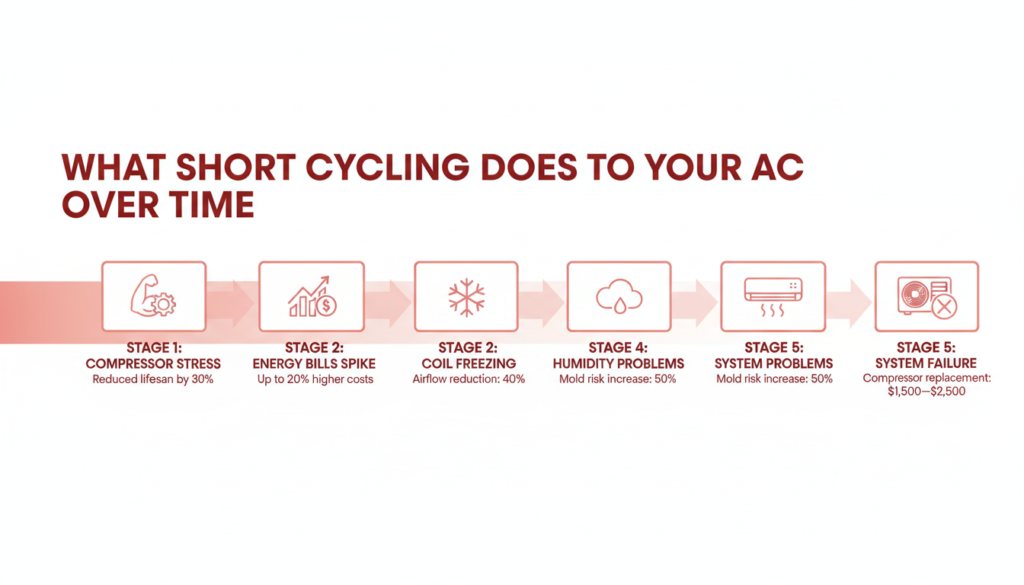
Let’s be clear: AC short cycling is not something to wait on. Here’s what happens the longer you let it go:
- Compressor damage: The compressor works hardest during startup. Constant starting and stopping put massive stress on it. Compressors are expensive, often costing $1,500 to $2,500 to replace. In many cases, it’s cheaper to replace the entire unit.
- Higher energy bills: Every time your AC starts up, it draws a surge of electricity. More startups = significantly higher monthly bills.
- Shorter system lifespan: An AC that should last 15 to 20 years can fail in 8 to 10 years if it spends years short-cycling.
- Poor humidity control: Incomplete cycles mean your AC never gets to the dehumidification phase. In Lafayette’s humid climate, this makes your home feel uncomfortable even when the temperature seems okay.
- Worse indoor air quality: Shorter cycles also mean less air filtration, which can affect allergy and asthma sufferers.
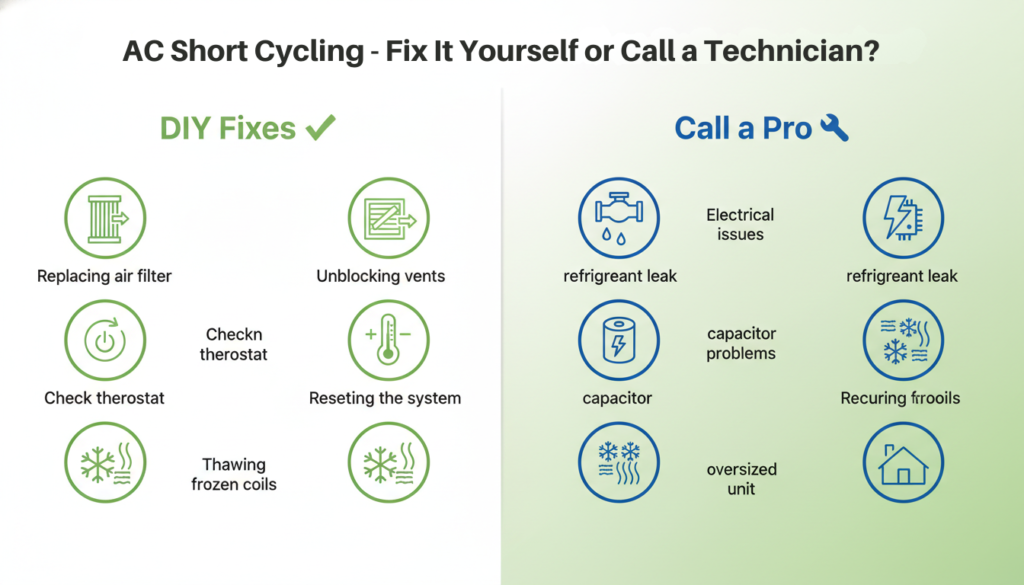
How to Fix AC Short Cycling, What You Can Do vs. When to Call a Pro
DIY Fixes You Can Try First
1. Replace the air filter. Turn off the system, locate the filter (usually in the return air vent or air handler), and swap it out. Use a filter with a MERV rating between 8 and 11 for best results without restricting airflow.
2. Check and unblock all vents. Walk through every room and make sure supply and return vents are fully open. Move furniture, rugs, or anything else sitting on or in front of a vent.
3. Check your thermostat
- Replace batteries
- Make sure it’s set to COOL, not FAN or HEAT
- Check if it’s placed near a heat source and consider relocating it
- Try setting the temperature a few degrees lower to see if the system runs longer
4. Reset your AC system. Turn the system off at the thermostat. Go to your electrical panel and flip the AC breaker off. Wait 30 seconds, then turn it back on. Wait a few minutes before turning the thermostat back to cool. Sometimes this clears a temporary fault.
5. Thaw frozen coils. If you suspect frozen coils, switch the thermostat to FAN ONLY mode (not cooling) and let it run for a few hours to melt the ice. Then replace the filter before switching back to cooling mode.
When to Call Fontenot Air Conditioning and Heating
Some causes of AC short cycling are beyond DI, and trying to fix them yourself can make things worse or even dangerous. Call us if:
- The problem comes back even after you’ve replaced the filter and checked the vents
- You hear hissing or bubbling sounds from your outdoor unit (possible refrigerant leak)
- You see ice on your refrigerant lines or outdoor unit regularly
- Your electricity bills have spiked without explanation
- Your AC is short-cycling and is older than 10 years
- The system makes new, unusual noises like clicking, buzzing, or grinding
- You suspect an electrical or capacitor issue
Our team at Fontenot Air Conditioning and Heating has been helping Lafayette homeowners keep their AC systems running right, especially during the long, brutal Louisiana summers. We’ll diagnose the real cause of your short cycling, give you an honest recommendation, and fix it the right way.
How to Prevent AC Short Cycling
The good news is that most causes of AC short cycling are preventable with regular care. Here’s what we recommend:
- Change your air filter every 1–3 months. Set a reminder on your phone. This one habit prevents more AC problems than anything else.
- Schedule a professional tune-up every year. A technician will check refrigerant levels, clean coils, test electrical components, and catch small problems before they become expensive ones. Spring (before the cooling season) is the best time in Lafayette.
- Make sure all vents stay open, even in rooms you don’t use often.
- Don’t skip the Manual J load calculation when replacing your unit — it’s the industry standard for correctly sizing your AC system. Make sure your HVAC contractor sizes the system correctly for your home. Bigger is not better.
- Upgrade to a smart thermostat . Smart thermostats are better at managing cycling and can even alert you to unusual patterns before they become full problems.
- Keep the area around your outdoor unit clear, trim back plants, remove debris, and make sure there’s at least 2 feet of clearance around the unit for proper airflow.
AC Short Cycling vs. Normal AC Behavior: How to Tell the Difference
If you’re not sure whether what you’re seeing is actually short cycling or just normal operation, here’s a simple way to check:
Time is one complete cycle. From the moment your AC turns on, watch the clock. How long does it stay on before shutting off?
- Less than 5 minutes: That’s almost certainly short cycling. Something is wrong.
- 5 to 10 minutes: This is borderline; it could be short cycling, or it could be that your home has cooled close to the set temperature. Check if your home is actually reaching the thermostat setting.
- 10 to 20 minutes: This is normal. Your system is doing its job.
- Over 20–30 minutes without shutting off: Your system may be undersized, have a refrigerant issue, or the filter may be severely clogged.
Also, pay attention to how your home feels after the system shuts off. If it feels genuinely cool and comfortable, the cycle was probably complete. If it still feels warm and humid, the system is likely short-cycling.
Frequently Asked Questions About AC Short Cycling
What is AC short cycling?
AC short cycling is when an air conditioner turns on and shuts off repeatedly in short bursts, usually every 2 to 5 minutes, without completing a full cooling cycle. It prevents the home from reaching the set temperature and puts excessive strain on the compressor.
How long should an AC cycle last?
A normal AC cycle lasts between 15 and 20 minutes. In very hot weather, cycles may run longer. If your system shuts off in under 10 minutes repeatedly, it’s likely short cycling.
Can I fix the AC short cycling myself?
Some causes, like a dirty air filter, blocked vents, or a thermostat issue, can be handled on your own. However, causes like a refrigerant leak, frozen coils that keep coming back, or electrical problems require a licensed HVAC technician.
Is AC short cycling dangerous?
Short cycling itself won’t cause immediate danger, but it’s damaging to your system over time. It puts extreme stress on the compressor, raises your energy bills, reduces system lifespan, and leaves your home uncomfortable. It also often signals a problem (like a refrigerant leak) that needs prompt attention.
How much does it cost to fix AC short cycling in Lafayette?
It depends on the cause. Replacing a dirty air filter costs just a few dollars. A new capacitor might run $150 to $300 with labor. Fixing a refrigerant leak can cost $200 to $1,500, depending on the severity. Replacing an oversized unit is the most expensive option. That’s why proper diagnosis matters; you don’t want to pay for the wrong fix.
Will AC short cycling fix itself?
No. Whatever is causing the problem won’t go away on its own. In fact, most causes of short cycling get worse over time, especially compressor stress from repeated startups. The sooner you address it, the less it typically costs to fix.
Why does my AC short cycle only on hot days?
On very hot days, your AC works harder to keep up with demand. If there’s an underlying issue, low refrigerant, a failing capacitor, or a dirty filter, the extra strain on hot days pushes the system past its limits, triggering short cycling that might not show up as much on mild days.
Conclusion
AC short cycling is one of those problems that’s easy to ignore at first. Your AC is still turning on, so it feels like it’s working. But underneath that, your compressor is wearing out, your bills are climbing, and your home isn’t getting the cooling it needs.
The good news is that once you know what to look for, it’s not hard to spot. And in many cases, the fix is simple if you catch it early.
Start with the basics: check your air filter, make sure your vents are open, and time a few cycles to see how long your system runs. If the problem persists or you suspect something more serious, like a refrigerant leak or an electrical issue, don’t wait.
Dealing with AC short cycling in Lafayette? The team at Fontenot Air Conditioning and Heating is here to help. We’ll figure out exactly what’s causing the problem and get your system running the way it should efficiently, reliably, and without all that frustrating on-and-off cycling.
🔗 Experiencing other issues with your air conditioner? Check out our complete guide to common AC problems to learn about other symptoms, causes, and fixes that every Lafayette homeowner should know.