


If your air conditioner is acting strange this summer in Lafayette, the problem might be smaller than you think, and a lot cheaper to fix if you catch it early. One of the most overlooked causes of AC problems is a failing capacitor.
The most common AC capacitor failure signs include the unit not turning on, a humming or buzzing noise from the outdoor unit, warm air blowing from the vents, the system shutting off randomly, and a noticeable jump in your electricity bill. Catching these symptoms early can save you from a much more expensive repair down the road.
In this guide, you’ll learn exactly what a capacitor does, the 7 clear warning signs that yours is failing, what causes it to go bad, and what to do next. If you’re already dealing with multiple AC problems, a bad capacitor is often where the trouble starts.
What Is an AC Capacitor and What Does It Do?
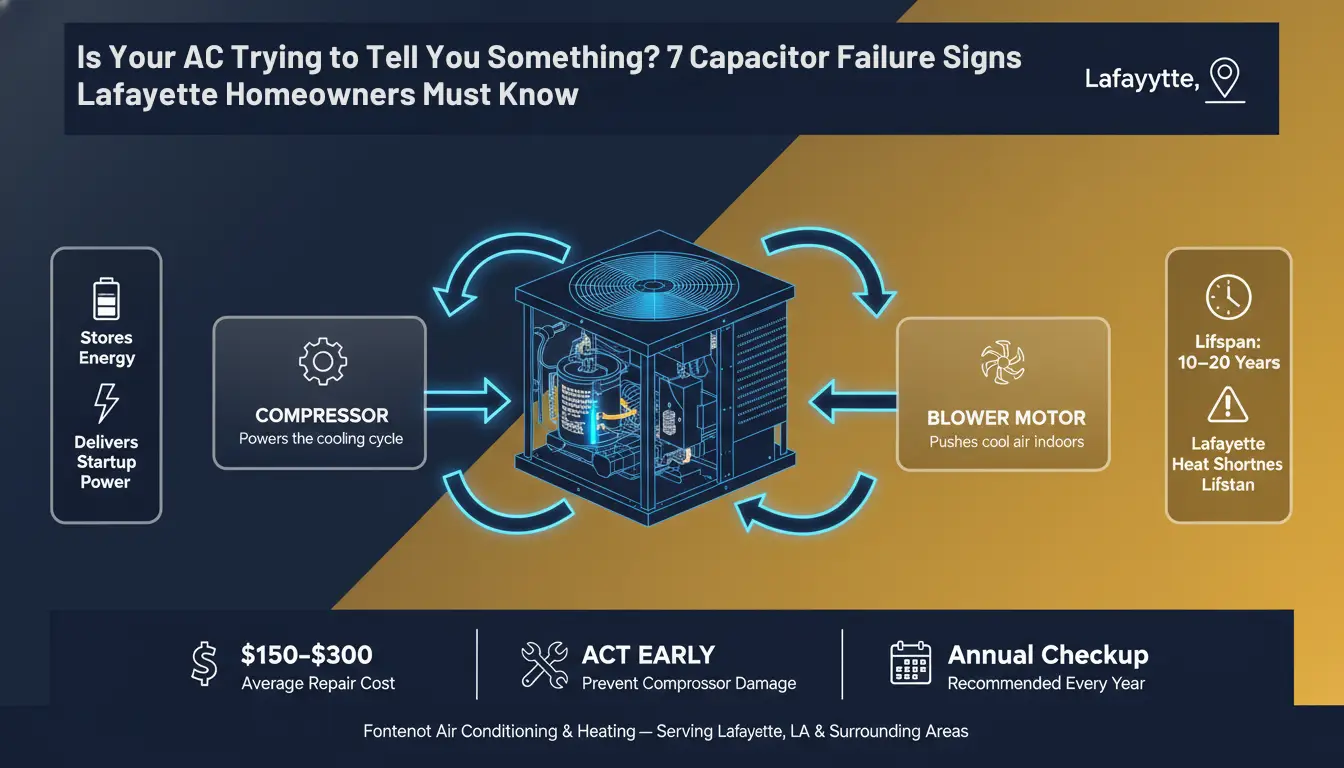
Think of an AC capacitor like a battery that gives your system a jumpstart. Every time your air conditioner turns on, the motors need a quick burst of energy to get going. The capacitor stores that energy and delivers it right when it’s needed.
There are two main types:
- Start Capacitor: Provides the initial power boost to get the compressor or fan motor started.
- Run Capacitor: Keeps a steady flow of energy going while the system runs.
These capacitors work directly with three key components: the compressor, the condenser fan motor, and the blower motor. Without them, none of these parts can do their job properly.
Under normal conditions, a capacitor can last 10 to 20 years. But here in Lafayette, the combination of intense summer heat, humidity, and near-constant AC use puts a lot of extra stress on these parts. That’s why capacitor issues tend to show up sooner than homeowners expect.
7 AC Capacitor Failure Signs You Shouldn’t Ignore
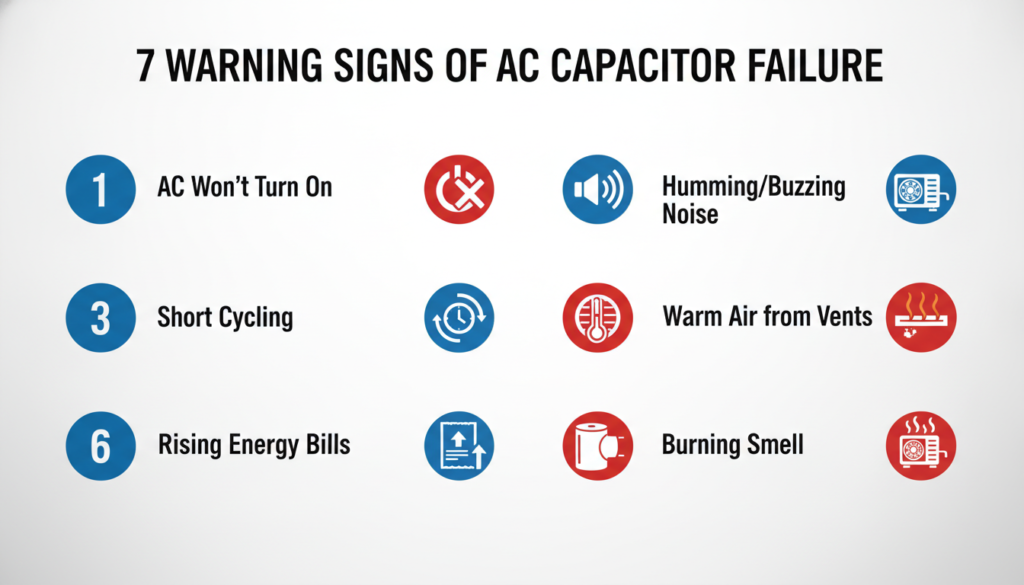
This is the most important part of this guide. The earlier you spot these symptoms, the less damage you’ll end up dealing with. Here’s what to watch for:
Sign #1: Your AC Won’t Turn On or Takes a Long Time to Start
This is one of the most obvious AC capacitor failure signs. When you adjust your thermostat and nothing happens, or the system takes 30 to 60 seconds before it kicks in, your capacitor is likely struggling to deliver the startup power the motors need.
A healthy system should respond almost immediately. If yours hesitates or refuses to start altogether, don’t keep trying to force it on. Repeated failed starts put serious strain on the compressor, which is a much more expensive part to replace.
Sign #2: You Hear a Humming or Buzzing Noise From the Outdoor Unit
If you walk up to your outdoor unit and hear a low hum or buzzing sound but the fan isn’t actually spinning, that’s a classic sign of capacitor failure. The motor is trying to start, but without enough power from the capacitor, it just sits there and hums.
This sound is easy to miss because people often assume the system is “just running.” But if you hear humming and feel no cold air inside, go check the outdoor unit. If the fan blade isn’t moving, turn the system off immediately and call a technician.
Letting it run in this state can burn out the fan motor, turning a $150–$300 capacitor repair into a $600+ motor replacement.
Sign #3: The AC Keeps Shutting Off on Its Own (Short Cycling)
Short cycling is when your AC turns on, runs for just a few seconds or a minute, then shuts off, and the cycle keeps repeating. This is one of the more frustrating AC capacitor failure signs because the system seems like it’s working, but it’s really not.
Here’s what’s happening: A weak capacitor can sometimes give the system just enough power to start, but not enough to keep it running. The system overheats quickly and shuts down as a safety measure.
Every failed cycle generates extra heat inside the compressor. Over time, this wears down the compressor much faster than normal. If your system is short-cycling frequently, this is not something to wait on.
Sign #4: Warm Air Is Coming From Your Vents
You expect cold air. You’re getting lukewarm air, or worse, warm air. Before you assume your refrigerant is low, check whether a failing capacitor might be the real cause.
When the capacitor is weak, the compressor can’t run at full speed. That means the refrigerant doesn’t cycle through the system the way it should, and the cooling process gets disrupted. The result is reduced cooling or no cooling at all.
Many Lafayette homeowners call for a refrigerant recharge when the actual problem is the capacitor. A good HVAC technician will check the capacitor first, because it’s a much quicker and cheaper fix.
Sign #5: Your Energy Bills Have Gone Up for No Reason
This one catches people off guard because there’s no visible or audible symptom, just a higher electricity bill at the end of the month.
When a capacitor starts to fail, the motors it supports have to work harder to compensate. More effort means more electricity consumed. If your usage habits haven’t changed but your bill has gone up, a struggling capacitor could be the quiet reason behind it.
In Lafayette’s summer months, your AC already runs hard. A failing capacitor makes it run even harder, and you’ll feel it in your wallet before you feel it in your home’s temperature.
Sign #6: You Can See Physical Damage on the Capacitor
If an HVAC technician opens up your unit or you happen to get a look inside the electrical panel, here’s what a bad capacitor looks like:
- Bulging top: The top of the capacitor looks swollen or rounded instead of flat.
- Leaking fluid, an oily or sticky residue around the base.
- Burn marks or melted casing, dark staining, or visible heat damage.
Any one of these is a clear sign the capacitor needs immediate replacement. Do not attempt to touch or handle a capacitor yourself, even when the unit is powered off. Capacitors can hold a dangerous electrical charge long after the power is disconnected.
Sign #7: You Smell Something Burning From the Outdoor Unit
A burning smell near your outdoor unit is never normal and should never be ignored. When a capacitor is failing, the motor it supports works overtime to compensate, which generates excessive heat. That heat can cause surrounding components to smell like burning plastic or rubber.
Turn the system off right away. Running it longer risks creating a more serious electrical failure, and in extreme cases, a fire hazard. This is one of the AC capacitor failure signs that demands an immediate call to a professional.
What Causes AC Capacitor Failure?
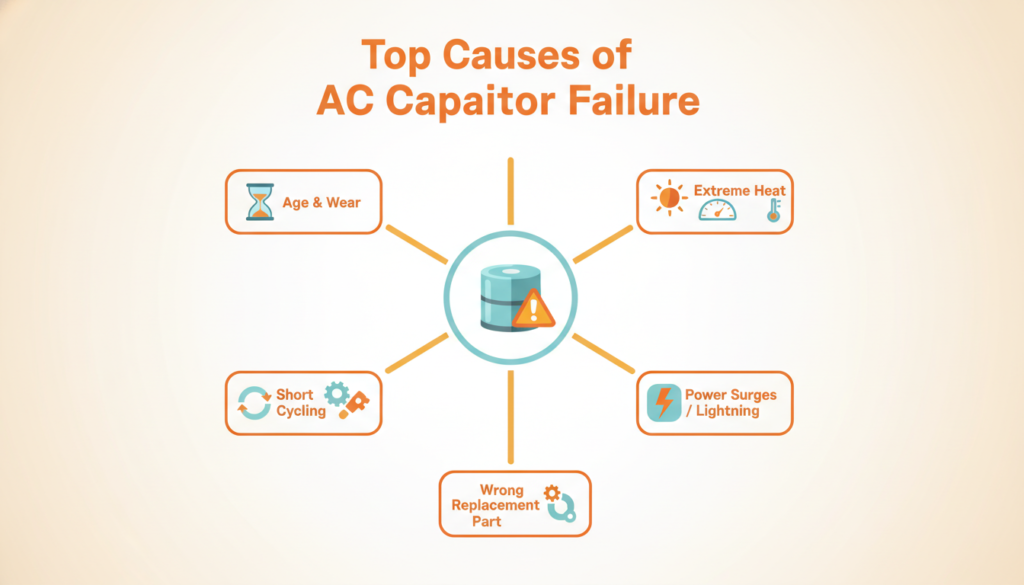
Knowing the signs is important, but understanding why it happens can help you prevent it from happening again. The most common causes include:
Age: All capacitors wear out over time. Even a well-maintained unit will need a capacitor replacement somewhere between 10 and 20 years of use.
Extreme Heat: Here in Lafayette, summer temperatures regularly push outdoor units hard. When the condenser sits in direct sunlight, the internal temperatures inside the unit can climb high enough to degrade the capacitor much faster than average.
Power Surges: Lightning storms and sudden voltage spikes can instantly damage or destroy a capacitor. This is a real concern in Louisiana’s stormy seasons.
Short Cycling: Every time your AC turns on and off, it puts stress on the capacitor. A system that cycles frequently, due to an oversized unit or thermostat issues, wears out the capacitor ahead of schedule.
Wrong Replacement Part: If a previous repair used a capacitor with the wrong voltage or microfarad (MFD) rating, it will fail earlier than expected. Always make sure replacements match your system’s specifications exactly.
How to Test an AC Capacitor
For homeowners (visual check only):
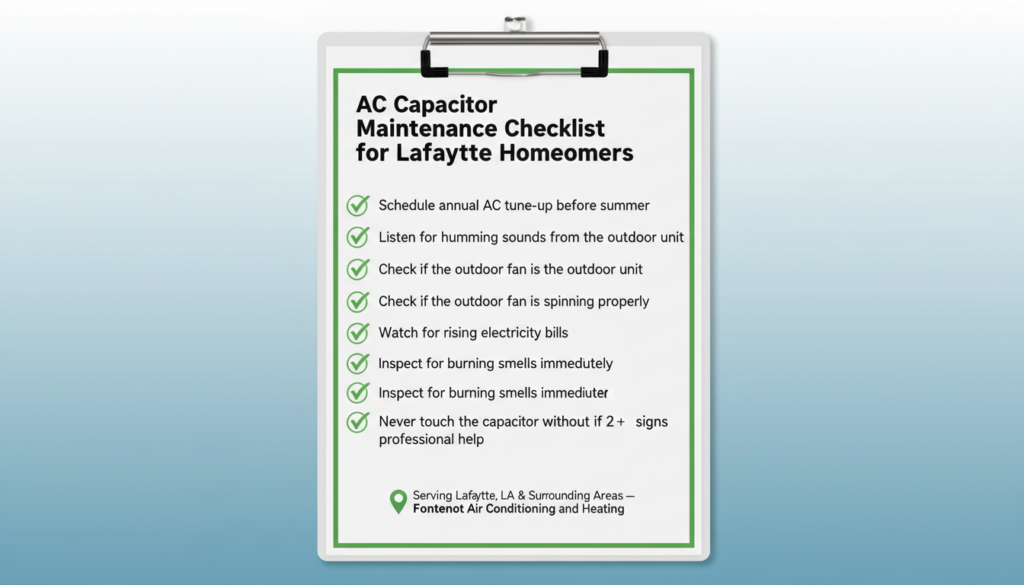
Look at the outdoor unit from the outside. Listen for humming when the system is supposed to be running. Check if the fan is spinning. If you can safely view the capacitor without touching it, look for bulging, leaking, or burn marks.
For technicians (multimeter test):
A certified HVAC technician will use a multimeter set to capacitance mode to measure the capacitor’s microfarad (MFD) reading. If the reading is more than 5–6% below the rating printed on the capacitor label, it needs to be replaced.
Important safety note: Never touch a capacitor without properly discharging it first. Even with the power off, a capacitor can retain a high-voltage charge that is strong enough to cause serious injury. Leave the hands-on testing to a licensed HVAC technician.
Can You Keep Running Your AC With a Bad Capacitor?
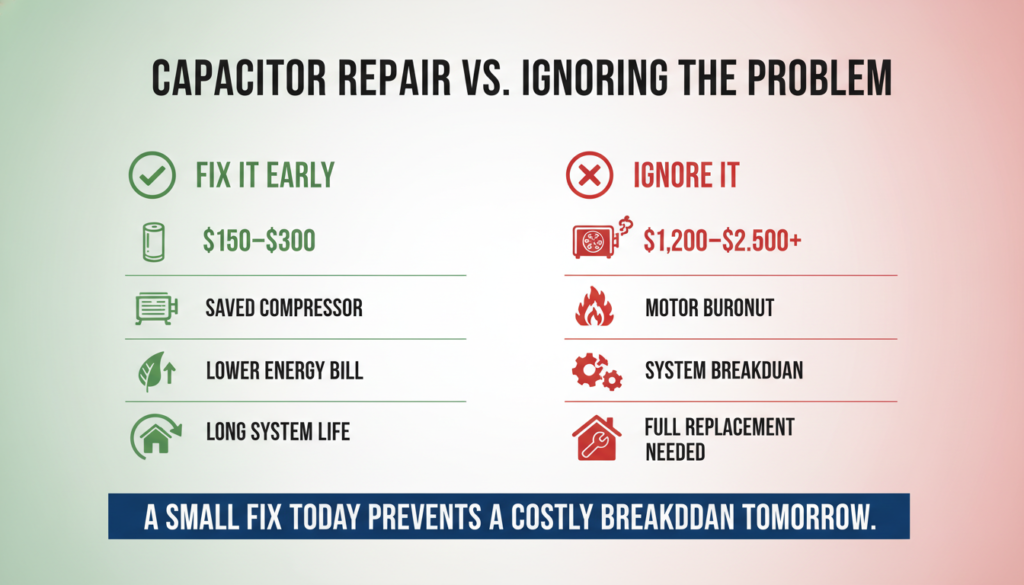
The short answer is no, and here’s why it matters.
A failing capacitor forces your compressor and fan motors to work in conditions they weren’t designed for. The compressor, which is the most expensive single component in your AC system, takes the biggest hit. Running it with a weak capacitor shortens its lifespan significantly.
You may also notice:
- Your circuit breaker is tripping repeatedly
- The system is overheating and triggering a safety shutoff
- Increasing wear on motor windings, leading to a complete motor failure
A capacitor replacement in Lafayette typically costs between $150 and $300, including parts and labor. A compressor replacement? That can run $1,200 to $2,500 or more, sometimes making a full system replacement the more cost-effective option.
Catching a bad capacitor early is one of the best ways to protect your HVAC investment.
When to Call Fontenot Air Conditioning and Heating in Lafayette
If you’re seeing two or more of the signs listed in this guide, it’s time to stop guessing and get a professional diagnosis.
At Fontenot Air Conditioning and Heating, we’ve been helping Lafayette homeowners keep their AC systems running through every Louisiana summer. Our licensed HVAC technicians can quickly test your capacitor, identify the root cause, and replace the part with the correct specification, so the problem doesn’t come back in a few months.
We also recommend scheduling an annual AC tune-up before summer starts. During a tune-up, we check capacitor health along with refrigerant levels, electrical connections, and everything else that keeps your system reliable when temperatures peak.
Don’t wait until your AC stops working on the hottest day of the year. A simple capacitor check today can save you from a major breakdown tomorrow.
📞 Call Fontenot Air Conditioning and Heating for fast, honest AC service in Lafayette and the surrounding areas.
Frequently Asked Questions About AC Capacitor Failure Signs
How do I know if my AC capacitor is bad?
The most common signs are the AC not starting, a humming noise from the outdoor unit with no fan movement, warm air blowing from vents, the system shutting off repeatedly, and rising electricity bills. Physical damage to the capacitor, bulging, leaking, or burn marks, is also a clear indicator.
Can an AC run with a bad capacitor?
It may run briefly or partially, but it’s not safe to continue. A bad capacitor forces the compressor and fan motors to work beyond their limits, leading to overheating, electrical issues, and potentially permanent motor damage. Prompt replacement is always the better choice.
What causes an AC capacitor to fail?
The most common causes are age (10–20 years is the typical lifespan), excessive heat exposure, power surges from storms, frequent short cycling, and installation of a replacement capacitor with the wrong voltage or MFD rating.
How long do AC capacitors typically last?
Under normal operating conditions, most AC capacitors last between 10 and 20 years. However, in hot climates like Lafayette, where AC systems run heavily through long summers, capacitors tend to wear out on the earlier end of that range.
Is replacing an AC capacitor expensive?
No, it’s actually one of the more affordable HVAC repairs. In Lafayette, most homeowners pay between $150 and $300 for a capacitor replacement, including labor. The cost of ignoring it, however, can be much higher if the compressor gets damaged.
Can I replace the AC capacitor myself?
It’s strongly recommended that you don’t. Capacitors hold a high-voltage electrical charge even when the unit is powered off, which makes them genuinely dangerous to handle without proper training and tools. Incorrect installation or the wrong part rating can also cause further damage or void your warranty.
How often should I have my AC capacitor checked?
Have your capacitor inspected at least once a year, ideally during your spring or pre-summer AC maintenance visit. If your system is older than 10 years, consider asking your technician to check it at every service call.
Final Thoughts
An AC capacitor is a small, inexpensive part, but it plays a big role in keeping your system running properly. The AC capacitor failure signs covered in this guide, from a unit that won’t start, to strange noises, warm air, short cycling, and rising energy bills, are all early warnings that something is wrong.
In Lafayette’s heat, your air conditioner isn’t a luxury. It’s a necessity. The best thing you can do is learn to recognize these symptoms early and act before a small problem turns into a costly one.
If you’re dealing with any of these issues, or if you just want peace of mind before the summer hits hard, reach out to Fontenot Air Conditioning and Heating. We’re here to keep Lafayette cool.
Having multiple AC issues at once? Read our complete guide to the most common AC problems Lafayette homeowners face, and how to fix them before they get worse.