
Replacing Old AC Ductwork During a New AC Installation in Lafayette, LA
Search
Recent Posts
How Much Does Air Duct Cleaning Cost in Lafayette, LA?
October 21, 2026
Heat Pump vs Furnace: Which Fits Louisiana Homes?
October 15, 2026
Tags
Follow Us on
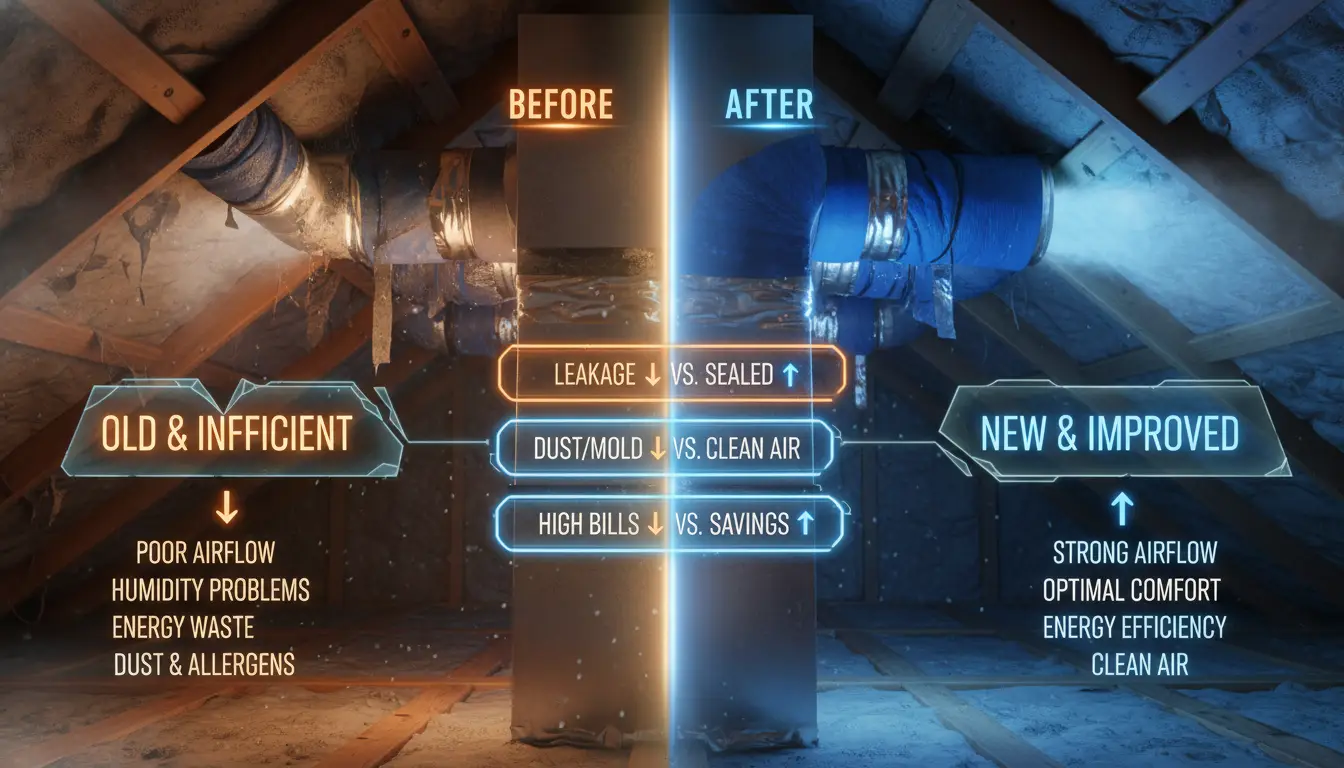
Replacing old AC ductwork during a new installation is often worth it in Lafayette, LA. Aging or damaged ducts can waste 20–30% of conditioned air before it reaches your rooms. If your ductwork is over 15 years old, leaking, or improperly sized, replacing it alongside your new AC system delivers better efficiency, comfort, and long-term savings.
Key Takeaways
- Ductwork older than 15–20 years often has enough leakage and heat damage to offset the performance gains from a new, high-efficiency AC unit.
- South Louisiana’s extreme attic heat and humidity accelerate flexible duct deterioration faster than in most other U.S. climates.
- Replacing ducts at the same time as your AC system saves money on labor, since contractors are already accessing your attic and air handler.
- Signs like uneven room temperatures, weak airflow, or skyrocketing summer energy bills are often duct problems, not AC problems.
- A proper Manual J and Manual D evaluation by a licensed HVAC contractor tells you definitively whether your ducts need replacement or can be repaired.
Should You Replace Ductwork When Installing a New AC System?
One of the most common questions Lafayette homeowners ask when buying a new air conditioner is whether to keep the existing ductwork. It feels like a reasonable way to save money. But the answer depends on the age, condition, and design of what is already in your attic or crawlspace.
New AC systems are significantly more efficient than units from 10 or 15 years ago. But that efficiency only shows up on your energy bill if the ductwork delivering conditioned air is in good shape. Putting a high-performance AC system on an old, leaking duct system is like buying a brand-new car and running it on a cracked fuel line.
When Can Existing HVAC Ductwork Be Reused?
Your existing ductwork may be suitable for reuse if it meets several conditions. The system should be less than 10–12 years old, free of visible damage or disconnections, properly sized for your new AC unit’s airflow requirements, and sealed with minimal leakage.
A licensed HVAC technician can confirm this through testing. If your ducts pass a leakage test and static pressure measurements align with your new system’s specifications, reusing them is a reasonable choice.
When Is Duct Replacement Recommended?
Duct replacement becomes the recommended path when the existing system is more than 15–20 years old, shows signs of physical damage, has significant air leakage, or was never properly designed for the home’s layout. In Lafayette and the surrounding Acadiana region, heat exposure in attics accelerates duct wear well beyond national averages.
Replacement is also recommended when you are upgrading to a variable-speed or two-stage AC system, since these units require more precise airflow than older single-stage systems.
How Does Old Ductwork Reduce New AC System Performance?
Old ductwork undermines a new AC system in several ways. Air leaks in ducts allow conditioned air to escape into the unconditioned attic space before it ever reaches your living areas. Collapsed or kinked flex duct sections restrict airflow and increase the workload on your new air handler. Poor return air design causes the system to short-cycle or run inefficiently.
According to the U.S. Department of Energy, leaky duct systems can reduce HVAC efficiency by 20–30%, meaning you pay for cooling you never actually feel inside your home.
How Do HVAC Contractors Evaluate Existing Ductwork?
A qualified HVAC contractor evaluates existing ductwork through a combination of visual inspection and diagnostic testing. They look for disconnected joints, crushed flex duct, missing insulation, and signs of moisture damage. They also run static pressure tests and duct leakage tests to measure how much air the system loses before it reaches supply vents.
This evaluation is the only way to make an informed decision. Skipping it means guessing, and guessing wrong costs you money for years.
What Are the Signs Your Existing HVAC Ductwork Needs Replacement?
Your ductwork does not always fail all at once. Instead, it sends signals through your home’s comfort and your energy bills. Recognizing these early can help you make a smarter decision before committing to a new AC installation.
Is Uneven Cooling Between Rooms a Duct Problem?
If some rooms in your Lafayette home are consistently warmer than others, and your AC is otherwise functioning, the ductwork is often the cause. Disconnected branch ducts, collapsed sections, or an unbalanced supply design prevent conditioned air from reaching certain areas of the home reliably.
What Does Weak Airflow From Supply Vents Indicate?
Reduced airflow from one or more vents typically points to a duct obstruction, a collapsed flex duct, or significant leakage upstream of that supply run. This is not something that improves on its own. Weak airflow makes your AC run longer to compensate, increasing wear and energy costs.
Why Do High Energy Bills During Louisiana Summers Signal Duct Problems?
Louisiana summers are brutal. If your energy bills are climbing year over year despite no change in usage habits or thermostat settings, air leakage in your duct system is a likely cause. When conditioned air escapes into your attic instead of your living space, your AC runs continuously trying to meet a setpoint it cannot reach.
Can Old Ducts Cause Excess Dust and Poor Indoor Air Quality?
Leaking ducts pull air from unconditioned spaces like attics, crawlspaces, and wall cavities. That air carries dust, insulation particles, and allergens directly into your home’s airstream. If you notice more dust on surfaces or worsening allergy symptoms indoors, your duct system may be introducing contaminants with every cooling cycle.
What Causes Mold, Moisture, or Musty Odors in Air Ducts?
South Louisiana’s high humidity makes duct systems especially vulnerable to condensation. When warm, humid attic air contacts a cool duct surface, moisture collects inside the duct. Over time, this creates conditions for mold growth. A musty smell coming from your vents is a serious warning sign that needs professional attention, not a temporary fix with a deodorizer.
Are Noisy or Whistling Air Ducts a Problem Worth Fixing?
Popping, rattling, or whistling sounds from your ductwork often indicate pressure problems, loose joints, or undersized duct runs. These sounds mean your system is working harder than it should. High static pressure caused by restricted or poorly designed ducts shortens the life of your air handler and blower motor.
How Does Aging Flexible Ductwork in Hot Attics Degrade?
Flexible ductwork has an average lifespan of 10–25 years, but that range shortens considerably in Lafayette’s attic conditions. Attic temperatures in South Louisiana can exceed 140°F in summer. At those temperatures, the outer jacket and inner liner of the flex duct become brittle, crack, and separate. Once the insulation jacket fails, the duct loses its thermal protection entirely.
How Does Rodent or Pest Damage Affect Ducts?
Rodents and pests often nest in attic duct systems. They chew through flex duct liner and insulation, creating large air leaks and contaminating the airstream with biological matter. If a pest inspector or HVAC technician finds evidence of nesting or chewed duct material, replacement is the only appropriate solution.
What Are the Most Common Ductwork Problems in Lafayette and Acadiana Homes?
The climate and construction patterns in South Louisiana create specific ductwork challenges that do not apply equally across the country. Understanding these local factors helps explain why duct replacement comes up more often in Acadiana than in other regions.
How Does Humidity Damage Duct Systems in South Louisiana Attics?
Humidity is the defining environmental factor for HVAC systems in Lafayette. When humid outdoor air enters an attic and contacts cooled duct surfaces, condensation forms. Over the years, this moisture saturates duct insulation, promotes mold growth, and degrades both flexible and sheet metal duct systems. Homes without properly sealed and vapor-controlled attics are especially vulnerable.
Why Do Heat-Damaged Flexible Ducts Fail Early in This Climate?
As mentioned, attic temperatures in Louisiana routinely exceed 130–140°F during peak summer months. Standard flex duct is manufactured to handle temperatures up to around 120°F continuously. Operating above rated temperatures accelerates the breakdown of the inner liner and foil jacket, causing premature failure well before the product’s rated lifespan.
Where Does Air Leakage Occur Most Often in Older Lafayette Homes?
Air leakage is most common at duct connections, joints, and take-offs from the main trunk line. In older Lafayette homes built before modern energy codes, these connections were often secured with low-quality tape that dries out and fails over time. Without mastic sealant or high-quality foil tape, these joints open up and allow significant air loss.
What Role Does Poor Duct Insulation Play in Energy Loss?
Duct insulation in an attic serves a critical purpose: it prevents heat from transferring into conditioned air before it reaches the supply vent. Ducts with degraded or insufficient insulation allow attic heat to reheat the air your system just spent energy cooling. This dramatically reduces your system’s effective efficiency, even when the unit itself is brand new.
How Does Mold Grow From Condensation Inside Duct Systems?
Mold requires three things: a food source, the right temperature, and moisture. Duct systems in humid attics provide all three. Dust accumulating inside ducts acts as a food source. Temperatures are warm enough for mold growth for much of the year. And condensation from humidity introduces the moisture needed to start a colony. Once mold establishes inside a duct system, the entire system needs to be removed and replaced, not cleaned.
Why Does Old Ductwork Reduce HVAC Efficiency?
A new, high-efficiency AC unit is only as effective as the delivery system it depends on. Old ductwork limits efficiency in ways that are measurable and preventable.
What Is Air Leakage and How Much Conditioned Air Does It Waste?
Air leakage occurs when conditioned air escapes through gaps, cracks, or disconnections in the duct system before reaching supply registers. According to ENERGY STAR, typical homes lose about 20–30% of the air moving through their duct system to leakage. In a 2,000-square-foot Lafayette home, that means you are effectively paying to cool your attic every month.
What Are Static Pressure Problems in Older Duct Systems?
Static pressure refers to the resistance the air handler must overcome to push air through the duct system. When ducts are undersized, kinked, or blocked, static pressure rises. High static pressure makes your blower motor work harder, reduces airflow to supply vents, and shortens the life of HVAC components. Most older duct systems were not designed to the precise specifications that modern systems require.
How Does Poor Return Air Design Restrict Airflow?
Return air is the air pulled back to the air handler to be reconditioned. If the return air capacity is insufficient, the system starves for air. This creates negative pressure in the home, causes the system to short-cycle, and prevents the air handler from operating at its rated capacity. Many older homes in Lafayette have one central return air grille that was adequate for an older system, but falls short for a modern, higher-efficiency unit.
What Happens When Ductwork Is the Wrong Size for a Modern AC System?
Modern AC systems are sized using Manual J load calculations that account for insulation levels, window area, occupancy, and local climate data. The ductwork must be designed to match this load through Manual D calculations. Older ductwork was often installed without these calculations, leaving it undersized for some areas and oversized for others. Attaching a new, properly sized AC to a wrongly sized duct system creates persistent comfort problems.
Why Do Variable-Speed HVAC Systems Need Proper Duct Design?
Variable-speed and two-stage HVAC systems modulate their output based on demand, running at lower speeds more frequently rather than cycling on and off at full capacity. This is more efficient, but it requires a duct system designed to handle lower airflow velocities without creating cold or hot spots. Old, poorly designed duct systems do not support variable-speed operation effectively, neutralizing one of the main selling points of a high-efficiency system.
What Should an HVAC Duct Inspection Include Before AC Replacement?
Before any reputable HVAC contractor recommends duct replacement or new installation, they should perform a thorough evaluation. This is not a visual walk-through. It is a systematic, data-driven assessment.
What Is a Manual J Load Calculation?
Manual J: a standardized calculation that determines the precise heating and cooling load of a home based on square footage, insulation values, window area, ceiling height, local climate data, and occupancy. A proper Manual J ensures the new AC system is neither oversized nor undersized for your home.
What Is a Manual D Duct Design Evaluation?
Manual D: a companion calculation to Manual J that determines the correct size, layout, and configuration of the duct system to match the AC unit’s output. Without Manual D, duct sizing becomes guesswork. Many comfort problems in Lafayette homes trace directly back to ductwork that was never properly designed.
How Is Static Pressure Testing Used to Evaluate Ducts?
A static pressure test measures the pressure difference across the air handler and throughout the duct system. High readings confirm that the duct system is restricting airflow. This test takes about 30 minutes and provides quantifiable data that determines whether the existing ducts can support a new system.
What Does a Duct Leakage Test Reveal?
A duct leakage test uses a blower door or duct blaster to pressurize the duct system and measure how much air escapes. Results are expressed as a percentage of total system airflow. According to ENERGY STAR standards, well-sealed duct systems should leak no more than 4% of total airflow. Systems leaking 15%, 20%, or more are strong candidates for replacement.
What Are CFM Measurements and Why Do They Matter?
CFM (cubic feet per minute) measures the volume of air moving through each supply register. Low CFM readings at specific vents indicate restrictions in those branch ducts. Measuring CFM at every register gives the contractor a complete picture of how evenly the existing system distributes conditioned air throughout your home.
How Is Return Air Capacity Evaluated?
Return air capacity is assessed by measuring the total area of return air grilles and comparing it to the system’s required return air volume. Undersized return air systems are one of the most common and most overlooked problems in residential HVAC installations in Louisiana. Correcting this during a duct replacement dramatically improves system performance.
What Are the Benefits of Replacing Ductwork During AC Installation?
Timing duct replacement to coincide with a new AC installation is the most cost-effective approach. The HVAC contractor is already in your attic, the air handler is already disconnected, and the labor overlap saves you money compared to two separate projects.
How Does New Ductwork Improve Airflow Throughout the Home?
A properly designed duct system delivers the right volume of air to every room based on its individual cooling load. Rooms that previously ran warm get adequate airflow. Rooms that were overcooled stop wasting energy. The result is whole-home comfort that older, improperly designed systems rarely provide.
Can New Ductwork Lower Your Cooling Costs in Louisiana?
Yes, significantly. Eliminating 20–30% duct leakage, adding proper insulation, and correcting airflow imbalances can reduce cooling costs by hundreds of dollars per year in a South Louisiana climate. When you factor in the heat load from uninsulated or damaged ducts, the savings compound quickly over a 10–15 year system lifespan.
How Does New Ductwork Help With Humidity Control in Louisiana?
Humidity control is as important as temperature control in Lafayette. A properly sealed, insulated duct system prevents humid attic air from entering the airstream. It also allows the AC system to run longer, lower-intensity cycles, which removes more moisture from the air than short, high-intensity cycles. Better humidity control means a more comfortable home, even when temperatures are moderate.
Does New Ductwork Produce More Consistent Indoor Temperatures?
Consistent temperatures depend on balanced airflow. When every room receives the right volume of conditioned air, temperature differentials between rooms shrink dramatically. Homeowners who replace aging, unbalanced duct systems consistently report that the improvement in comfort is noticeable from the first day of operation.
How Does Proper Ductwork Reduce Wear on Your AC System?
When your duct system flows freely and returns adequate air to the blower, the AC system operates within its design parameters. It cycles on and off correctly, runs at appropriate pressures, and experiences less mechanical stress. Systems installed on properly designed ductwork consistently outlast systems struggling against high static pressure and airflow restrictions.
How Does New Ductwork Improve Indoor Air Quality?
New, properly sealed ductwork eliminates the pathways through which attic dust, insulation particles, and outdoor allergens enter your living space. Combined with a properly sized filtration system, new ducts provide a clean, controlled airstream throughout the home. For households with allergy sufferers or respiratory sensitivities, this improvement alone often justifies the investment.
What Types of HVAC Ductwork Are Used in Modern Installations?
Not all duct materials perform equally, especially in South Louisiana’s climate. Your contractor should explain the options and recommend the most appropriate material for your home’s specific conditions.
What Is Flexible HVAC Ductwork?
Flexible ductwork: a type of duct made from a coiled wire frame wrapped in plastic and covered with insulation and a foil vapor barrier. It is lightweight, easy to install, and cost-effective. However, it must be properly supported and run without excessive bending to avoid airflow restrictions. In Lafayette attics, quality flex duct with sufficient insulation (R-8 minimum) is the most common choice for residential installations.
What Are Sheet Metal Duct Systems?
Sheet metal ductwork: rigid, galvanized steel duct fabricated in standard shapes and connected with joints sealed with mastic or foil tape. Sheet metal is more durable than flex duct and maintains its shape indefinitely. It is the preferred material for trunk lines and main supply runs. The trade-off is higher material and labor costs.
What Is Fiberglass-Lined Duct?
Fiberglass-lined duct: rigid ductwork with a fiberglass liner on the interior surface that provides both insulation and acoustic dampening. It reduces airflow noise and offers good thermal performance. However, if the fiberglass liner deteriorates, it can shed particles into the airstream. For this reason, some contractors prefer alternative options in high-humidity environments.
What Insulated Ductwork Options Work Best in Louisiana Attics?
In Lafayette’s climate, insulation value is critical. Duct insulation is rated by R-value: the higher the number, the better the thermal resistance. For attic installations in South Louisiana, R-8 flex duct is the minimum recommended standard, with some contractors using R-10 or higher for maximum performance. The insulation also needs a continuous, intact vapor barrier to prevent condensation in humid attic conditions.
What Is the Best Duct Material for Lafayette Attic Installations?
For most Lafayette homes, the recommended approach is a combination of sheet metal trunk lines with R-8 or R-10 insulated flex duct branch runs. This balances durability, cost, thermal performance, and installation flexibility. A properly supported and sealed flex duct system installed by an experienced contractor performs well for 20 or more years in this climate.
What Should You Expect During HVAC Duct Replacement?
Understanding what the replacement process involves helps you plan and ensures you know what a quality installation looks like.
How Long Does Duct Replacement Usually Take?
A full duct replacement in an average-sized Lafayette home (1,500–2,500 square feet) typically takes one to two days. Larger homes or those with complex layouts may require two to three days. When combined with a new AC installation, some contractors can complete both projects simultaneously, minimizing the total time your cooling system is offline.
What Attic and Crawlspace Access Is Required?
Contractors need clear attic access to remove old ductwork and install new runs. In Lafayette, most residential ductwork runs through the attic. The contractor should protect your home’s interior during the process, covering attic access openings to prevent debris from entering living spaces.
Will There Be a Temporary Cooling Interruption?
Yes. During duct replacement, your AC system cannot operate. In summer, this means scheduling the project during a period when temperatures are tolerable or arranging temporary cooling. Reputable contractors work efficiently to minimize downtime and often complete the most critical portions of the installation before the hottest part of the day.
What Happens During Post-Installation Cleanup and Testing?
After installation, the contractor should verify all duct connections, seal every joint with mastic or approved tape, confirm insulation integrity across all duct runs, and run the system through a series of airflow and static pressure tests. They should also walk you through the completed installation and confirm that every supply and return register is delivering appropriate airflow.
Should You Repair or Replace HVAC Ductwork?
This is the practical question most homeowners face. The answer depends on the extent of the damage, the age of the system, and the cost comparison between the two options.
When Is Duct Sealing or Repair Enough?
Duct sealing makes sense when the ductwork is relatively new, structurally intact, and the leakage is limited to accessible joints and connections. Aeroseal duct sealing technology can seal leaks from the inside without accessing every section of the duct system. This can reduce leakage significantly at a lower cost than full replacement.
When Is Full Duct Replacement the Better Option?
Full replacement is the better option when ductwork is over 15 years old, when multiple sections are physically damaged, when the system was never properly sized, or when repairs would require accessing inaccessible sections repeatedly. If the cost of repairs approaches 50% or more of a full replacement, replacement is almost always the smarter long-term investment.
How Do the Long-Term Energy Savings Compare?
A properly replaced and sealed duct system delivers consistent energy savings over its lifespan. Repaired ductwork may improve performance initially, but often develops new leaks at adjacent connections. Over a 10–15-year period, the cumulative energy savings from a full replacement typically outweigh the upfront cost difference.
Which Option Improves Comfort and Airflow the Most?
Full replacement, when properly designed with Manual D calculations, addresses both leakage and airflow distribution. It corrects structural problems that repairs cannot fix. Repair can reduce leakage, but it cannot resize undersized ducts or rebalance a system that was poorly designed from the start. For whole-home comfort improvements, replacement delivers more consistent and lasting results.
Should You Add HVAC Zoning During Duct Replacement?
Duct replacement is the ideal time to evaluate whether a zoned HVAC system makes sense for your home. Adding zoning after ducts are installed is more complicated and expensive.
What Are the Benefits of Zoned Cooling Systems?
Zoning divides your home into separate temperature-controlled areas, each with its own thermostat and damper controls within the duct system. This allows you to cool occupied rooms more aggressively while reducing energy use in unoccupied areas. In a two-story Lafayette home where the upstairs runs significantly warmer than the downstairs, zoning provides both comfort and efficiency improvements.
When Does a Zoned Duct System Make Sense?
Zoning makes the most sense in homes with multiple floors, large open floor plans, rooms with significant sun exposure, or areas used on very different schedules, such as a home office versus bedrooms. Homes where one thermostat cannot satisfy all zones consistently are strong candidates.
Is Zoning Compatible With Modern High-Efficiency HVAC Systems?
Yes, with the right setup. Variable-speed systems pair especially well with zoning because they can modulate output to match the reduced demand of a single zone without short-cycling. However, zoned systems require careful duct design to manage static pressure when dampers close off sections of the system. This is another reason to involve an experienced HVAC contractor in the planning stage.
How Much Does It Cost to Replace AC Ductwork in Lafayette, LA?
Cost is usually the deciding factor in duct replacement decisions. Understanding what drives pricing helps you evaluate quotes and make an informed decision.
What Are Average Duct Replacement Costs?
In Lafayette, LA, full duct replacement for a typical residential home generally ranges from $3,000 to $8,000, depending on home size, accessibility, and material selection. Homes over 2,500 square feet or with complex layouts may exceed this range. When combined with a new AC installation, some contractors offer bundled pricing that reduces the overall cost compared to two separate projects.
What Factors Affect HVAC Duct Installation Pricing?
Several variables influence the final cost of a duct replacement project in Lafayette.
Home Size and Layout
Larger homes require more duct material and more labor hours. Homes with open floor plans and simple layouts cost less than homes with multiple additions, unusual ceiling heights, or irregular room configurations.
Duct Material Selection
Sheet metal ductwork costs more than flex duct for both material and labor. However, it lasts longer and maintains its shape better in attic environments. The right choice depends on your budget, attic conditions, and how long you plan to stay in the home.
Attic Accessibility
Attics with adequate height and clear access panels are faster and less expensive to work in. Low-pitch attics, attics filled with excessive insulation, or those with limited access hatches increase labor time and therefore cost.
Insulation Requirements
Higher R-value insulation costs more upfront but pays back in energy savings. In Lafayette’s climate, spending more on R-8 or R-10 duct insulation is generally a worthwhile investment given the extreme summer heat loads.
Labor and Installation Complexity
Experienced HVAC contractors with crews familiar with South Louisiana’s climate conditions may charge more per hour than less experienced operators. However, quality installation directly affects how long the duct system lasts and how well it performs. Cutting corners on labor costs typically leads to callbacks and premature failures.
Do You Save Money by Replacing Ductwork With a New AC System?
Yes, in most cases. When an HVAC contractor is already on-site for an AC installation, the attic is already accessible, and the air handler is already disconnected. This reduces the labor cost of simultaneous duct replacement compared to scheduling it as a separate project. Many homeowners find that bundling both projects results in a combined cost that is 10–20% lower than two independent jobs.
Is Duct Replacement Worth the Investment?
For most Lafayette homeowners with ductwork over 15 years old, the answer is yes. The combination of lower energy bills, improved comfort, better humidity control, and reduced wear on a new AC system typically produces a payback period of 4–7 years in South Louisiana’s climate. After that point, the savings are compounding annually.
What Are the HVAC Code and Permit Requirements in Lafayette Parish?
In Lafayette Parish, HVAC installation and duct replacement work typically requires a mechanical permit issued through the appropriate local authority. Licensed contractors must pull permits before beginning work, and inspections are required upon project completion.
Louisiana follows the International Mechanical Code with state-specific amendments. Ductwork must meet minimum insulation requirements for the local climate zone. In Louisiana’s hot-humid climate zone, ducts located in unconditioned attics must be insulated to at least R-8 per current energy code standards.
Always confirm that your contractor is properly licensed in Louisiana and pulls the required permits for your project. Unpermitted HVAC work can create complications when selling your home and may void equipment warranties. Reputable contractors include permit costs in their project estimates and manage the inspection process on your behalf.
Schedule a Professional HVAC Duct Inspection in Lafayette, LA
If your home is showing signs of duct problems, or if you are planning a new AC installation, the right first step is a professional duct evaluation. The Fontenot’s Air Conditioning team serves Lafayette and the surrounding Acadiana area with thorough diagnostic inspections designed to give you clear answers, not guesses.
What Happens During a Ductwork Evaluation?
A professional ductwork evaluation begins with a visual inspection of all accessible duct sections, connections, and insulation. The technician checks for physical damage, disconnected joints, crushed flex runs, and signs of moisture or mold. This initial inspection often reveals obvious problems before any testing begins.
How Is Airflow and Static Pressure Testing Performed?
After the visual inspection, the technician connects diagnostic equipment to the air handler and duct system. Static pressure readings are taken at multiple points. Airflow measurements at each supply register confirm whether the system is delivering the correct volume of air to each room. These tests take approximately one to two hours for an average home.
What Can Duct Testing Reveal About Energy Loss and Comfort Problems?
The combination of a leakage test and airflow measurements tells you exactly how much conditioned air your current duct system is wasting and where the biggest problems are located. This data gives you a clear, objective basis for deciding whether repair or replacement is the right path for your home.
How Do You Get an Estimate for AC and Duct Replacement in Lafayette?
Contact Fontenot’s Air Conditioning through the AC installation services page to schedule an evaluation or request a quote. Their team will assess your current duct system, explain your options, and provide a clear estimate for any recommended work. Getting an estimate costs nothing, and the information you receive helps you make a confident, well-informed decision.
Conclusion
Replacing old AC ductwork during a new AC installation in Lafayette is often one of the most effective investments a homeowner can make in long-term comfort and energy efficiency. South Louisiana’s extreme heat and humidity push duct systems to their limits faster than most other climates. When ductwork is aging, leaking, or undersized, even the most efficient new AC unit cannot perform the way it should.
The decision comes down to the condition of your existing ducts, your long-term plans for the home, and the cost comparison between repair and replacement. A professional duct evaluation takes the guesswork out of that decision.
Ready to find out whether your ductwork is holding back your new AC system? Visit Fontenot’s Air Conditioning to schedule a professional duct inspection in Lafayette, LA. Their team provides honest assessments and clear pricing so you can move forward with confidence.
Frequently Asked Questions
How do I know if my ducts need to be replaced before a new AC installation?
The clearest signs are uneven room temperatures, weak airflow from supply vents, rising energy bills, and musty odors from registers. A licensed HVAC technician can confirm the condition of your ducts through static pressure testing and a duct leakage test. These tests take one to two hours and provide definitive answers.
Can I install a new AC without replacing old ductwork?
Yes, but it depends on the condition of your existing ducts. If they are less than 10–12 years old, properly sealed, and sized correctly for your new system, reuse may be viable. Ducts that are older, damaged, or leaking significantly will reduce the performance of your new AC and increase operating costs.
How long does duct replacement take in a typical Lafayette home?
Most full duct replacement projects in homes between 1,500 and 2,500 square feet take one to two days. Larger homes or those with complex attic layouts may require two to three days. Combining the project with a new AC installation can reduce total project time and overall labor costs.
What duct material is best for Lafayette’s climate?
For South Louisiana attics, R-8 or R-10 insulated flexible ductwork for branch runs, combined with sealed sheet metal trunk lines, provides the best combination of durability and thermal performance. The high R-value insulation is especially important given the extreme attic temperatures common in this region from June through September.
Is it cheaper to seal ducts or replace them entirely?
Duct sealing costs less upfront and is the right choice when ductwork is structurally sound with limited leakage. Full replacement costs more initially but is the better long-term investment when ducts are damaged, improperly sized, or over 15 years old. According to ENERGY STAR, properly sealed and insulated ducts can cut cooling costs by 20–30% annually.
Does replacing ductwork require a permit in Lafayette Parish?
Yes. HVAC duct replacement in Lafayette Parish requires a mechanical permit. A licensed contractor should pull this permit before work begins and manage the required inspection. Always confirm your contractor is licensed and handling permits properly; unpermitted work can cause issues when selling your home and may affect equipment warranties.
Related Articles
How Much Does Air Duct Cleaning Cost in Lafayette, LA?
October 21, 2026