

AC Maintenance Guide: How to Keep Your Air Conditioner Running Efficiently in Lafayette
Search
Recent Posts

Humidity Control in Louisiana Homes: A Complete Guide
August 19, 2026
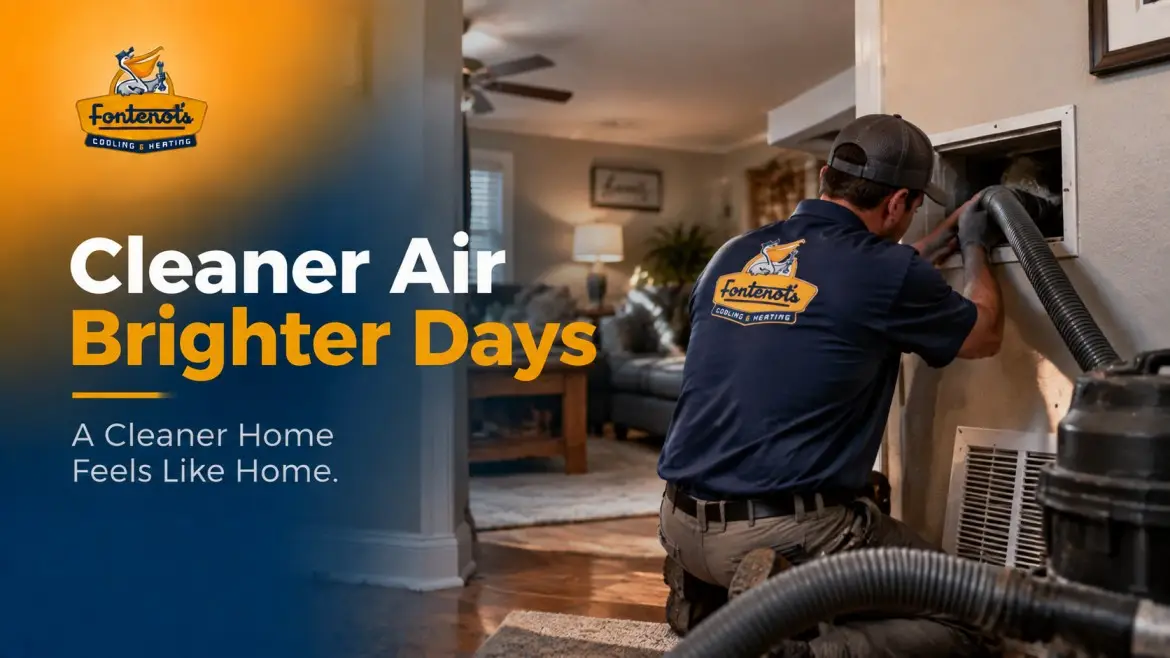
Is Air Duct Cleaning Worth It? What the EPA Says
August 14, 2026
Tags
Follow Us on
AC Maintenance Guide is the routine cleaning, inspection, and testing that keeps a cooling system running at the efficiency it was built for. Homeowners handle the filter, the space around the outdoor unit, and simple airflow checks. A trained technician handles coils, refrigerant, electrical testing, and drain service. In Lafayette’s long cooling season, plan on monthly filter checks plus one professional tune-up each spring.
Key Takeaways
- Check the filter every month during cooling season. According to the U.S. Department of Energy, swapping a dirty, clogged filter for a clean one can lower an air conditioner’s energy consumption by 5% to 15%.
- Book the professional visit in spring, not July. ENERGY STAR recommends a pre-season checkup on the cooling system, and contractor schedules tighten once the heat sets in.
- In Acadiana, the condensate drain deserves as much attention as the filter. Your system pulls gallons of water out of humid indoor air every day in summer, and a blocked drain line is one of the more common reasons a working AC shuts itself off.
- Anything involving refrigerant or live electrical parts is not a DIY job. Federal law requires EPA Section 608 certification to handle refrigerant, and capacitors can hold a dangerous charge even after the power is off.
- Keep your maintenance records. Many manufacturer warranties require documented annual professional service, and proof of that service is what protects the coverage on a compressor or coil.
Air conditioning is not a seasonal convenience in South Louisiana. It runs hard from roughly April through October, and it works a double shift the entire time: pulling heat out of your house and pulling moisture out of the air along with it. That second job is the one most maintenance advice ignores, and it is the reason a cooling system in Lafayette wears differently than the same equipment in Denver or Chicago.
This guide walks through what AC maintenance actually involves, which tasks belong to you and which belong to a licensed technician, what a real professional tune-up covers, what it typically costs, and how to tell when maintenance has stopped being the answer. It is written for the homeowner with a central cooling system who wants to understand the equipment well enough to make good decisions about it, not just follow a checklist.
What Is AC Maintenance?
AC maintenance is preventive work performed on a functioning system. It is different from repair, which restores a system that has already failed, and different from replacement, which swaps the equipment entirely. The point of maintenance is to keep the system operating close to its design conditions and to catch small problems while they are still small.
In practice, maintenance runs on two tracks. The homeowner track covers the tasks that need doing every month or two and require no tools, no panels removed, and no contact with electrical or refrigerant components. The professional track covers the annual inspection, cleaning, and measurement that require training, instruments, and certification.
Neither track replaces the other. A homeowner who changes filters religiously but never has the system inspected will still accumulate dirty coils, a weakening capacitor, and a drifting refrigerant charge. A homeowner who books a tune-up every spring but leaves the same filter in for eight months undoes a good part of that visit within weeks.
How a Central Air Conditioner Works
A central air conditioner does not create cold air. It moves heat from inside your house to the outside, using refrigerant as the carrier.
The cycle runs like this. Warm indoor air is pulled through your return grille and across the evaporator coil, a cold coil inside the indoor unit. Refrigerant inside that coil absorbs heat from the air, and the blower pushes the now-cooler air back out through your supply vents. The refrigerant, now carrying that heat, travels outside to the condenser coil, where a fan blows outdoor air across it and releases the heat. The compressor keeps the refrigerant circulating between the two coils.
Here is the part that matters most in Louisiana. When humid indoor air hits a cold evaporator coil, water vapor condenses on the coil surface, exactly the way a glass of iced tea sweats on a July afternoon. That water drips into a drain pan and leaves the house through the condensate drain line. Your air conditioner is a dehumidifier as much as it is a cooler, and on a muggy day a good portion of the energy it uses goes toward removing moisture rather than lowering temperature.
That single fact explains why so much local AC maintenance centers on drainage, airflow, and coil cleanliness. Restrict the airflow or foul the coil, and the system loses its ability to manage moisture before it loses its ability to manage temperature. The house feels clammy at 74 degrees, and most people blame the thermostat.
Key AC Components Homeowners Should Know
You do not need to know how to service these parts. You do need to recognize them, because knowing the vocabulary makes every conversation with a technician more productive.
| Component | Where it lives | What it does | Maintenance it needs |
| Air filter | In the return grille or a slot at the air handler | Protects the blower and evaporator coil from dust and debris | Homeowner checks monthly, replaces as needed |
| Evaporator coil | Inside the indoor air handler or above the furnace | Absorbs heat and moisture from indoor air | Professional inspection and cleaning |
| Blower | Indoor unit | Moves air across the coil and through the ducts | Professional inspection, airflow measurement |
| Condensate drain pan and line | Under the evaporator coil, draining outside or to a plumbing tie-in | Carries away the water pulled from indoor air | Homeowner watches for signs of clogging; professional clears and treats |
| Condenser coil and fins | Outdoor unit | Releases collected heat to outdoor air | Homeowner keeps clear of debris; professional cleans |
| Compressor | Outdoor unit | Circulates refrigerant through the system | Professional testing only |
| Capacitor and contactor | Inside the outdoor unit’s electrical panel | Start and run the motors; switch the system on and off | Professional testing only; never homeowner access |
| Refrigerant lines | Between indoor and outdoor units | Carry refrigerant between the coils | Professional inspection; visual check of insulation by homeowner |
| Thermostat | Living space wall | Controls when and how the system runs | Homeowner checks settings and batteries |
Why AC Maintenance Matters in Lafayette, Louisiana
Maintenance matters everywhere. It matters more here because of run time and moisture load, and because equipment that fails in Acadiana tends to fail during the stretch of the year when you can least tolerate it.
How Lafayette’s Heat and Humidity Affect Air Conditioners
Lafayette sits in a humid subtropical climate. Average highs reach roughly 90 to 92 degrees in July and August, and dew points climb above 65 degrees from around May through September, which is the range where outdoor air feels genuinely heavy. July is also one of the wettest months of the year, typically bringing five to six inches of rain across a couple of dozen wet days.
Three consequences follow for your air conditioner:
Run time is long. A system that runs six or seven months a year accumulates wear faster than one that runs three. Bearings, capacitors, contactors, and blower motors all age on operating hours, not calendar years.
The moisture load is heavy. Every hour the system runs on a humid day, it condenses water out of the air. That water has to reach a drain and leave the building. Standing moisture in a warm drain pan is a good environment for biological growth, which is exactly what clogs drain lines and trips float switches in August.
The outdoor unit lives in a demanding environment. Spring pollen, grass clippings, live oak leaves, and the fast vegetation growth that comes with heat plus regular rain all conspire to blanket a condenser coil. Add the debris that a tropical system can scatter across a yard in a few hours, and the outdoor unit needs checking more often than it would in a drier climate.
How Preventive Maintenance Improves Efficiency and Comfort
Efficiency losses in a neglected system are mostly airflow and heat transfer problems. A loaded filter restricts the air moving across the evaporator coil. A dirty condenser coil makes it harder for the system to reject heat outdoors, so the compressor works longer and draws more power for the same result. A refrigerant charge that has drifted off its target changes how much heat the system can move per cycle.
The Department of Energy’s Energy Saver guidance puts a number on the simplest of these: replacing a dirty, clogged filter with a clean one can lower an air conditioner’s energy consumption by 5% to 15%. That is a meaningful range, and it is worth being honest about why it is a range. How much you actually save depends on how restricted the filter had become, how your ductwork is laid out, how well the house is sealed and insulated, and what your utility rate is. Anyone who promises a specific dollar figure from a tune-up is guessing.
The comfort side is easier to feel than to quantify. A system with proper airflow and a clean coil spends more of its run time actually dehumidifying. When airflow drops, the coil can get too cold in spots and too warm in others, dehumidification suffers, and rooms farthest from the air handler start to lag. Most homeowners describe this as “it’s cooling, but it feels sticky,” which is a fairly reliable signal that something in the airflow or charge is off.
How Regular Maintenance Prevents Breakdowns and Extends Lifespan
Maintenance cannot guarantee a system will last a set number of years. What it does is reduce the number of preventable failures and give you warning before the expensive ones arrive.
ENERGY STAR is blunt about the underlying cause of most equipment problems: dirt and neglect are the leading causes of heating and cooling system failure and inefficiency. That tracks with what shows up during tune-ups. A capacitor that measures below its rated capacitance still works, but it is on its way out and can be replaced on a scheduled visit in April rather than during a failure in August. A contactor with pitted contacts will eventually weld shut or fail to close. A drain line that is starting to restrict will fully clog under peak load. A refrigerant charge that has drifted low usually means a leak somewhere, and finding it early is cheaper than finding it after the compressor has been running hot for a season.
None of these are guaranteed outcomes. They are the failure modes that inspection can realistically catch, which is a more useful framing than a promise about lifespan.
AC Maintenance Checklist for Lafayette Homeowners
This is the homeowner side of the work. Each item includes how often to do it. Nothing here requires opening a sealed component, touching an electrical terminal, or handling refrigerant.
Check and Replace the Air Filter (Monthly Check, Recommended Replacement Schedule)
Check monthly during the cooling season. Replace when it looks loaded, and in most Acadiana homes that lands somewhere between every one and three months.
ENERGY STAR recommends checking the filter once a month in a central air conditioner, furnace, or heat pump. The Department of Energy suggests cleaning or replacing it every month or two during the cooling season, and more often if the system runs constantly, the environment is dusty, or you have pets that shed.
Rather than committing to a calendar interval you will forget, learn what your own filter looks like when it is done. Pull it out, hold it up to a light, and look through it. A filter you cannot see light through needs replacing. After two or three cycles, you will know whether your house is a six-week house or a twelve-week house.
A few practical notes. Write the installation date on the filter’s cardboard edge with a marker. Note the exact size, printed on the frame, in your phone so you are not measuring in the hardware store aisle. And pay attention to the airflow arrow printed on the frame, which should point toward the air handler, in the direction air travels.
Some homes have more than one return, which means more than one filter. It is worth walking the house once to confirm how many you actually have.
Choose the Right Air Filter for Your System
Reassess when you change filter types, and check with a technician before moving to a significantly higher rating.
Filters are rated on the MERV scale, which stands for Minimum Efficiency Reporting Value. Higher numbers capture smaller particles. It is tempting to read that as “higher is always better,” and for indoor air quality alone that is roughly true. For your equipment, it is not that simple.
Denser filter media resists airflow. Every filter creates some pressure drop, and a high-MERV filter creates more. If your system’s blower cannot overcome that resistance, airflow across the evaporator coil falls, which can cost you cooling capacity and dehumidification, lengthen run times, and in some cases contribute to coil freezing. Most residential systems land comfortably somewhere in the MERV 8 to MERV 13 range, but the right answer depends on your specific equipment, not on the number that sounds most protective.
Two things genuinely help:
Filter depth matters more than most people realize. A four- or five-inch media filter has far more surface area than a one-inch filter at the same MERV rating, which spreads the airflow across more media and reduces pressure drop. If your air handler accepts a deep filter cabinet, you can usually run higher filtration with less penalty.
Ask for a static pressure reading. A technician with a manometer can measure the pressure your system is actually operating against and tell you whether it has room for the filter you want. This takes minutes and turns a guess into a measurement. If someone in the house has asthma or significant allergies and you want the best filtration your equipment can support, that measurement is the right starting point. Fontenot’s also works with dedicated indoor air quality equipment, which is often a better answer than forcing a restrictive filter into a system that was not designed for one.
Clean the Outdoor Condenser Unit, Coils, and Fins
Rinse once or twice per cooling season, and after any event that leaves debris in the yard.
The outdoor unit rejects heat, and it can only do that if air moves freely through the coil. Before you touch it, shut off power at the outdoor disconnect box near the unit and at the breaker in your electrical panel. Do not skip this. The fan can start on its own if the system calls for cooling.
Once power is off, clear leaves, grass, and dirt from around the base and out of the top grille where you can reach without removing panels, then rinse the coil with a garden hose, spraying gently and, where the design allows, from the inside outward so you push debris the way it came in rather than driving it deeper into the fins.
Do not remove the top panel or the electrical access cover. The fan motor is wired to the top, and the electrical compartment contains components that can hold a charge. Homeowner cleaning is an exterior rinse, not a disassembly.
If the fins are visibly bent, the Department of Energy notes a fin comb can straighten them, but this is delicate work and aluminum fins tear easily. If a large area is flattened or the coil looks matted with a felt-like layer of dirt, that is a job for a technician with proper coil cleaner.
Keep Vegetation and Debris Away From the Outdoor Unit
Walk out and look at it once a month during cooling season. Trim as needed.
A general working target is roughly two feet of clearance on all sides and about five feet of open space overhead, though you should check your equipment’s installation manual, since manufacturers specify their own minimums.
In this climate, the clearance you established in March is not the clearance you have in July. Heat plus regular rain drives fast growth, and shrubs planted decorously around a condenser to hide it will crowd it within a season. Grass clippings are a specific problem: aim the mower discharge away from the unit, because clippings blown into a wet coil stick and mat.
A couple of things people get wrong here. Covering the unit in summer is not helpful and restricts airflow. And “shading the condenser to help it work less” is largely a myth in practice; what actually matters is unrestricted airflow through the coil, and most shading attempts compromise that.
Check the Indoor Air Handler and Accessible Components
Look, do not open. Once a month during heavy use.
This is a visual inspection of what you can see without removing panels. Walk to the air handler, whether it is in a closet, an attic, or a garage, and look for:
- Water on the floor, in the secondary drain pan, or staining below the unit
- Rust streaks on the cabinet, which usually indicate a drainage problem
- Ice on the copper refrigerant lines or visible on the coil
- Missing or deteriorated insulation on the larger copper line
- Any sound that is new, especially grinding, scraping, or rattling
Keep the area around the air handler clear. Storage boxes stacked against a return, which is common in closet and garage installations, restrict the air the system needs.
Do not remove the blower compartment door or the electrical access panel. In systems where the air handler sits above a furnace, the cabinet may also contain gas components. There is nothing in there a homeowner needs to reach.
Clear and Inspect the Condensate Drain Line
Check monthly during cooling season. This is the item most worth your attention in a humid climate.
Your system is producing condensate continuously on a humid day. That water leaves through a drain line, typically a PVC pipe that exits the house at an exterior wall or ties into a plumbing drain. Over a season, biological growth and dust form a slime inside that line that eventually restricts and then blocks it.
Most modern installations have a float switch, a safety device that senses a full drain pan and shuts the system off before water damages your ceiling. If your AC suddenly stops running but the thermostat and breakers look normal, a tripped float switch from a clogged drain is a reasonable thing to suspect. That is not a diagnosis, but it is a possibility worth mentioning when you call.
What you can safely do:
- Find the exterior end of the drain line, usually a small PVC pipe near the outdoor unit or the foundation, and confirm it is dripping while the system is running on a humid day. A completely dry line in July, when the system is running regularly, is worth a closer look.
- Attach a wet/dry vacuum to that exterior end and pull the clog backward out of the line. This is genuinely effective and requires no access to the equipment.
- Check the secondary drain pan under an attic air handler for standing water.
What to leave alone: pouring chemicals into the drain access without knowing what your equipment tolerates. Manufacturers differ on what is acceptable, and some cleaners can attack metals in the pan or coil. If the line is blocked past what a wet/dry vacuum will clear, or the pan holds water after you clear it, that is a service call.
Check the Thermostat and Cooling Settings
Once a season, plus any time comfort changes.
Start with the basics: replace the batteries in a battery-powered thermostat once a year, and confirm the schedule still reflects how the household actually lives.
The setting that matters most in Louisiana is the fan switch. Set the fan to AUTO, not ON. With the fan on AUTO, it runs only during a cooling cycle. With it set to ON, it runs continuously, and between cycles it blows house air across an evaporator coil still wet with condensate, re-evaporating that moisture and sending it back into your rooms. In a dry climate, this is a minor issue. Here it can raise indoor humidity noticeably while the thermostat cheerfully reports the temperature you asked for.
Also check where the thermostat is mounted. A thermostat in direct sun, above a lamp, or on a wall shared with a hot attic chase will read high and run the system longer than needed.
Inspect Vents, Registers, and Airflow
Once a season, and any time a room starts feeling different from the rest of the house.
Walk the house and check that supply registers and return grilles are open and unobstructed. Furniture pushed against a return, a rug over a floor register, or a closed damper in a guest room all reduce the air the system can move.
Closing vents in unused rooms is one of the most persistent pieces of bad advice in home comfort. It does not redirect that air usefully. It raises static pressure in the duct system, which makes the blower work harder and can reduce total airflow, and in leaky duct systems it increases the pressure driving air out through the leaks.
While you are walking, hold your hand at each supply register and compare. If one room’s airflow is clearly weaker than the others and the filter is clean, that points toward a duct problem, a closed damper, or a restriction, and it is worth mentioning at your next service visit.
Watch for Leaks, Ice, Unusual Noises, or Odors
Ongoing. This is pattern recognition rather than a scheduled task.
Some signals warrant a quick response:
Ice on the refrigerant lines or the coil. Turn the system off at the thermostat and set the fan to ON to help the ice melt. Do not run cooling while the coil is frozen. Once it has thawed, check the filter. If it freezes again with a clean filter, stop running it in cooling and call for service, because continued operation in that state stresses the compressor.
Water where it should not be. Ceiling stains below an attic air handler, water pooling around an indoor unit, or a soggy area near the drain exit all indicate a drainage problem that will get worse.
New noises. A hard clicking or buzzing when the outdoor unit tries to start, a grinding sound from a motor, or a metallic rattle that was not there last week are all worth reporting. Describe the sound and when it happens; that detail helps a technician narrow things down before arriving.
Odors. A musty smell when the system starts often relates to moisture in the drain pan or duct system. A burning or hot-electrical smell is different. If you smell burning, hot plastic, or hot wiring, shut the system off at the thermostat and at the breaker and call for service before running it again. Do not repeatedly reset a breaker that keeps tripping.
Seasonal and Professional Maintenance Schedule
Cooling season here is long enough that a single spring visit carries a lot of weight. Timing matters as much as frequency.
Spring Maintenance Before Peak Cooling Season
Spring is when the professional visit should happen, ideally before sustained heat arrives. ENERGY STAR specifically recommends scheduling the cooling checkup in the spring, partly for the equipment and partly for the practical reason that contractors get busy once summer starts.
The homeowner side of spring: install a fresh filter, clear the winter’s accumulation of leaves and debris from around the outdoor unit, rinse the condenser coil, cut back anything that grew into the clearance zone, and run the system in cooling for a full cycle while the weather is still mild. A problem discovered on a 78-degree day in March is a scheduled repair. The same problem discovered on a 95-degree day in July is an emergency.
Summer Maintenance During Heavy Use
Summer is monitoring rather than intervention. Check the filter monthly, since it loads faster under continuous run time. Confirm the condensate line is dripping on humid days. Glance at the outdoor unit after storms and mowing. Watch for the comfort changes that precede mechanical problems: a house that will not get below its setpoint on the hottest afternoons, a noticeable increase in humidity, or run times that seem to have lengthened.
One realistic expectation to hold onto: on a genuinely extreme afternoon, a correctly sized system may run nearly continuously and still hold a reasonable indoor temperature. Long run times alone are not a fault. Long run times combined with rising indoor temperature or humidity are a different signal.
Fall and Winter Considerations for Heat Pump Systems
If your system is a heat pump, and many Acadiana homes have them, the outdoor unit does not get an off-season. It reverses in winter and pulls heat from outdoor air into the house, which means it runs year-round and needs attention in both directions.
Practical points for the cool months:
- Keep the same clearance around the outdoor unit. Fall leaves are the main culprit.
- Expect the unit to frost up in cold, damp weather and to run a defrost cycle that produces steam and a whoosh of sound. That is normal operation, not a fault.
- Never chip or pry ice off a heat pump coil. You will damage the fins or a refrigerant line. If ice persists through multiple defrost cycles, call for service.
- Make sure the base of the unit drains. Defrost water that cannot escape can refreeze around the coil.
- Test the heating mode on the first cool morning in fall rather than the first cold night. A heat pump using its supplementary electric heat far more than expected is worth investigating.
Because a heat pump serves both seasons, the standard recommendation is two professional visits per year rather than one, one before cooling and one before heating.
How Often Should You Follow an AC Maintenance Guide in Lafayette
For a straight air conditioner paired with a gas furnace, one professional cooling tune-up per year in spring is the baseline, with a separate heating checkup in fall.
For a heat pump, plan on two visits per year, since the same outdoor equipment carries the load in both seasons.
Fontenot’s HVAC maintenance program, the Energy Savings Plan, is built around two visits per year covering system checks, cleaning, and testing, and the office calls you when a visit is due rather than leaving it to memory. That scheduling detail sounds minor. In practice, it is the difference between a maintenance plan that gets used and one that expires unused.
DIY Maintenance vs. Professional Service (Safety Guidelines)
The dividing line is not about competence. It is about what can hurt you, what requires certification by law, and what requires instruments to do correctly.
Tasks Homeowners Can Safely Perform
- Checking and replacing air filters
- Rinsing the outdoor condenser coil with a garden hose, with power off
- Clearing leaves, clippings, and debris from around the outdoor unit
- Trimming vegetation back to the recommended clearance
- Clearing a condensate drain line from its exterior end with a wet/dry vacuum
- Checking thermostat settings, batteries, and fan mode
- Confirming supply registers and return grilles are open and unblocked
- Looking for water, ice, rust, or unfamiliar noises, without opening panels
- Checking whether a breaker has tripped, and resetting it once
That last one has a firm limit. Reset a tripped breaker once. If it trips again, stop and call for service. A breaker that keeps tripping is doing its job, and repeatedly resetting it is a fire and shock risk.
Tasks That Require a Professional (Refrigerant, Electrical Components)
Anything on this list requires training, tools, or certification that homeowners do not have:
Refrigerant work of any kind. Under EPA Section 608, technicians who handle refrigerant must be certified, and venting refrigerant is illegal. There is also no consumer path to doing this correctly: charge is verified by measuring pressures and temperatures against the manufacturer’s specifications, not by adding refrigerant until the air feels colder.
Electrical testing and component replacement. Capacitors store an electrical charge and can discharge dangerously even after power is disconnected. Testing contactors, measuring voltage and amperage at motors, and checking control boards all involve live-circuit work.
Opening sealed components, cleaning an evaporator coil in place, testing safety controls, measuring static pressure, and performing a full performance test. These require instruments and access that homeowner maintenance does not include.
Safety Precautions Before Any DIY Maintenance
Before touching the outdoor unit for any reason:
1. Turn the thermostat off, so the system is not calling for cooling.
2. Pull the outdoor disconnect, the small box mounted on the wall near the condenser.
3. Turn off the corresponding breaker in your electrical panel. Both, not one or the other.
4. Wear gloves. Condenser fins are thin aluminum and cut easily.
5. Keep water away from the electrical compartment when rinsing the coil.
Before working near the indoor unit, turn the system off at the thermostat and at its breaker. Attics in this climate get dangerously hot in summer; if your air handler is up there, do your looking early in the morning, and reconsider entirely on an extreme day.
And a general rule that has never steered anyone wrong: if a task requires removing a panel with a warning label on it, it is not a homeowner task.
What Does a Professional AC Tune-Up Include?
A thorough tune-up is an inspection and measurement visit, not a cleaning service. ENERGY STAR publishes a maintenance checklist covering what a contractor should perform, and a good visit tracks closely with it. Here is what each part is actually for.
Evaporator and Condenser Coil Inspection
Both coils accumulate dirt over years of service, and dirt on a coil acts as insulation, reducing its ability to transfer heat. The Department of Energy recommends checking the evaporator coil annually and cleaning it as necessary.
The evaporator coil is the one homeowners cannot reach. It sits inside the air handler, and in a humid climate it stays wet through most of the cooling season, so anything that gets past the filter tends to stick. A technician inspects both coils, checks the fins for damage, and cleans as needed using appropriate coil cleaner rather than a pressure washer.
Refrigerant Charge and Leak Inspection
This is the part most often misunderstood. Refrigerant is not consumed. A properly sealed system does not use it up over time, so a system that is low on refrigerant has a leak somewhere.
A technician verifies the charge by measurement, typically checking superheat or subcooling against the manufacturer’s target for that equipment, along with operating pressures and temperatures. If the charge is off, the correct response is to find and repair the leak, then recharge to the specified weight. Adding refrigerant without addressing the leak means you will be doing it again next season, and running a system undercharged over time is hard on the compressor.
If a leak is suspected, locating it may require additional diagnostic work with electronic leak detectors or dye, which is usually a separate service from a tune-up.
Capacitor, Contactor, and Electrical Component Testing
This is where a tune-up most often pays for itself in avoided breakdowns.
A capacitor provides the electrical boost that starts and runs the compressor and fan motors. It degrades gradually. A technician measures its actual capacitance in microfarads and compares it to the rating printed on the can. A capacitor reading meaningfully below its rating still works, but it is making the motor work harder, and it is on borrowed time.
A contactor is the switch that energizes the outdoor unit. Its contacts arc every time the system cycles, and over years they pit and burn. A visual inspection catches this before the contactor sticks closed or fails to close at all.
The technician also tightens electrical connections and measures voltage and current draw at the motors. Loose connections cause both unsafe operation and premature component failure.
Blower Motor and Airflow Inspection
Airflow is the quiet variable behind most comfort complaints. A technician checks the blower wheel for dirt buildup, which reduces the amount of air it can move, and inspects the motor and its electrical connections.
The more revealing test is static pressure, measured with a manometer. Static pressure tells you what resistance the blower is fighting against, which reflects the combined effect of the filter, coil, and duct system. A system operating well above its design static pressure is losing capacity and efficiency for reasons that no amount of refrigerant will fix. This measurement is worth asking about specifically, because not every tune-up includes it.
Technicians also commonly check the temperature split, the difference between the air entering the return and the air leaving the supply, as a quick indicator of whether the system is performing near expectations.
Condensate Drain, Drain Pan, and Float Switch Inspection
In this climate, this deserves the same weight as the refrigerant check. ENERGY STAR notes that a plugged drain can cause water damage and affect indoor humidity levels, both of which are more than theoretical in South Louisiana.
A technician clears the drain line properly rather than from the exterior end only, inspects the primary and secondary drain pans for standing water and corrosion, confirms the line has proper slope and an intact trap, and tests the float switch to verify it will actually shut the system down when it should. A float switch that has failed is a silent problem until the day water comes through a ceiling.
Thermostat, Controls, and Ductwork Inspection
The technician confirms the thermostat is reading accurately and calling correctly, checks the system’s start and shutdown sequence, and verifies that safety controls operate properly.
Ductwork inspection during a tune-up is generally visual and limited to accessible sections: obvious disconnections, crushed flex duct, damaged or missing insulation, and connections that have separated. In this region, ducts often run through unconditioned attics, and a leak up there does more than lose cooled air. It can pull hot, humid attic air into the return side of the system, which raises the moisture load on your equipment and can make the house feel humid even when the AC is keeping up on temperature. A full duct evaluation, with pressure testing, is a separate service, but a visual inspection should flag whether one is worth doing.
Overall System Performance Testing
The visit should end with the system running through a complete cycle while the technician confirms it starts, operates, and shuts down properly, then documents readings.
Ask for those readings in writing. A tune-up that produces a report with actual measurements, capacitor values, operating pressures, temperature split, and static pressure where taken is far more valuable than one that produces a checkmark. Year over year, those numbers show you which components are drifting, which is the entire point of preventive maintenance.
Common AC Problems Preventive Maintenance Can Help Prevent
A symptom rarely proves a single cause. What follows is what each symptom may indicate and what a technician would need to test. No article can diagnose your system from a description.
AC Blowing Warm Air or Weak/Uneven Airflow
Air that is not cool, or airflow that has clearly weakened, has several possible explanations. On the airflow side: a loaded filter, a dirty blower wheel, closed or blocked registers, a disconnected duct, or a restrictive filter the system cannot handle. On the cooling side: low refrigerant charge from a leak, a fouled condenser coil, or a compressor or capacitor problem.
What you can check first: the filter, the thermostat mode, and whether registers and returns are open. If cool air is reaching some rooms but not others, that pattern points more toward duct or airflow issues than toward the equipment itself.
What requires a technician: measuring the charge, checking the temperature split, and taking static pressure to determine whether the problem is on the air side or the refrigerant side. Those two paths lead to very different repairs, and guessing is expensive.
AC Running Constantly or Cycling Frequently
These opposite symptoms can share causes.
Constant running may reflect a system losing capacity through a dirty coil, low charge, or restricted airflow, or duct leakage that means conditioned air is not reaching the rooms. It can also simply be an extreme day. Frequent short cycling is different: it can indicate an electrical control problem, a refrigerant issue, a thermostat placement problem, or, in some homes, equipment that is oversized for the load.
The oversizing point is worth understanding. A system with more capacity than the house needs cools the air quickly, satisfies the thermostat, and shuts off before it has run long enough to remove much moisture. The result is a house that reaches temperature and still feels damp, plus extra wear from repeated starts. This is why equipment selection should follow a load calculation that accounts for insulation, windows, orientation, air leakage, ductwork, and local design conditions, rather than a square-footage rule of thumb.
Frozen Evaporator Coils and Condensate Drain Clogs
Coil freezing usually traces back to one of two categories: not enough air moving across the coil, or not enough refrigerant in the system. Both let the coil surface drop below freezing, and once ice forms, it restricts airflow further, making it worse.
Immediate steps: turn cooling off, set the fan to ON to help thaw the coil, and check the filter. Do not chip at the ice, and do not keep running cooling.
Then get it checked. If the filter was clogged and the problem does not return, you found it. If it freezes again with a clean filter and open registers, it needs measurement, because running a system with a frozen coil risks liquid refrigerant reaching the compressor.
Drain clogs are the more common of the two here, and they are the more preventable. Annual professional drain service plus periodic homeowner checks handle most of them.
High Energy Bills and Reduced Cooling Efficiency
A rising bill with no change in habits is worth investigating, though not every increase is a system fault. Utility rates change, and a hotter than usual month raises consumption on its own. Compare against the same month last year rather than last month, and check whether your rate has changed.
If usage genuinely rose, the mechanical possibilities include a restricted filter, a dirty condenser coil, a refrigerant charge that has drifted, a failing capacitor causing motors to draw more current, duct leakage into an attic, or a thermostat schedule someone quietly overrode. These are exactly the items a tune-up examines, which is the practical argument for annual service.
Strange Noises or Odors
Noises worth reporting: repeated clicking or a loud hum when the outdoor unit tries to start, grinding or squealing from a motor, a new rattle or buzz, or a hard bang at shutdown. Each points to a different area, and none should be self-diagnosed.
A musty odor when the system starts usually relates to moisture in the drain pan, on the coil, or in the ducts, which is a common issue in humid climates and one that maintenance addresses directly. A burning smell, an electrical or hot plastic odor, or any sign of smoke means shutting the system off at the breaker and calling for service. If you have a gas furnace attached to the same air handler and ever smell gas, leave the building first and call your gas utility from outside.
Common AC Maintenance Mistakes to Avoid
Waiting Too Long to Replace the Filter
The most common mistake, and the one with the clearest cost. A loaded filter restricts airflow, reduces efficiency, strains the blower, and contributes to coil freezing. Worse, when a filter becomes restrictive enough, air starts bypassing it around the edges of the frame and carries dirt straight onto the evaporator coil, which is the expensive thing you bought the filter to protect.
The fix is to check monthly rather than trusting a calendar reminder, since actual loading depends on your house, your pets, and how hard the system is running.
Blocking the Outdoor Unit With Vegetation or Debris
Usually well-intentioned. Homeowners plant around the condenser to hide it, or build a screen, or set a storage bin nearby. Then the plants grow, the season turns, and the unit is fighting for air.
The same goes for the top of the unit, which needs vertical clearance for the fan to discharge. Anything set on top, and anything overhanging closely, works against it.
Using Excessive Water Pressure on Coils
Condenser fins are thin aluminum. A pressure washer will flatten them, and flattened fins block the airflow you were trying to improve. The damage is not always obvious at first, and it is tedious to correct.
Use a garden hose with normal household pressure. If the coil is fouled deeply enough that a rinse does not help, the answer is professional cleaning with the appropriate chemical cleaner, not more pressure.
Adding Refrigerant Without Diagnosing a Leak
Refrigerant is not a consumable. If a system is low, it is leaking, and adding more without finding the leak treats the symptom on an annual subscription basis.
There are also current regulatory reasons to take this seriously. Under the EPA’s AIM Act rules, manufacturers have transitioned new residential systems to lower global warming potential refrigerants, primarily A2L refrigerants such as R-454B and R-32, and new equipment using R-410A is no longer being produced for this market. What that does not mean is that your existing R-410A system is illegal or unserviceable. Servicing existing R-410A equipment remains legal, and technicians can continue to repair and recharge those systems. What is changing is supply: as production allowances step down, R-410A is expected to become scarcer and more expensive over time.
The practical implication for maintenance is straightforward. Finding and repairing a leak in an R-410A system is more worth doing now than it was a decade ago, because the refrigerant you lose is getting harder to replace cheaply. It also matters that you cannot drop a newer A2L refrigerant into a system designed for R-410A; the equipment is engineered differently. Any recommendation about refrigerant should come from a technician who has actually diagnosed your system.
Skipping Annual Professional Maintenance
Skipping a year rarely produces an immediate failure, which is exactly what makes it easy to keep skipping. What accumulates instead is unmeasured drift: a capacitor slowly weakening, a charge slowly falling, a coil slowly loading, a drain slowly restricting. The failure arrives eventually, and by the timing of these things, it usually arrives during a heat wave.
There is a second cost, which is warranty exposure. See the warranty section below.
How to Improve AC Efficiency Beyond Routine Maintenance
Maintenance keeps the equipment operating as designed. These measures reduce how much work the equipment has to do.
Optimize Thermostat Settings
The underlying principle from the Department of Energy is simple: the smaller the difference between your indoor temperature and the outdoor temperature, the lower your cooling cost. Setting the thermostat as high as you find comfortable is the single largest lever most households have.
Setbacks work, with one important caveat for this climate. A deep setback while you are out lets both temperature and humidity climb inside the house, and when the system restarts, it has to remove that accumulated moisture from the air and out of the furnishings and drywall that absorbed it. That takes longer than removing the heat alone. A moderate setback of a few degrees usually works better here than a large one, and a programmable or smart thermostat that starts recovery before you get home avoids the worst of the catch-up.
One thing that never helps: setting the thermostat much lower than your target to “cool faster.” The system does not have a high gear. It only makes it run past your actual comfort point.
Control Indoor Humidity
The EPA recommends keeping indoor relative humidity below 60%, and ideally in the 30% to 50% range, primarily to limit mold and dust mite growth. In Acadiana, hitting that reliably is a real design problem rather than a given.
What helps:
- Fan on AUTO, for the reason described earlier.
- A hygrometer. An inexpensive one tells you what your indoor humidity actually is, which turns a vague complaint into a number you can act on.
- Addressing bulk moisture sources. Bathroom and kitchen exhaust fans that vent outside, not into the attic. Dryer venting that is intact.
- Sealing duct leakage, especially on the return side, since a return leak in a hot attic pulls humid attic air directly into your system.
- Longer, gentler run times rather than short bursts. This is largely a function of correct equipment sizing, and it is one of the strongest arguments for a proper load calculation at replacement time.
If humidity stays high despite a well-maintained system, dedicated equipment may be the answer. Fontenot’s offers humidity control and ventilation options as part of its indoor air quality services.
Maintain Proper Home Insulation
Your air conditioner is sized for the load your house presents. Reduce the load, and the equipment runs less.
Attic insulation is usually the highest-value improvement in this climate, because attic temperatures climb well above outdoor air on a summer afternoon and that heat drives down into the living space. Air sealing matters alongside it: gaps around recessed lights, attic hatches, plumbing penetrations, and top plates let conditioned air out and humid air in.
Duct insulation deserves particular attention. Ducts running through a superheated attic pick up heat before the air ever reaches your rooms, and damaged or compressed insulation on those ducts undoes a good part of what the system just accomplished.
These are building improvements, not HVAC service, but they change the arithmetic of everything above. A tighter, better-insulated house lets a properly maintained system cycle in a way that both cools and dehumidifies well.
Does AC Maintenance Affect Your Warranty?
Yes, more often than homeowners expect, and this is one of the more expensive things to find out after the fact.
Manufacturer Maintenance Requirements
Most major HVAC manufacturers include maintenance conditions in their limited warranties. Common requirements include annual professional maintenance, proper installation by a qualified contractor, and product registration within a set window after installation, frequently 60 or 90 days, in order to receive the extended warranty term rather than the shorter base coverage.
The specifics vary by manufacturer and by model, so the only reliable source is your own warranty certificate. If you cannot find it, the model and serial numbers on the equipment nameplate will let a contractor or the manufacturer look up your coverage. It is worth doing this once and filing the answer, because the parts covered by these warranties, compressors and coils in particular, are the expensive ones.
DIY Maintenance and Warranty Considerations
Routine homeowner maintenance does not endanger a warranty. Changing filters, rinsing the condenser, and keeping the unit clear are expected of you, and a claim denied because you cleaned around your own equipment is not a realistic scenario.
The risk sits with work that should have been professional. Opening the sealed refrigerant circuit, attempting refrigerant work without certification, replacing electrical components yourself, or having unlicensed work done can all give a manufacturer grounds to deny a claim, and can create safety problems in their own right. The general principle: homeowner maintenance protects the warranty; homeowner repair endangers it.
Why You Should Keep Maintenance Records
If a warranty requires annual professional maintenance, the burden of showing it happened falls on you. A folder or a phone album with dated invoices from each visit is enough, and it costs nothing to maintain.
Good records serve a second purpose that has nothing to do with warranties. Service reports with actual measurements let you see trends: a capacitor that has dropped a little each year, operating pressures that have shifted, a static pressure reading that keeps climbing. That history is also what makes a repair-versus-replace conversation concrete rather than speculative.
Fontenot’s keeps detailed maintenance logs for the systems it services, which helps on both fronts. Ask for a copy of the report at each visit regardless of who performs the work.
How Much Does AC Maintenance Cost in Lafayette, Louisiana?
Fontenot’s does not publish tune-up pricing online, so the numbers below are national market ranges as of 2026, offered for budgeting context rather than as a quote. Local pricing depends on your system and your home, and the only accurate figure is one you get directly.
Across current cost guides, a standard single AC tune-up generally runs about $75 to $200, with more comprehensive visits that include deeper cleaning, extended diagnostics, or airflow testing landing higher, often in the $200 to $400 range. Annual maintenance plans that bundle two visits typically run about $150 to $500 per year, depending on what the plan covers.
For current pricing and any active offers in the Lafayette, Broussard, and Youngsville area, check Fontenot’s savings and promotions page or call the office directly.
Factors That Affect Tune-Up Costs
- System type. A central AC, a heat pump, or a ductless system each involve a different scope. Multi-zone ductless systems take longer because each indoor head needs service.
- Number of systems. Two-system homes cost more than one-system homes, though often less than double.
- Equipment age and condition. A system that has not been serviced in several years needs more cleaning than one on a regular schedule, and the first visit sometimes carries additional cost.
- Accessibility. Attic air handlers with limited access take longer than garage or closet installations.
- Scope of the visit. A basic seasonal check and a full diagnostic visit with static pressure and airflow measurement are different services at different prices.
- Timing. Pre-season scheduling is generally easier and sometimes cheaper than mid-summer.
- What the visit does not include. Tune-up pricing typically covers inspection, testing, and cleaning. Repairs, replacement parts, and refrigerant are separate. Ask what is included before booking.
Maintenance Costs Compared With Emergency Repairs
The comparison people usually want is maintenance versus repair, and it is worth being careful about how that argument gets made. Maintenance does not eliminate repairs. What it changes is the mix of scheduled versus unscheduled work, and the odds of catching a cheap failure before it becomes an expensive one.
A weak capacitor found in April is a modest, planned repair on a routine visit. The same capacitor failing on a Saturday in August is a service call under worse conditions, with the house heating up while you wait. A refrigerant leak found early is a repair. The same leak ignored for two seasons can mean a compressor running undercharged and hot, which is a different order of expense.
There is also a smaller, steadier cost to skipping maintenance: a system running with a dirty coil, restricted airflow, or an incorrect charge uses more energy every hour it runs, across a six- or seven-month cooling season.
Are AC Maintenance Plans Worth It?
The honest answer depends on your system and your habits. A useful way to evaluate one:
Compare the plan price to two individual tune-ups. If the plan costs about the same or less, the additional benefits- priority scheduling, repair discounts, and automatic reminders- effectively come free.
Weigh how likely you are to schedule on your own. The most common failure of a pay-per-visit approach is not cost. It is that spring gets busy, and nobody calls. A plan where the company contacts you removes that failure point entirely, which is how Fontenot’s Energy Savings Plan is structured: two visits per year, with the office reaching out when service is due.
Consider your equipment’s age and warranty status. For a system under manufacturer warranty that requires documented annual service, the plan is doing double duty by protecting coverage. For a system past ten years with no warranty, the value shifts toward catching failures early and the repair discounts.
Read what is actually included. Plans vary widely. Some include two full tune-ups. Some are primarily discount programs. Ask specifically what happens at each visit, whether parts or refrigerant are covered, and what discount applies to repairs.
When Maintenance Isn’t Enough: Repair or Replace?
Signs Maintenance Alone Won’t Solve the Problem
Maintenance keeps a fundamentally sound system running well. It cannot compensate for a system that has reached the end of its useful service.
Signals that the conversation has shifted from maintenance to a bigger decision:
- Repairs that are becoming frequent rather than occasional
- A repair quote large enough relative to replacement cost that it changes the math
- Refrigerant that has to be added repeatedly, indicating a leak that is impractical or uneconomical to repair
- Comfort problems that persist after a proper tune-up, particularly humidity the system cannot control
- Difficulty sourcing parts for older equipment
- Rising operating costs that maintenance does not bring back down
Resist any single rule for this decision, including the popular ones about age thresholds or repair-cost percentages. Age is one factor among many, and a well-maintained older system in good condition can be a better bet than a newer one that has been neglected. The decision realistically involves the specific diagnosis, repair cost against replacement cost, the system’s repair history, current efficiency and operating cost, whether the equipment still holds humidity acceptably, refrigerant and parts availability, remaining warranty, and how long you plan to stay in the house.
The right next step is a diagnosis, not a formula. Fontenot’s offers free estimates on equipment replacement and free second opinions, which means you can get the numbers in front of you before committing to anything. If your system is currently having problems, the AC repair page covers what a diagnostic visit involves.
How to Choose an AC Maintenance Company in Lafayette, LA
What to Look for in a Local HVAC Company
A tune-up that includes measurement, not just inspection. The difference between a valuable visit and a cheap one is whether you receive actual readings. Companies advertising very low tune-up prices sometimes use the visit primarily to find things to sell.
Willingness to service your brand. Some companies work primarily on brands they sell. Fontenot’s services and maintains all brands of HVAC equipment, which matters if your system was installed by someone else.
Realistic scheduling and availability. Cooling failures here do not respect business hours. Ask what the company’s hours actually are and what happens on a weekend.
Straight talk about what they found. A technician who shows you the capacitor reading, or a photo of the coil, is easier to trust than one who hands over a verdict.
Actual local presence. A company with a physical address in the area and a service history in your specific communities is accountable in a way a call center is not.
Questions to Ask Before Scheduling a Tune-Up
- What specifically is included in the visit, and roughly how long does it take?
- Will I get a written report with measurements, or a checklist?
- Do you measure static pressure and check the temperature split?
- Is drain line service included, and do you test the float switch?
- What is not included? Are parts, refrigerant, and repairs billed separately?
- Do you service my brand and system type?
- Is there a diagnostic or trip fee, and is it applied toward repairs?
- If you find a problem, will I get options and pricing before work starts?
- What does your maintenance plan include compared with a single visit?
A useful test on that first question: a thorough AC tune-up is generally not a fifteen-minute job. If a visit is finished almost as soon as it started, ask what was measured.
Verify Licensing, Credentials, and Insurance
This is where a little local specificity helps.
Louisiana contractor licensing. HVAC work in Louisiana falls under the Louisiana State Licensing Board for Contractors, in the mechanical classification with a subclassification for heat, air conditioning, ventilation, ductwork, and refrigeration. A license is required when the value of the work exceeds $10,000. A routine tune-up sits well below that threshold, so the license is not what governs a maintenance visit, but it matters a great deal for repairs and replacement. You can verify any contractor’s license through the LSLBC license verification tool.
EPA Section 608 certification. This one is federal and applies regardless of job size. Any technician who handles refrigerant must hold EPA Section 608 certification. It is a fair question to ask.
Insurance. Ask for proof of general liability coverage and workers’ compensation. If someone is injured on your property, or something is damaged, this is what stands between you and the consequences.
Reviews with substance. Read past the star rating for reviews that describe what actually happened on the visit, and look at how the company responds to criticism.
Look for Experience With Lafayette’s Climate
Local experience is not a marketing line here; it changes the work.
A technician who works in Acadiana year-round treats the condensate system as a primary concern rather than a footnote, because they have seen what a blocked drain does in August. They understand that a humidity complaint in a house holding 74 degrees is a real problem worth investigating, not a homeowner being fussy. They know how quickly outdoor units get overtaken by vegetation in a climate with this much heat and rain. And they know how attic duct systems behave when the attic is 130 degrees, and the outdoor air is saturated.
Fontenot’s Air Conditioning & Heating has served homeowners and small businesses in Lafayette, Broussard, Youngsville, and surrounding Acadiana communities since 2007, working on systems in this specific climate year-round.
Conclusion
Keeping an air conditioner running efficiently in Lafayette comes down to a small set of habits and one professional visit a year. Check the filter monthly and replace it when it looks loaded. Keep the outdoor unit clear and rinse the coil a couple of times a season. Watch the condensate drain, because in this climate it does more work than almost any other part of the system. Leave refrigerant and electrical work to a certified technician, and book the tune-up in spring rather than waiting for a hot afternoon to force the issue.
When you do book that visit, ask for measurements and keep the report. Those numbers protect your manufacturer’s warranty; they make repair-versus-replace decisions concrete instead of speculative; and year over year they tell you which parts of your system are drifting before they fail.
Fontenot’s Air Conditioning & Heating has been serving Lafayette, Broussard, Youngsville, and the surrounding Acadiana area since 2007. The Energy Savings Plan covers two visits per year, including system checks, cleaning, and testing, with the office reaching out when service is due. Service is available seven days a week from 7 a.m. to 8 p.m., and the team works on all brands of equipment.
To schedule a cooling tune-up or ask about the maintenance plan, call (337) 789-6070 or book an appointment online.
Related Articles
Humidity Control in Louisiana Homes: A Complete Guide
August 19, 2026