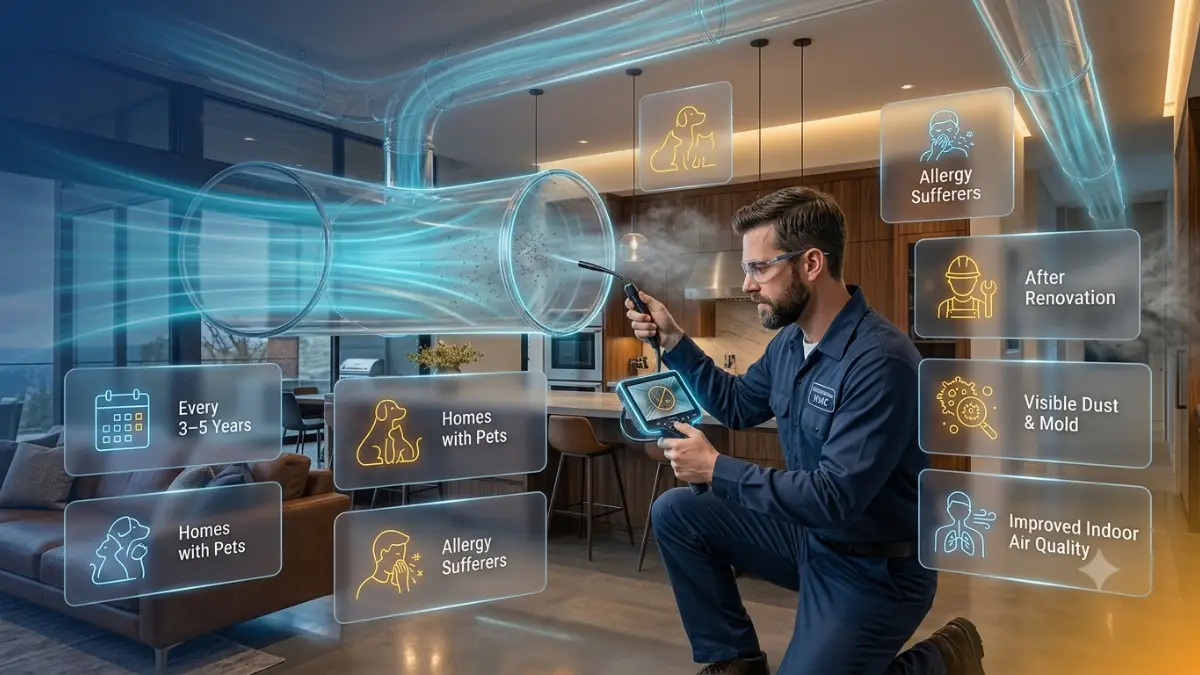
In this article, you will learn exactly how often should you clean air ducts, what the EPA and NADCA recommend for air duct cleaning frequency, and which warning signs mean you should not wait. You will also learn which situations call for immediate air duct cleaning service, no matter your schedule.
Most Louisiana homes need air duct cleaning every 2 to 3 years, sooner than the national 3 to 5 year average. Heat, humidity, and long cooling seasons speed up dust buildup and mold risk. Pets, allergies, and older HVAC systems shorten that window further. Annual inspections help you catch problems before they cost more to fix.
Key Takeaways
Louisiana’s humid climate cuts the typical duct cleaning interval from 3 to 5 years down to closer to 2 to 3 years for most homes.
The EPA does not set a fixed schedule, but NADCA (the industry standards body) recommends cleaning every 3 to 5 years for average households.
Flooding, hurricane damage, or visible mold require immediate duct cleaning, regardless of your last service date.
Homes with pets, smokers, or family members with asthma often need cleaning every 1 to 2 years instead.
Weak airflow, rising energy bills, and musty odors are signs your ducts need attention now, not later.
Louisiana summers do not go easy on your HVAC system. You run your air conditioner nearly year-round, and that constant airflow pulls dust, pollen, and moisture through your ductwork every single day. Over time, that buildup turns into a real problem for your air quality and your energy bills.
At Fontenot Air Conditioning & Heating, we have serviced homes across Lafayette, Broussard, Scott, Youngsville, Carencro, Maurice, and Milton for years. We have seen firsthand how Acadiana’s humidity accelerates duct contamination compared to drier climates. This local knowledge shapes the guidance we give every customer who asks about cleaning frequency.
In this article, you will learn exactly how often to clean your air ducts, what the EPA and NADCA actually recommend, and which warning signs mean you should not wait. You will also learn which situations call for immediate cleaning, no matter your schedule.
Why Louisiana Homes Need More Frequent Air Duct Cleaning
Louisiana’s climate is not like most of the country. That difference matters when you decide how often to clean your ducts.
Louisiana’s Heat, Humidity, and Long Cooling Season
Your air conditioner runs longer here than almost anywhere else in the country. That extended runtime pulls more air, and more contaminants, through your ductwork each year.
High humidity also means condensation forms more easily inside your system. This moisture combines with dust to create the exact conditions mold needs to grow. As a result, Louisiana ducts accumulate grime faster than ducts in drier states.
Mold, Moisture, and Indoor Air Quality Risks
Mold spores thrive in warm, damp environments, and Acadiana offers both in abundance. The EPA notes that indoor air can be 2 to 5 times more polluted than outdoor air, and humid climates raise that risk further (Source: EPA).
Indoor air quality suffers most when moisture and dust sit undisturbed inside dark ductwork for months. Left unchecked, this creates a cycle: more moisture, more mold, and worse air circulating through your home. However, routine duct cleaning breaks that cycle before it becomes a bigger issue.
Why Lafayette Homes Accumulate More Dust and Allergens
Lafayette’s mix of agricultural land, seasonal pollen, and coastal humidity adds extra dust and allergen load to local homes. Your ducts act as a filter of sorts, catching much of this material as air passes through.
Over time, that trapped material builds up in corners, bends, and low airflow zones. This buildup can shed particles back into your living space every time your system turns on. Consequently, allergy and asthma symptoms often worsen without an obvious cause.
How Often Should You Clean Air Ducts? (EPA & NADCA Guidelines)
Two organizations shape most cleaning frequency advice: the EPA and NADCA. Understanding both helps you make a smarter decision for your home.
Recommended Cleaning Schedule for Most Homes (3–5 Year Rule)
NADCA (National Air Duct Cleaners Association) recommends cleaning air ducts every 3 to 5 years for a typical residential system under normal operating conditions. This baseline assumes a standard household without major risk factors like pets, smokers, or chronic allergies.
For Louisiana homes specifically, we generally recommend leaning toward the 3-year mark rather than 5. Our humid climate and near-constant HVAC use push most local systems toward faster contamination.
What the EPA and NADCA Recommend
The EPA takes a different approach than NADCA. The EPA states that duct cleaning has not been shown to prevent health problems, and recommends cleaning only when specific conditions are present, such as confirmed mold growth, vermin infestation, or substantial debris restricting airflow.
In other words, NADCA answers “how often is smart,” while the EPA answers “when is it necessary.” Neither position contradicts the other. Instead, they address two different questions homeowners often ask at once.
When Annual Inspections Are Recommended Instead
If you are unsure which schedule applies to your home, an annual inspection solves the guessing game. A technician checks your ductwork for visible debris, moisture, or mold without a full cleaning service.
This approach lets you clean based on actual conditions rather than a fixed calendar. For many Lafayette homeowners, this hybrid method offers the best balance of cost and air quality control.
Factors That Affect How Often Your Ducts Need Cleaning
Your specific household changes the ideal cleaning frequency. A few common factors shift that 3- to 5-year baseline significantly.
Pets, Allergies, Asthma, or Smokers in the Home
Pet dander, cigarette smoke, and allergen buildup all shorten your ideal cleaning interval. Homes with these factors often need service every 1 to 2 years instead of the standard 3 to 5.
If someone in your household has asthma or a chronic respiratory condition, this shorter interval matters even more. Cleaner ducts mean fewer airborne triggers circulating through bedrooms and living spaces.
Older HVAC Systems and Large/High-Use Households
Older systems tend to have less efficient filtration and more wear inside the ductwork itself. This can trap more debris over time compared to a newer, well-sealed system.
Large households, or homes where the HVAC system runs nearly nonstop, also see faster buildup. More people mean more dust, dander, and daily air movement through your ducts.
Homes Near Construction or High-Dust Areas
Nearby construction sends fine dust and debris straight into your HVAC intake, often without you noticing at first. Homes in newer Lafayette developments or near ongoing road work face this risk regularly.
If you live near active construction, consider a duct inspection sooner than your normal schedule. Catching debris buildup early prevents it from settling deep into your ductwork.
When You Should Schedule Duct Cleaning Immediately
Some situations call for cleaning right away, regardless of when you last had service. Louisiana’s weather makes these situations more common than in many other states.
After Flooding, Hurricanes, or Water Damage
Flooding and hurricane damage introduce moisture directly into your ductwork, creating ideal mold conditions almost overnight. This is one of the clearest, most urgent triggers for immediate cleaning.
Water damage inside ducts should never wait for your next scheduled service. Mold can begin growing within 24 to 48 hours under the right conditions, so speed matters here.
After Remodeling, Fire/Smoke Damage, or Pest Infestation
Remodeling projects kick up drywall dust, sawdust, and insulation particles that often land straight in your ductwork. Fire and smoke damage leave behind residue and odor that spread throughout your home every time the system runs.
Pest infestations bring droppings, nesting material, and odor into your ducts as well. Any of these situations calls for cleaning before you turn your HVAC system back on for regular use.
Visible Mold Growth or Moving Into a Previously Owned Home
Visible mold inside your ductwork means cleaning is not optional. This is one of the few situations where both the EPA and NADCA agree cleaning should happen immediately.
If you just purchased a previously owned home, you likely have no record of its duct cleaning history. A fresh inspection, and likely a cleaning, gives you a clean starting point in your new space.
Signs, Risks, and Health Effects of Dirty Ducts
Dirty ducts rarely announce themselves clearly. However, a few signs tend to show up before the problem gets serious.
Common Signs (Odors, Dust, Weak Airflow, Rising Bills)
Watch for these common warning signs in your home:
Musty or stale odors when your HVAC system turns on
Visible dust blowing from vents shortly after cleaning your home
Weak or uneven airflow between rooms
Energy bills that climb without a clear explanation
Family members experiencing more frequent allergy or sinus symptoms indoors
If you notice two or more of these signs, an inspection is worth scheduling soon.
Health Effects and Risks If Ignored (Mold, Allergens, Reduced Efficiency)
Ignoring these signs allows mold spores, dust mites, and allergens to keep circulating through your home’s air. Over time, this can worsen allergy symptoms, trigger asthma flare-ups, and reduce overall comfort.
Your HVAC system also suffers. Restricted airflow forces your equipment to work harder, which raises energy costs and shortens your system’s lifespan. This is why routine HVAC maintenance and duct care work best together.
Is Duct Cleaning the Right Solution?
Not every airflow or air quality issue calls for full duct cleaning. Understanding what this service does, and does not do, saves you money and frustration.
Air Duct Inspection vs. Cleaning
Air duct inspection: a visual and sometimes camera assisted check of your ductwork’s condition, without removing debris. Air duct cleaning: a full mechanical service that removes dust, debris, and contaminants from inside your system.
An inspection tells you whether cleaning is actually needed. This step alone can save you from paying for a service your home does not yet require.
What Duct Cleaning Can and Cannot Fix
Duct cleaning removes existing dust, debris, pet dander, and light mold from your ductwork. It can noticeably improve airflow and reduce allergens circulating through your home.
However, duct cleaning cannot fix leaky ducts, poor insulation, or design flaws in your system’s layout. If your ducts leak air into your attic or crawl space, cleaning alone will not solve that underlying issue.
Duct Cleaning vs. Duct Sealing
Service
What It Fixes
Best For
Duct Cleaning
Removes dust, debris, mold, allergens
Air quality, odor, airflow restriction
Duct Sealing
Repairs leaks, gaps, and poor connections
Energy loss, uneven room temperatures
Many Louisiana homes actually benefit from both services together. Cleaning improves air quality, while sealing improves efficiency, and combining them gives you the best long-term result.
Professional Duct Cleaning vs. DIY
You might wonder whether you can handle duct cleaning yourself. In most cases, the answer is no, and here is why.
Why DIY Falls Short
DIY duct cleaning tools typically only reach the first few feet of ductwork near each vent. This leaves the majority of your system, including hard-to-reach bends and the main trunk line, completely untouched.
Without professional-grade negative pressure equipment, DIY methods can even push debris deeper into your ducts. This often makes the problem worse rather than better.
Why NADCA-Certified Professionals Matter
NADCA-certified technicians follow established industry standards for assessment, cleaning, and restoration of HVAC systems. This ensures your entire system gets cleaned properly, not just the parts you can reach by hand. For the full process and what to expect, see our Duct Cleaning & Installation page.
Conclusion
Louisiana’s heat, humidity, and long cooling season mean most local homes need duct cleaning closer to every 2 to 3 years, sooner than the national average. Pets, allergies, older systems, and recent construction can shorten that window even further. Immediate cleaning becomes necessary after flooding, remodeling, fire damage, or any sign of visible mold.
Watching for warning signs like musty odors, weak airflow, and rising energy bills helps you catch problems early. An annual inspection remains one of the smartest, most affordable ways to know exactly where your system stands. This small step often prevents a much larger, more expensive issue down the road.
At Fontenot Air Conditioning & Heating, we have helped homeowners across Lafayette, Broussard, Scott, Youngsville, Carencro, Maurice, and Milton keep their air clean and their systems running efficiently. We combine EPA and NADCA guidance with our own hands-on experience in Louisiana’s climate. Call us today for a same-day HVAC assessment, or see our full duct cleaning process and pricing to get started.
FAQ
How often should you clean air ducts in a humid climate like Louisiana?
Most Louisiana homes benefit from cleaning every 2 to 3 years, sooner than the national 3 to 5 year average. Humidity speeds up mold risk and dust buildup, so shorter intervals protect your air quality and your system.
Does the EPA recommend a specific duct cleaning schedule?
No, the EPA does not set a fixed schedule. Instead, they recommend cleaning when specific conditions appear, such as visible mold, pest infestation, or debris actively releasing into your home.
Can dirty air ducts really affect my energy bills?
Yes, restricted airflow from dirty ducts forces your HVAC system to work harder to reach your set temperature. This added strain raises energy consumption and can shorten your system’s overall lifespan.
Should I clean my air ducts after a hurricane or flooding?
Yes, water damage inside ductwork creates ideal conditions for mold growth within 24 to 48 hours. This situation requires immediate cleaning, regardless of your regular maintenance schedule.
Is duct cleaning worth it if I do not see any problems?
An annual inspection is often the smarter first step if you see no obvious signs. This lets you clean based on actual conditions rather than guessing on a fixed calendar.