

How a Professional HVAC System Installation Process Works
Search
Recent Posts
Tags
Follow Us on
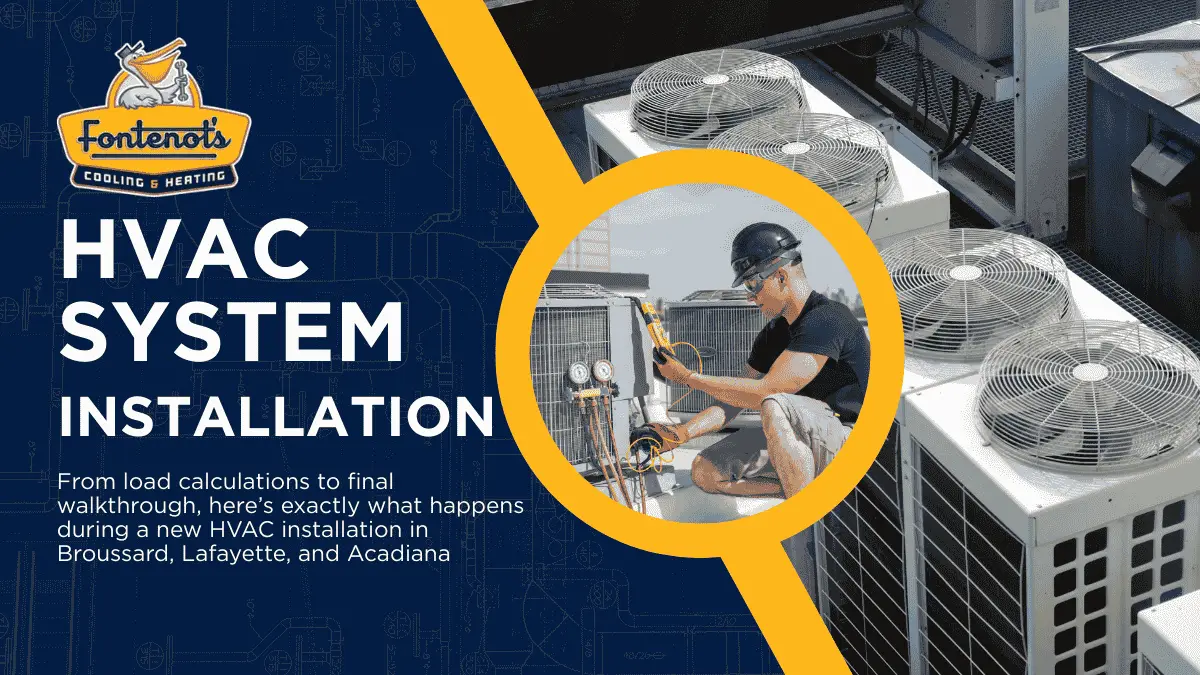
Getting a new HVAC system installation is one of the biggest investments you’ll make for your home. We know it can feel overwhelming when you’re looking at spending $8,000-$15,000 on something most people don’t think about until it breaks down.
Here in South Louisiana, we face some of the toughest weather conditions in the country. Our summers bring sweltering heat that can reach over 95°F, paired with humidity levels that make it feel even hotter. According to the National Weather Service, our region experiences heat index values exceeding 110°F for over 60 days each summer.
Download Free Installation Day Checklist
Get your printable preparation guide here →
That’s why having a reliable HVAC system isn’t a luxury in our area; it’s absolutely necessary for your family’s health and safety. Your system works hard year-round to keep your family comfortable, your energy bills manageable, and your indoor air quality healthy.
We’ve been installing HVAC systems in Broussard, Lafayette, and throughout Acadiana for over 18 years, and we’ve learned that most homeowners worry about the same things: Will the installation disrupt our daily routine? How long will we be without air conditioning? What exactly happens during the process?
The good news is that HVAC installation doesn’t have to be stressful or confusing. When you work with experienced, NATE-certified professionals who understand our local climate challenges, the process runs smoothly from start to finish.
Installing a new HVAC system is one of the most important upgrades for maintaining indoor comfort and energy efficiency in your home. From selecting the right unit to ensuring proper ductwork and airflow, the installation process requires careful planning and technical knowledge.
If you prefer working with professionals, our HVAC installation services in Louisiana can help ensure your system is installed safely and efficiently by certified technicians.
🌡️
Not sure which HVAC system is right for your home?
Fontenot’s offers free in-home assessments across Acadiana — no pressure, no obligation.
Get a Free Estimate →
Step-by-Step HVAC System Installation Process
Step 1 – In-Home Assessment & Load Calculation
Before installing any equipment, we conduct a thorough evaluation of your home using industry-standard procedures that many contractors skip entirely.
During our site visit, we measure room dimensions, ceiling heights, and window sizes throughout your home. We also check your insulation levels (using thermal imaging when needed), note which direction your home faces, and assess how many people live there. Your existing ductwork gets a careful inspection with pressure testing equipment.
Pro Tip: We often find that homes built before 2000 have undersized return ducts. In a recent Broussard installation, we discovered the original return was 40% too small, causing the previous system to work twice as hard.
The Manual J Load Calculation Process:
- We use ACCA-approved software that meets Department of Energy standards
- Your home’s measurements are combined with 30-year climate data from NOAA
- The calculation determines precise heating and cooling capacity (measured in BTUs)
- We factor in South Louisiana’s specific humidity levels and solar heat gain
Why This Matters: Getting the size right prevents the two most common problems we see. An oversized system will short-cycle, wasting energy and failing to control humidity, which is critical in our 80%+ humidity climate. According to EPA guidelines, improper humidity control leads to mold growth within 48-72 hours.
An undersized system runs constantly during our 95°F+ days, driving up costs and never achieving comfortable temperatures.
Schedule Your Free Load Calculation →
Step 2 – System Selection & Quoting
Once we understand your home’s specific needs, we help you select equipment that matches both your budget and performance expectations. This isn’t about selling you the most expensive option; it’s about finding the right fit.
We’ll explain different system options based on your home’s layout and your family’s preferences. Central air with gas heating works well for most homes, while heat pumps provide both heating and cooling in one efficient unit. For homes with specific zone requirements or no existing ductwork, ductless mini-splits offer excellent flexibility.
Understanding Efficiency Ratings:
- SEER ratings (13-25): Higher numbers mean lower electric bills. Each SEER point saves about 7% on cooling costs according to Energy Star data
- AFUE ratings (80%-98%): Shows heating efficiency for gas furnaces
- Energy Star certification: Qualifies for utility rebates (currently $300-$1,200 in our area)
Modern Features Worth Considering:
- Smart thermostats: Save 10-23% annually per Energy Star studies
- Variable speed systems: Provide better humidity control and 30% energy savings
- Whole-house air purifiers: Essential for Louisiana’s pollen and mold challenges
- Zoning systems: Perfect for multi-story homes or families with different comfort preferences
Real Installation Example: The Martinez family in Lafayette upgraded from a 10 SEER system to an 18 SEER heat pump with smart thermostat. Their first summer electric bill dropped by $180 per month.
Your Detailed Quote Includes:
- Complete equipment specifications with model numbers
- Itemized labor costs and projected timeline
- Required permits and inspection fees (we handle all paperwork)
- Full warranty coverage: 10 years parts, 5 years labor
- Available financing: 0% APR for 18 months (approved credit)
Step 3 – Preparing for Installation Day
Proper preparation before our crew arrives ensures your installation goes smoothly and efficiently. While we handle all the technical aspects like permits and scheduling, there are several things you can do to help the process.
Creating clear access paths is essential for our team to work safely and efficiently. Remove furniture and belongings from around your existing equipment, and clear pathways from entry doors to where your new indoor and outdoor units will be installed. If bushes or plants are growing around your outdoor unit area, trim them back to give us room to work.
Protecting your home and family:
- Cover or relocate valuable items near work areas
- Remove wall hangings along installation routes
- Clear attic access areas if ductwork modifications are needed
- Arrange for pets to stay in a secure area away from work zones
- Plan activities for children in areas away from installation work
Space and access requirements: We need at least 6 feet of clearance around your outdoor unit installation site, and clear access to your electrical panel, attic, basement, or crawl space entrances. Make sure your driveway has space for our service trucks and equipment staging.
We coordinate all permits with local authorities before installation day and schedule required inspections. Our office will call you 24 hours before your scheduled installation to confirm timing and answer any last-minute questions.
- We confirm the installation timeline 24 hours in advance
Step 4 – Removing the Old System
Before installing your new equipment, we safely remove your old system following strict environmental and safety protocols that protect both your home and our technicians.
We begin by turning off all electrical power at both the unit and main panel, then use voltage meters to verify zero energy before any work begins. This multi-step lockout procedure prevents electrical accidents.
EPA-Compliant Refrigerant Recovery: Federal law requires proper refrigerant handling, and violations carry fines up to $37,500. Our EPA Section 608-certified technicians use professional recovery equipment to capture all refrigerant from your old system. We never release refrigerants into the atmosphere – they’re either recycled or properly disposed of through licensed facilities.
Careful Equipment Removal: The actual removal involves systematically disconnecting electrical wiring, refrigerant lines, and drain connections. We protect your floors with heavy-duty plastic sheeting and use furniture dollies to move equipment without damaging walls or doorways.
Documentation Process: We photograph all connections before removal for warranty purposes and to ensure proper new system installation.
Ductwork Inspection and Decisions:
- Visual inspection reveals damaged or disconnected ducts
- Pressure testing identifies air leaks (up to 30% efficiency loss)
- Ducts in good condition are professionally cleaned and reused
- Damaged sections are repaired or replaced with proper insulation
- All connections are sealed with mastic (not just duct tape)
This removal process typically takes 2-3 hours for standard systems. Older equipment with corroded connections or difficult access may require additional time, but we always communicate timeline changes immediately.
Step 5 – Installing the New System
With your old system safely removed, we begin the precision installation of your new equipment. This phase requires careful attention to manufacturer specifications and local building codes to ensure optimal performance and warranty compliance.
We start by positioning your new indoor and outdoor units according to our detailed installation plan. Indoor unit placement considers airflow patterns, future maintenance access, noise levels, and structural support requirements. Your outdoor unit gets positioned on a reinforced concrete pad with proper clearance for airflow and service access.
Critical System Connections:
- Refrigerant lines: Precisely measured, bent, and brazed using nitrogen purging to prevent oxidation
- Electrical wiring: Routed through approved conduit and connected per NEC standards
- Condensate drainage: Installed with proper slope and backup overflow protection
- Gas connections: Pressure tested to 1.5x operating pressure per local codes
Installation Insight: “The most common mistake we see from other contractors is improper refrigerant line sizing,” notes lead installer Tony Broussard. “Undersized lines reduce efficiency by up to 15% and can cause compressor failure.”
Ductwork Integration and Sealing: The connection between your new system and existing ductwork requires precise modifications. We resize duct connections to match your new equipment’s airflow requirements and professionally seal all joints using UL-181-approved mastic.
Advanced Sealing Process:
- All ductwork connections are sealed with mastic compound
- Joints wrapped with reinforcing mesh tape
- Pressure testing verifies less than 6% total duct leakage
- Insulation is properly installed to prevent condensation
Smart Thermostat Installation: If you’ve chosen a smart thermostat, our technicians install it in an optimal location away from direct sunlight, drafts, and heat sources. We configure initial settings, connect it to your Wi-Fi network, and set up the mobile app on your phone.
Technology Integration: Recent installations include Nest, Ecobee, and Honeywell smart thermostats. “The Ecobee with room sensors works great in two-story Louisiana homes,” explains technician Mike Landry. “It averages temperatures from multiple rooms instead of relying on one thermostat location.”
Throughout installation, we follow manufacturer specifications exactly and document everything with digital photos for warranty purposes. This installation phase typically takes 4-6 hours for standard residential systems, with complex installations requiring additional time for proper completion.
If you’re looking for professional HVAC installation services in Louisiana, our certified technicians are ready to help. Visit our HVAC installation service page to get a free estimate today.
With your old system safely removed, we begin installing your new equipment. This is the most detailed part of the process, where our experienced technicians position, connect, and configure all components of your new HVAC system.
We start by carefully positioning your new indoor and outdoor units in their designated locations. The indoor unit placement considers factors like airflow patterns, accessibility for future maintenance, and noise levels. Your outdoor unit gets positioned on a level pad with proper clearance for airflow and service access.
Critical connections and setup:
- Refrigerant lines are precisely measured, bent, and connected between units
- All electrical wiring is routed safely and connected according to manufacturer specifications
- Condensate drain lines are installed with a proper slope to prevent water backup
- Gas lines are connected and pressure tested for furnace or hybrid systems
Ductwork integration and sealing: The connection between your new system and existing ductwork requires careful attention. We modify duct connections as needed to match your new equipment’s specifications. All joints get professionally sealed to prevent air leaks that waste energy and reduce comfort.
Smart thermostat installation: If you’ve chosen a smart thermostat, our technicians will install it in an optimal location away from direct sunlight, drafts, and heat sources. We’ll configure the initial settings and connect it to your home’s Wi-Fi network if applicable.
Throughout this process, we follow all manufacturer specifications and local building codes. Our team takes photos of connections and keeps detailed records for warranty purposes. This installation phase typically takes 4-6 hours for a standard residential system, though complex installations may require additional time.
Step 6 – System Testing & Commissioning
Once all components are installed and connected, we perform comprehensive testing that goes far beyond simply turning the system on. This critical commissioning process verifies safe operation and optimal performance before we leave your home.
We begin with electrical verification using digital meters to check voltage, amperage, and proper grounding at all connection points. Every safety control gets tested individually, including high/low pressure switches, temperature limits, and emergency shutoffs.
Comprehensive Performance Testing:
- Airflow measurement: Digital manometers verify proper CFM at each vent
- Temperature differential: Supply air should be 15-20°F cooler than return air
- Static pressure: Ensures your system isn’t working harder than designed
- Amp draw verification: Confirms all motors operate within specifications
Refrigerant System Verification: Refrigerant charge must be precisely correct for peak efficiency and equipment longevity. Using manifold gauges and digital thermometers, we verify:
- Superheat and subcooling temperatures match manufacturer specs
- Operating pressures fall within normal ranges
- No refrigerant leaks at any connection points
Complete System Cycling Tests: We run your new system through multiple complete heating and cooling cycles while monitoring:
- Startup sequences and component timing
- Defrost cycles on heat pump systems
- Thermostat communication and response
- All safety controls and their proper operation
Final Quality Checks: Before finishing, we check for unusual noises, vibrations, or odors that could indicate installation issues. We verify that condensate drains properly and test all electrical connections one final time.
This thorough testing process takes 1-2 hours but ensures your system will provide reliable comfort for 15-20 years. We provide you with a detailed commissioning report showing all test results and measurements.
Step 7 – Final Walkthrough & Owner Orientation
The final step of your HVAC installation involves a comprehensive walkthrough where we show you how to operate and maintain your new system. This isn’t just a quick demonstration – we take time to ensure you’re completely comfortable with your new equipment.
We start by walking through your home together, checking airflow at each vent, and explaining how your new system operates. You’ll notice the difference in air quality and temperature control immediately, and we’ll point out any changes in airflow patterns compared to your old system.
Thermostat operation and programming:
- We demonstrate all thermostat functions, including basic temperature adjustments
- Smart thermostat features like scheduling and remote access are explained step-by-step
- You’ll learn how to switch between heating and cooling modes
- We show you energy-saving settings and programmable schedules
- Mobile app setup and troubleshooting tips for smart thermostats
Essential maintenance knowledge: Your new system will last longer and run more efficiently with proper maintenance. We’ll show you exactly where your air filter is located and demonstrate how to remove and replace it. We explain what type of filter to buy and how often to change it based on your home’s conditions and occupancy.
Warranty registration and documentation: We handle the manufacturer’s warranty registration for you, but we’ll provide you with all warranty paperwork and explain what’s covered. You’ll receive documentation showing model numbers, installation dates, and our contact information for future service needs.
How Long Does HVAC System Installation Take?
Most residential HVAC installations are completed in a single day, typically taking 8-12 hours from start to finish. This timeline includes removing your old system, installing the new equipment, testing everything thoroughly, and walking you through the operation of your new system.
For a standard replacement where we’re swapping out similar equipment in existing locations, you can expect our crew to arrive early in the morning and finish by late afternoon or early evening. We work efficiently while maintaining high-quality standards, so you’re not without air conditioning any longer than necessary.
Two-day installations: Some installations require two days, particularly when extensive ductwork replacement is needed or when we’re converting from one system type to another (like switching from electric heat to gas). In these cases, we’ll complete the work in phases to minimize your time without climate control.
Commercial installation considerations: Business and commercial installations typically take 2-5 days, depending on system complexity and building size. We work with business owners to minimize disruption to operations, often scheduling work during off-hours or weekends when possible.
Weather conditions can also affect timing. During extreme heat or cold, we prioritize getting your system operational as quickly as possible while maintaining our quality standards. Our experienced crews know how to work efficiently even in challenging South Louisiana weather conditions.
HVAC installation involves several technical steps, including equipment sizing, duct inspection, electrical connections, and system calibration. Even a small mistake during installation can reduce system efficiency or cause long-term performance issues.
Because of this, many homeowners choose to work with professional HVAC installation experts who have the proper tools and experience to install the system correctly and safely.
Serving Acadiana Since 2007
Want this done right- the first time?
Licensed NATE-certified technicians. Upfront pricing. Same-day service available in Lafayette, Broussard & Youngsville.
Tips for a Smooth HVAC Installation
Success starts with choosing the right contractor and making informed decisions about your system upgrade. Here are our recommendations based on thousands of installations throughout Acadiana.
Choose Certified Professionals: Always verify proper Louisiana state licensing (check at lslbc.louisiana.gov) and current insurance coverage. Look for NATE certification, which demonstrates advanced technical knowledge through rigorous testing.
Our Credentials:
- Louisiana State License #12345
- NATE-certified technicians (North American Technician Excellence)
- EPA Section 608 refrigerant handling certification
- BBB A+ rating with zero unresolved complaints
- Member of Air Conditioning Contractors of America (ACCA)
Verify Installation Experience: Ask about specific experience with your installation type. Contractors who primarily work new construction may lack expertise in retrofit installations with existing ductwork challenges.
Plan Maintenance From Day One:
- Schedule the first tune-up 6 months after installation
- Change filters every 30-90 days (we’ll send reminders)
- Annual professional maintenance prevents 85% of system failures
- Keep the outdoor unit clear of debris year-round
Consider Smart Technology Upgrades: Modern HVAC technology offers significant improvements over basic systems:
- Smart thermostats: Learn your schedule and save 10-23% on energy costs
- Variable speed systems: Provide superior humidity control and efficiency
- Zoning systems: Allow different temperatures in different areas
- Air quality systems: Essential for Louisiana’s allergen challenges
Research Contractors Thoroughly:
- Read recent Google and Facebook reviews (look for 50+ reviews)
- Ask for references from similar installations within 6 months
- Verify BBB rating and complaint resolution history
- Check the licensing board for any disciplinary actions
Red Flags to Avoid:
- Door-to-door sales or high-pressure tactics
- Quotes significantly below others (often indicates shortcuts)
- No written warranty or unclear warranty terms
- Unlicensed or uninsured contractors
- Refusal to provide local references
Why Local Expertise Matters
Working with contractors who understand South Louisiana’s unique climate challenges makes a significant difference in system performance, longevity, and your overall satisfaction.
Our Climate’s Unique Challenges: South Louisiana presents some of the most demanding HVAC conditions in the United States. According to NOAA climate data, our region experiences:
- 60+ days annually with a heat index over 100°F
- Average relative humidity of 80%+ during the summer months
- Minimal temperature variation requires year-round system operation
- High pollen counts and mold spore levels
Critical Design Considerations:
- Humidity control: Systems must remove moisture, not just cool air
- Drainage design: Proper condensate management prevents water damage
- Duct insulation: Special attention to prevent condensation in humid conditions
- Equipment sizing: Oversizing is worse than undersizing in our climate
Fontenot’s Local Advantage: We’ve been serving Broussard, Lafayette, and the greater Acadiana region for years, giving us deep knowledge of local building codes, permit requirements, and weather patterns. Our technicians understand how different neighborhoods’ soil conditions affect outdoor unit installation and drainage requirements.
We maintain relationships with local suppliers, which means faster access to parts and equipment when you need service. Our trucks are stocked with components that commonly fail in our climate, reducing downtime when repairs are needed.
While understanding the HVAC installation process is helpful, having the system installed by trained professionals ensures better performance and long-term reliability. Proper installation can improve energy efficiency, extend equipment lifespan, and reduce future repair costs.
If you’re planning to install a new system, explore our HVAC installation services in Louisiana to see how our experienced technicians can help you choose the right HVAC system and complete the installation with precision.
Get Your Free Assessment
Ready to upgrade to reliable, efficient comfort? We’d love to help you explore your options with no pressure and no obligation.
Why Choose Fontenot’s AC & Heating: As a family-owned business, we treat every customer like family. We’re not just selling equipment – we’re building relationships that last decades. When you call our office, you’ll speak with knowledgeable staff who understand your system and can quickly address concerns.
Our Guarantee:
- 100% satisfaction guarantee on all installations
- 10-year manufacturer warranty on equipment
- 5-year warranty on our installation work
- 24/7 emergency service availability
- Price matching on comparable quotes
📞 Contact Information:
- Phone: (337)20789-6070
- Email: info@fontenotsac.com
- Address: 726 Albertson Pkwy, Broussard, LA 70518, United States
- Service Area: Lafayette, Broussard, Youngsville, Carencro, Scott, and surrounding Acadiana parishes
Don’t Wait for System Failure. Don’t risk being without air conditioning during peak summer heat. Our installation calendar fills quickly during the spring months, so call today to secure your preferred timing.
Schedule Your Free Consultation: Book Online Now
Ready to install a new HVAC system in your Louisiana home?
- Free in-home assessment & load calculation
- Same-day service available
- 10-year manufacturer warranty
- 0% APR financing available
- 100% satisfaction guarantee